By Nkiruka Nnorom
The Chairman of Livestock Feeds Plc, Mr. Larry Ettah, has said that operations of the feed milling industry was badly affected by the 40 per cent hike in the prices of major raw materials – maize and soya bean meal – required in the industry.

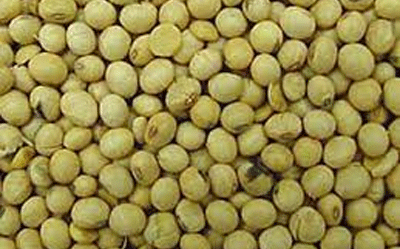
Soyabeans
He spoke at the Annual General Meeting, AGM, of the company in Lagos, saying that the scarcity of the major raw materials led to increased cost in the industry.
Ettah added that acute shortage of foreign exchange and the worsening exchange rate also affected businesses in the sector as importation of certain ingredients became difficult and expensive. “All these increased costs which could not be recovered through price increases, which led to shrunken margins in the industry,” he said.
Consequently, he said though the company recorded revenue of N8.9 billion, a growth of 13 per cent over 2014, however, due to the prevailing tough and difficult operating environment, cost of sales increased by about 16 per cent over 2014 leading to a profit before tax of N300 million, a 25 per cent decline on 2014. In the same vein profit after tax declined by about 26 per cent to N187.9 million, he said.
He, however, posited that the company is restructuring its operations for an improved performance, adding that the company is in the process of raising additional capital to support its operations.
He further stated that the company is poised to leverage on improved supply efficiency, develop technical collaborations, enhance operational efficiency, deepen market development to reach the unreached and launch innovative products to enhance its business fortune
Speaking further on the business environment, said that: “Acute shortage and production of poor quality Day Old Chicks (DOC) by hatcheries affected the ability of farmers to restock birds. The breakout of the dreaded avian influenza in the first month of the year which was thought to be an epidemic that would soon fizzle out proved to be a major setback in the industry as it persisted for the better part of the year. The disease ravaged many farms all over the country leading to culling of millions of birds and further worsening the decreased poultry population as most of the affected farms are yet to restock. In addition, the industry suffered severe egg glut and weak prices of poultry products leading to the inability to recover the increased costs of yields. This led to the shut-down of many poultry farms as the business was considered to be unprofitable”.
On the outlook for 2016, he said: “The re-occurrence of Avian Influenza disease especially in the northern part of the country is a cause for concern. We therefore call on all relevant bodies such as Veterinary Council of Nigeria, Nigerian Institute of Animal Science, Ministry of Agriculture, Federal Department of Livestock, and other regulatory bodies saddled with the responsibility of managing the sector to step up actions and campaigns against the spread of the disease.
“The control and prevention models of other countries should be studied and adopted where necessary. We must ensure sustainable growth of the poultry industry as it remains a quick and relevant enterprise for poverty alleviation in Nigeria’”.
Mr Ettah stated that ‘“The installation of full fat extrusion plant for the processing of soya beans at our Ikeja factory which commenced at the tail end of 2015 has been completed. This will ensure the ready supply of one of our major materials to all our locations and also as an avenue for product portfolio expansion.
Disclaimer
Comments expressed here do not reflect the opinions of Vanguard newspapers or any employee thereof.