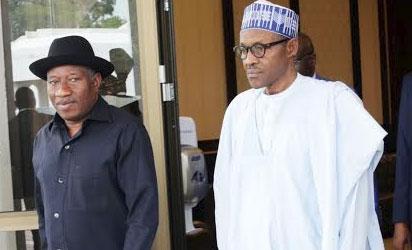
Former President Goodluck Jonathan (L) With President Muhammadu Buhari, After A Close Door Meeting At The Presidential Villa In Abuja On Monday (2/11/15).
By Benjamin Njoku
When President Muhammadu Buhari assumed office last year, not many believed the new administration would be willing to extend its hand of friendship to the entertainment industry.
Interestingly, like its predecessor, the present administration has not only extended its hand of friendship to the industry, it has also moved to confront the monster that has long undermined the growth of the industry.

Former President Goodluck Jonathan (L) With President Muhammadu Buhari, After A Close Door Meeting At The Presidential Villa In Abuja On Monday (2/11/15).
From all indications, the Buhari-led government has shown more concern about structuring the movie industry for easy regulation than splashing billions of naira on the stakeholders which the past administration was noted for.
Recall that while Jonathan’s administration lasted, the industry benefitted enormously from cash donations.
Apart from the initial $200 million loan scheme which the administration created in 2010 to support film makers in boosting the quality of their production, the former president also in
March 2013, announced a N3 billion ($115 million) new grant called “Project ACT Nollywood” to develop the competencies of film makers and actors, with an ambitious target to trump
India as the world’s second largest film nation after Hollywood. To many, Jonathan’s administration made a huge impact on the industry although stories of members squandering the money fed many ears.
But since President Buhari assumed office, the music has changed.
The stakeholders no longer enjoy the robust relationship they had with the past administration. In fact, the Buhari-led government’s inability to sustain the Project Nollywood Act which is supposed to be a yearly grant to practitioners, remains a clear indication of his resolve to stop frivolous spending.
Rather than sustaining the Project Nollywood Act, the President moved to create an enabling environment for the industry to thrive. Shortly after his swearing-in-ceremony on May 29, last year, Buhari, through his Vice, Prof Osinbajo, showed willingness to grow the industry when he directed the law enforcement agencies to step up efforts to curb piracy in the country’s creative industry. But till date, the relevant regulatory bodies and security agencies have not taken the directive seriously.
However, for the past one year, there has been no love lost between the present administration and the stakeholders in the industry. Overtime, the government has engaged the stakeholders in the entertainment sector of the economy, having acknowledged the potentials of Nollywood as a money-spinning industry that could help the Nigerian economy.
Only recently, the industry got a major boost when the Minister of Information and Culture, Lai Mohammed, inaugurated a 28-member committee for the review of the moribund Motion Picture Practitioners Council (MOPICON) document for the purposes of ultimately presenting it as an executive bill to the National Assembly for passage into law. The MOPICON draft document has been described as the panacea to the myriad of problems plaguing the movie industry.
This development has since generated a lot of mixed-feelings in the industry, with the major stakeholders challenging the process of selection of members of the committee. While some entertained the fear that government will establish another regulatory body to censor activities in the industry, others are of the opinion that the establishment of MOPICON will stifle creative minds in the industry while at the same time create cumbersome conditions for new entrants into the Nollywood.
But whatever the case may be, there is urgent need to regulate the industry and maintain high ethical standards. The MOPICON bill, if signed into law, will help Nollywood play a meaningful role in national development.
The committee comprises of seasoned practitioners including the likes of Peace Anyiam-Osigwe who is heading the committee, Mahmood Ali-Balogun, Brian Etuk, Alex Eyengho, Ralph Nwadike, Fred Amata and Anthony Anih among others.
For the former President of the Association of Nollywood Core Producer, ANCOP, Comrade Alex Eyengho, “President Muhammadu Buhari’s administration has not done badly for the Nigerian entertainment industry in the past one year. Though things can be better, he has started well and I hope he will finish strong.”
Disclaimer
Comments expressed here do not reflect the opinions of Vanguard newspapers or any employee thereof.