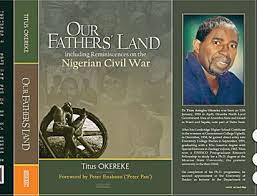
Tutus book cover
By Ode Okore
IT has been my view that it would be just as dangerously incestuous for an editor to review a book he worked on for a publishing house as it would be tacky for the chairman of a publishing house to launch a book from his own stable.
However, I am making in my case an exception to the rule because of one reason: I was also a consultant to the book. I am about to comment on, not a consultant in terms of being a guiding light to what happened in Nigeria or Biafra in those tragic years (I was outside the country during the civil war) but only as to whether, from a writer and a book editor’s point of view, the material was good enough to be published.
So my comments are as a friend of the author who watched him develop his ideas into this wonderful book and the main reason I feel compelled to write my comments will be made clearer at the end of the write up.
It was one morning early in 2014 when my friend Professor Moyibi Amoda called me to come to his house in Anthony that he wanted to introduce me to somebody, an old friend. I got there and met the Professor sitting in the ground floor living room of his mansion with the friend who was holding in his hand a few typed pages of a manuscript. The professor did not waste time in introducing us.
History of the civil war
He said Dr. Titus was an old Ughelli boy (that is, Government College, Ughelli), he is an academic and wanted to write something, maybe a book, on his experiences in Nigeria, before, during and after the civil war. He has started to put something down but he was not sure whether what he has written so far was of any use, that is, whether it could actually be publishable.
So he has called me to look at what he has written so far to see if it was good enough for him to continue or to stop wasting his time. The first thing that came to my mind was, “Oh, not another Biafra book again!”
Of course, the history of the civil war, or of any war for that matter, can never be exhausted but I was saying to myself, If it was an intellectual work, a historical and political study of the events that shaped our country in those years, then yes, but if it was going to be another popular biography about the war, then maybe, we have had enough!’

Tutus book cover
Perhaps the reason I initially felt that way was that in my own judgment many of the civil war biographies I have read are largely self-serving. Anyway, I told the two gentlemen that I would go home and read through what Dr. Titus had written and I would later call the professor to tell him what I thought. If the writing was not exactly up to par, but it could be worked on or ‘rescued’, I would also tell him and Dr. Titus the role I could play. If it was outright bad quality work, I would be honest and blunt about it.
When I got home that morning I threw the stapled pages on the bed. I did not take them to read until late in the night. And what I read excited me to no end. The next morning I called Professor Amoda quite excitedly and I told him how I felt about the write-up, “Marvelous!” I said “Simply marvelous!”He quickly called Titus to arrange another meeting for the three of us. Dr Titus was himself quite excited that I liked very much what he had so far written. My reaction encouraged him very much and after that he brought a few more segments for me to see. This was necessary because I wanted to see there was a consistency in the quality and vibrancy of what he was writing. After one more meeting between the three us, I was satisfied he had got a handle on his project. So he took off and I did not see him until several months later when he delivered the final work to me to edit. I could not really start on the work for quite some weeks because I was down with prostate problem. The Lord did not want me to be admitted and kept in the hospital, so I had to stay in bed most of the time except when I had to be taken to the hospital to change my catheter. So, for quite some time, the manuscript became my companion in bed because I took to editing it propped up on the bed.
I was able to edit the work in bed because it told a story that, even though I had read some portions closely and skimmed through others a number of times I was not tired of taking it up again and again. Why?
Titus was generally regarded by his many friends as an authentic “ Sapele and Warri boy”. That initially baffled me. How could a man born in Anambra by Igbo parents be regarded as an authentic “Sapele and Warri boy”? His life actually started in Sapele where his teacher father had been posted to as a teacher in the government school. Sapele in those years was a bustling township where people from different tribes lived together: the Urhobos, Itsekiris, Yorubas, Ijaws , Hausas, Igbos, Isokos, etc. Now, a Yoruba family had been watching this Igbo teacher Okereke and his family with their two sons. The Yoruba man liked the way Mr Okereke was bringing up his two sons. So, one day he went to Mr. Okereke and told him so. Not only that, he asked that his own son should live with him also believing that he would grow up a better person like the teacher’s children. Mr. Okereke said “Why not! Let him come.”And so the little Yoruba boy moved in to live with the Igbo family, the Okerekes.
A few years later, Mr. Okereke was again transferred to Warri, another bustling township of Delta. Mr Okereke went to inform the Yoruba father of the boy that he was being sent to Warri and that he would return his son to him during the week before he and his family leave for Warri. Again ,the Yoruba man asked Mr. Okereke if he was going to Warri with his two sons to which the teacher answered in the affirmative. Then the Yoruba father asked a most disarming question: “If your sons are going with you to Warri , why can’t my son also go with you to Warri?” Mr. Okereke looked flustered and said, “Okay! Why not! Your little son can also come with us to Warri”.
Living with the Okerekes
Now observe that throughout these two or three years of the Yoruba boy living with the Okerekes, there was never talk of how much the Yoruba father would pay to Mr. Okereke for the upkeep of his son in terms of his feeding, school fees, school uniforms and books and pencils. What has just transpired is indeed a first class adoption! Without the usual rancor, or fanfare.
Anywhere in the world what has just transpired would be singled out and celebrated as an example of pure unfettered love.
The relationship between the Okereke and the Yoruba families had just sprung up naturally and without strains but only to truncate the usually perceived primordial socio-cultural as well as political animosities between these two peoples.
I said to myself this was something too good, almost too beautiful to be true, yet I also knew it was not fiction, it was a true life story being told by the man who lived through it all.
Titus went later with the Warri and Sapele crowd of Urhobos, IItsekiris, Yorubas, Ijaws, Igbos and Edos (at the Government School in Warri, Titus had linked up with the Enahoros who were neighbors in the Warri GRA) to Government College, Ughelli and years later Ibadan. For many years, Titus’ best friends were Urhobos, Itsekiris, Ijaws and Yorubas, all stemming from the Ughelli- Warri – Sapele axis. Indeed, Titus was an authentic “Warri- Sapele boy”. It could not be said, as the English would put it, that he was “smoked and kippered” into it, he had grown up and developed as one, fully acculturated to the socio-cultural liberalism for which Deltans are generally known and for which they are so proud. Titus was now not only a “proper” Deltan, he had become a true “citizen” of the West. It was thus, to this friend, a tragedy of great proportions when the civil war forced him to the East or Biafra, as he has satirically expressed it somewhere in the book, as a “refugee”. So, it was not surprising that, after the war, after a brief stay at Nsukka (UNN), he returned to the West, first to Benin (to teach at the fledgling University) and later to the more familiar terrain of Lagos where many of the childhood friends, the Delta and Ibadan crowd had also settled down. Now this! When Titus got married, to the pretty young lady he had met during his sojourn in Biafra, first as a foreign service officer but later more as a sleuth, the wedding did not take place in Anambra or Enugu, but in Lagos and it was sponsored by those ubiquitous childhood friends from the Delta-Ibadan- Lagos axis. He had to, believe it or not, arrange for both his parents and the parents of his bride as well as all their relations and Igbo friends from the East to bring themselves to Lagos . Quite amazing!
Now, back to the narrative. Titus narrative about life inside Biafra was intriguing, but not harrowing, because he lived through the war not in the War-front carrying AK 47s and sleeping in trenches but as a sleuth (DMI). He spent most of his time in dark-lit drinking joints, sometimes though under disco lights a la Lagos, again every now and then bumping into his ubiquitous friends from the past, that is, from Sapele, Warri, Ughelli, Ibadan, as he moved from Enugu to Port Harcourt and back again and in between making new friends. In fact, it is hard to tell if, as a sleuth, all this yielded substantial results but the atmosphere all reminds me of the great Alfred Hitchcock’s memorable war thriller, CASABLANCA, which dealt with espionage and escape from war-torn Morocco during World War II. The significant point here though is that Titus’ up-bringing in the West, particularly Delta, had toughened him and given him a veneer of protection against any prolonged psychological wounds of war. Of course, it was not as though he had gone through the war wearing a teflon coat that seemed to shield him against the horrors of war. There were certain pains which remained and festered in his heart for a while. They were pains which the mouth could not easily utter, pains which the eyes only had seen and which sickened the heart because of the sheer scale of their horror. It is all part of what we might describe as the metaphysics of war— the terrible famine and hunger especially among children, and the consequent bloated bellies and gaping eye sockets, constant exodus of people (especially women and children),and the sick, the wounded and the dying to ‘safer’ havens in a shrinking enclave. Yet, Titus, through all this was still, at heart, a “refugee” in the East. Even in the midst of the war, Titus was still the “proper” Deltan, at times ready to challenge even the Biafran soldiers at a check point if he felt they were trying to be “unfair” or selectively rough with any civilian simply because he was not Igbo-speaking. Yes, his up-bringing in the West particularly in the heart of the Delta, had also made it easy for him at the end of the war to glide back into normal civilian life and to settle back into old relationships he had left behind in the escape to Biafra.
At the book launch at the Nigeria Institute of International Affairs, Victoria Island, the book reviewer, Ambassador (Dr) Patrick Dele Cole, himself a renowned historian and intellectual, made brief comments on the issue of “abandoned property”, always a touchy subject. As a matter of fact, the issue of abandoned property especially in Port Harcourt, Rivers State, occurs only in one short paragraph of six and a half lines at page 291 in a 324 page book. But it was as if all hell had broken loose. A number of people, those whose families lost their houses in Port Harcourt, were furious at the Ambassador dismissive stance on the issue. Some took to the mic to respond to him while many others left the NIIA hall fuming or just grumbling. Others thought the Ambassador had not really read through the book. But what an uproar the little tongue can cause!
Now as one who edited the book, I felt bemused by it all, not because the issue of abandoned property was not important, but because many of those persons furious with the Ambassador had not read the book either and, sadly indeed, may never read it at all. In that sense, the discussion on “abandoned property” had become a distraction from the essence of the work given to us by Dr. Titus Okereke. And this is why I thought the record must be set straight at least from my own view point. The heart of Dr. Okereke’s fascinating biographical narrative ends with his return to civilian life and his journey back to the West. The narrative does not include his critique of post-war Nigeria. It is essentially a simple story, on “how we were”, that is, in some not too distant past, a story told without guile and without bitterness. Yes, it was a time an Hausa man could be elected twice as mayor of Enugu, an Igbo man as mayor of Port Harcourt, an Igbo man as party leader in the West Regional parliament in Ibadan and a Yoruba man could give his son to an Igbo teacher to live with him in the heart of Delta because he loved the way the Igbo teacher was bringing up his own children. Where did things go wrong? True, Nigeria was never an Eden, yet Our Father’s Land by Dr Titus Okereke gives us an exhilarating glimpse of what would have been.
Disclaimer
Comments expressed here do not reflect the opinions of Vanguard newspapers or any employee thereof.