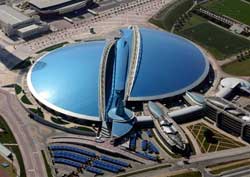
Aspire Dome is seen in Doha in this aerial view. Qatar will host the 2022 World Cup.
Secretary of the International Trade Union Confederation, Sharan Burrow has retracted a statement that suggested that thousands of expatriate workers in Qatar involved in the country’s preparations for the 2022 World Cup will die before the first ball is kicked.
In 2013, ITUC asserted that “more than 4,000 workers risk losing their life over the next seven years as construction for World Cup facilities gets under way if no action is taken to give migrant workers’ rights.”
The prediction has repeatedly been used by critics to condemn Qatar’s human rights record and has often dominated conversations about the 2022 World Cup.
In a new twist to all that, the ITUC general secretary Sharan Burrow told Doha News that she’s never suggested anyone has died building World Cup stadiums: “We’ve never said that. I’ve never said ‘on World Cup stadiums’…I’ve said up to 4,000 workers will die in Qatar before a ball is kicked off in 2022. That’s a very conservative figure.”
Burrow also defended ITUC’s methodology, even though the forecast represents the deaths of all foreign workers working in Qatar over the next several years, including professionals in industries unrelated to the World Cup.
Burrow said that even if she got the figure wrong, “by a few hundred middle-class Indians…nobody can deny there is no commitment from the Qatari government to treat workers here as human beings with fundamental human rights.”
The union’s figures are based on fatality data from the Nepali and Indian embassies in Qatar and factor in all deaths, not just those on construction sites or even people working on World Cup projects.
Similarly, the latest report by Amnesty International there was no evidence that anyone had died during construction of Khalifa International Stadium, one of six World Cup venues where work is currently underway.
However, the organization said it documented more than 100 human rights abuses, including employers confiscating workers’ passports, delaying salary payments and using threats to force them to keep working, involving blue-collar expatriates on the project.
“We know that workers are at risk here and the responsibility is the Qatari government’s to put in place the rights that will enable workers to tell you when there is an unsafe environment.
Disclaimer
Comments expressed here do not reflect the opinions of Vanguard newspapers or any employee thereof.