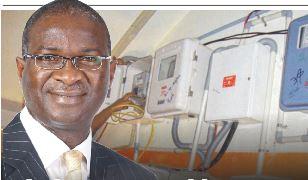
Fashola, electric meter
By Dele Sobowale
We will deliver 10,000MW target, Fashola says.”PUNCH, April 2, 2016, p 8. That statement, already made stale by previous administrations, was uttered on April 1, 2016. Nigerians hope that in three years it would not turn out to be an April fool’s joke. For three weeks before the Minister of Power restated that pledge, power supply had averaged less than 2500MW and Nigerians had been treated to the same litany of familiar, and stale, excuses – vandalisation of pipelines, no gas supply, breakdown of systems etc. With all due respects to Fashola, one might ask where he had lived these past sixteen years.
 When the All Progressive Congress, APC, promised change, the least people expected were positive changes with respect to power, fuel, jobs and security. Excuses would not do; certainly not almost a year after taking over.
With the uncertainties associated with power and fuel not abating it is difficult to imagine any sort of rapid economic progress being made. It is easily demonstrable that every economy runs on power and fuel supply. The twenty largest economies are also among the largest producers and consumers of power and fuel. Additionally, the power and fuel supply remain uninterrupted 24/7 in every leading country. This is not the case in Nigeria as recent events have demonstrated.
On March 31, 2016, eight of Nigeria’s power plants were shut. The nation recorded zero power generation for hours – driving consumers to either stop work or resort to the use of generators. That would have been disastrous enough in another country. But, the total power outage occurred at the same time that Nigerians were still serving the “economic death sentence” pronounced by the Minister of State for Petroleum who had announced that fuel scarcity will linger until May. But, even the two months deadline was not categorically stated. Dr Kachikwu had told us quite clearly that, “I don’t want to put a time frame”. So, even regular fuel supply is not guaranteed by May.
Under those circumstances what could the Summit, which had more low points, be discussing? The nation will have neither power nor fuel to carry out its programmes anyway. However, since the Federal government had organized an economic retreat and the results of their deliberations had been released, there is a need to examine some of them.
Whoever said that “the more things change, the more they remain the same” must have had the retreat in mind. From what was released, it was clear that nobody in attendance at that retreat had even a modest recollection of Nigeria’s economic history. The Summit would have benefited from the advice of somebody who remembers yesterday.
The National Agricultural Land Development Agency, NALDA, was an initiative of the Babangida administration which failed woefully. The reasons NALDA failed in the 1990s are too numerous to recount here. But, one of my first commentaries in the VANGUARD, during IBB’s regime was in relation to NALDA.
Then, as now, the praise-singers and spokesmen of the government had hailed it as a great initiative which would solve the problem of food security once for all. I thought differently. In fact, the point was made then, and is being repeated now, that NALDA was, and is, based on faulty foundations and that it would only result in massive fertilizer fraud. By the time IBB’s NALDA was laid to rest, virtually no state of Nigeria had established the machinery to make it work.
NALDA failed then for one cardinal reason. The programme clashed with the entrenched Land Use Decree of 1978 – which Obasanjo as military Head of State used to forcefully acquire peoples’ land at Sango Ota for Obasanjo Farms – which was called Temperance Farms at the time. The states still own the land, and for NALDA to take off, each state would have to grant the required parcels of land in each Local Government to the Federal Government. Anybody in Abuja who thinks that state governments are prepared to give up 50,000 hectares of land in each LG must be living in a fool’s paradise. The LGs when IBB established NALDA were about 583 in number; now they are 774. Even before the break-up of some of the LGs, it was virtually impossible to obtain 10,000, 20,000 or 50,000 hectares anywhere to be used for NALDA’s projects.
Furthermore, some states are more urbanized than others. In the 1990s, a question was asked, and the question is repeated now. Where in Lagos Island, Lagos Mainland, Ikeja, Mushin, or Apapa can anybody find 100 hectares of land for NALDA?
The same question can be asked of Ibadan, Abeokuta, Akure, Ado-Ekiti, Benin, Onitsha, Enugu, Portharcourt, Aba, Calabar, Uyo, Kaduna, Jos, Kano etc. Any funds to be allocated to the scheme will ab initio amount to cheating for the most urbanized states which can never provide the land mass needed to prosecute their own programmes. Bluntly put, NALDA is a basically rural Northern programme from which no Southern state can benefit. Where is 50,000 hectares in Abak for God’s sake?
Another programme borrowed from the IBB era is the wheat project. Those of us who were close to the fraudulent wheat project on which IBB’s government threw away hundreds of millions of naira can only hope that there was a typo-graphical error there somewhere. Only God knows who persuaded Babangida that wheat, which is a temperate zone crop, could be cultivated, with comparative advantage, in the tropical sun.
Disclaimer
Comments expressed here do not reflect the opinions of Vanguard newspapers or any employee thereof.