By Henry Boyo
It is, inexplicable, that despite Nigeria’s ranking as a major oil producer, our economy is still literally in shambles with a tattered currency and a crushing unemployment rate above 25%; we still unfortunately presently expend almost 50% of our total export revenue on fuel imported from some of those refineries which buy our crude oil. Regrettably, despite the regular recurrence of fuel scarcity, with its severe public discomfort, and ravaging economic dislocation, there is still no assurance that this tortuous cycle will ever end. However, if the inefficient, and wasteful sporadic operation of existing government refineries is anything to go by, any serious proposal for government to build and operate more refineries may just be a death wish.

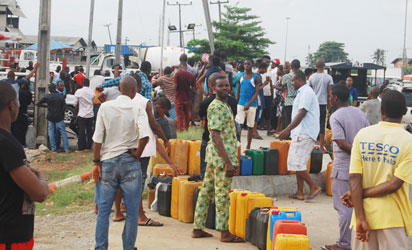
Long queue of jerry cans at a petrol station as fuel scarcity bites harder, yesterday. Photo: Joe Akintola, Photo Editor.
Although, it has been suggested that public/private sector partnership refineries will guarantee efficiency and best practice management, serious investors may, however, never emerge, if fuel price remains regulated; furthermore, if government’s plans to collaborate with private investors have still not advanced beyond an M.O.U, then it will be unrealistic to expect steady fuel supply, for at least another two years.
It has, also, been suggested that several small modular refineries can be established very quickly nationwide; evidently this strategy may only be feasible if pipelines are already laid from oil wells in the South/South to designated refinery sites, in widespread locations, before modular refineries become practical propositions.
Furthermore, the concept of modular refineries may not also attract private sector interest, if fuel price still remains regulated. Nigerians may readily recall that the approval given in 2012 to a Nigerian/American consortium to construct, 6 modular refineries within 30 months, has regrettably also failed to materialise; more than 20 other licensees have also remained inactive.
The preceding narrative suggests that the possibility of more refineries to augment fuel supply and possibly also earn additional export revenue may not materialise for a while yet, at least not until fuel pricing is deregulated. Nonetheless, our hope for fuel sufficiency may still be spurred by the steady progress of the multibillion dollar Dangote’s Lekki refinery. Dangote’s refinery, will produce about 500,000 barrels per day to cover over 50 % of our daily domestic requirement of over 40m litres. Anyhow, Dangote’s refinery may not come on stream until 2018, so fuel supply will still largely remain import based and will therefore continue to severely deplete our foreign exchange reserves.
Incidentally, the eventual commissioning of Dangote’s refinery in 2018 will certainly improve fuel supply but it may not significantly reduce the heavy depletion of our foreign exchange reserves from fuel imports.
Furthermore, the location of this gigantic project in an Export Processing Zone, connotes product prices will be denominated in dollars. Indeed, the Project’s Sponsor has never hidden the fact that, in addition to personal equity, foreign loans, which would be serviced and repaid in foreign currency were also secured to fund the projects; thus, Dangote’s Refinery will not sell its fuel in Naira and then proceed to buy dollars from CBN to service its external loans; indeed with such trade terms and, the continuous slide in Naira exchange rate, this multibillion dollar investment would invariably become a nightmare for the owners.
So, fuel supply may still predominantly come from NNPC imports, and fuel scarcity will unfortunately also remain abiding with NNPC’s monopoly; this, would be bad news for the market because private sector marketers will be happy to avoid the heavy financial burden which results when subsidy refunds and exchange differentials are not promptly settled to repay their high interest bank loans with the usual oppressive penalty clauses. Indeed, Fuel merchants are probably, presently, more comfortable with simply paying Naira to lift supplies directly from NNPC to service their own petrol outlets and earn a modest profit margin without much sweat, as this strategy invariably drastically reduces both the tenor and the high interest paid on loans that marketers incur to import fuel.
Nonetheless, although NNPC’s monopoly will reduce the level of petrol marketers’ loans well below the present estimated 40% of total bank credit, sadly however, commercial banks will probably still choose to re-invest the resultant surplus funds, in governments’ bills and bonds, to reap easy money rather than support the famished real sector with low cost funds.
Conversely, however, NNPC operations will inadvertently become challenged, as over 50% of its forex earnings will also have to be dedicated to pay for fuel imports. It is not yet clear how this system is currently playing out, particularly with the mandatory requirement for the Corporation to domicile its funds in CBN in compliance with the T.S.A system. Obviously, the sales income from petrol and kerosene supplies comes into NNPC coffers in Naira, so how will the Corporation account for unavoidable exchange rate differentials, when it has to pay for its fuel supplies in dollars?
The question is clearly, at what rates the NNPC will repurchase dollars with its naira sales income from CBN to pay for its fuel imports; conversely, NNPC may actually require an approved dollar denominated budget annually, for its fuel imports so as to avoid recourse to the dangers inherent in procuring dollars from CBN for this purpose.
It would seem from the preceding narrative, that there is no easy quick fix solution to the challenge of fuel supply without price deregulation. Nevertheless, deregulation will invariably also fail if the Naira exchange remains weak. Thus, government’s apparent inability to deregulate is actually because of the apprehension that such policy position will not be sustainable if Naira’s unending slide is not arrested. For example, if the Naira is allowed to depreciate below N300=$1 because of dollar demand pressure, the pump price of fuel which is presently below the N87/litre regulated price, will immediately spike above N140/litre to make abolition of fuel subsidy very unpopular; invariably, further depreciation will expectedly further increase fuel price beyond N140/litre.
Conversely, if the Naira appreciates to N100=$, for example, fuel price will fall below N50/litre, i.e. well below the regulated price, and support sustainable deregulation of the downstream market; furthermore, with deregulation, the market will embrace competitive pricing and services amongst marketers, so that, ultimately NNPC may withdraw and focus on more specialised subsectors of the oil industry.
Evidently, with the eternal presence of systemic surplus Naira in the money market, not even increasing dollar revenue will save the Naira exchange rate from further depreciation; however, a more competent management of naira liquidity by CBN will gradually redress the market imbalance in favour of Naira and steadily induce a stronger naira exchange rate that would support and sustain deregulation of fuel pricing. Instructively, Naira liquidity will be minimised if Naira allocations are not substituted for dollar denominated revenue.
Disclaimer
Comments expressed here do not reflect the opinions of Vanguard newspapers or any employee thereof.