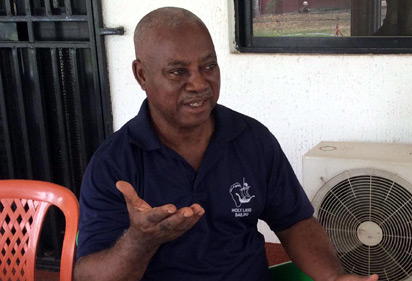
Gen. Omu
*Senators, Reps may frustrate anti graft war
Maj. Gen. Paul Ufuoma Omu (rtd), soldier and administrator, rose to the rank of Major-General and was a member of the Armed Forces Ruling Council, AFRC before his exit from the army in 1990. Omu served as military governor of the South-Eastern State during the Murtala Mohammed administration and was a point man of the Muhammadu Buhari’s anti-corruption crusade between 1984 and 1985 when he served as chairman of one of the feared military tribunals established by that government to try alleged corrupt politicians.
Omu also served as director-general of the Nigerian Institute of Policy and Strategic Studies, NIPSS before his recent engagement as chairman of the board of the institute.
Omu is married to Stella, a former senator who rose to become the Senate Chief Whip and in that position became the first and only female president pro tempore of the Senate.
In this interview he shares his views on the events that culminated in the death of Gen. Murtala Muhammed forty years ago among other issues. Excerpts:
By Egufe Yafugborhi & Ochuko Akuopha
It has been a quiet life since you disengaged from the military. What have you been really doing?
It has been a quiet life since I was born. Even in active service, I was not known to be a loud person; I have been quiet from youth till I joined the army and retired, so there has been no difference at all.
Why did you choose this quiet retirement to your community above the common practice of generals taking to partisan politics after retirement?
I gave that background that it is my nature. The army didn’t change me and politics certainly is not for me. I prefer my quiet life and that is why I retired home. I have been home now for 25 years since I retired and that is my life; I am not involved even in local politics.
But you are the immediate past President General of the Isoko Development Union, IDU. That’s more like local politics?
The IDU is non-political. It is a socio-cultural organization and it wasn’t like I wanted to be PG. There was a crisis and they pleaded with me to come to rescue and bring some sanity into the system and that was what I did for two years. As you know, I have handed over to a younger person to carry on.
There was stability for the two years I came in. I told them I was a PDP card carrying member, but that doesn’t make me a politician. I can vote but I didn’t seek for political office. Being in IDU is sheer community service; it has nothing to do with politics.
You were one of the key players when the late Gen. Murtala Muhammed was Head of State. Can you share your personal view about the life and times of the former Head of State and what he stood for?
This question is a difficult one because when you talk about your former boss, you have to be very careful of what you say. Muhammed was an outgoing and very energetic person and when he took over government, he had to appoint people to assist him; that is, governors to take over the states and ministers to run the ministries and so on.
I was in far away Maiduguri as Brigade Commander then when, on the radio, I was appointed military governor of South Eastern State, now Cross River and Akwa Ibom States. So that was my first direct relationship, because in the army he was in the Signals while I was in the Infantry. We really did not work close together before the government in which he became Head of State and I was military governor under him.

Gen. Omu
He was very energetic and hard working and sometimes he was brash. When I say brash, I mean he was in a hurry to get things happen. Unfortunately, he could not achieve much before he was assassinated. We came on board with him in August 1975 and in February 1976, he was assassinated. I didn’t work with him that close for up to one year.
The public knew the man as full of integrity and plans to change Nigeria positively. From your position what were some of those specific aspirations and strategies that his government intended to achieve?
For instance, there was this much controversial issue of the sack of civil servants, the reorganization of the civil service.
Security and protocol
It wasn’t a popular move, but he did it and it drove some fear into the system. Then another major thing was his choice of Abuja as Federal Capital Territory. Those were parts of the major landmarks of his administration.
But generally as I was saying, he was a very brash man. Sometimes he didn’t care whose ox was gored. He was a very vibrant young man but unfortunately, he couldn’t carry everyone along before he was assassinated.
Actually it was all because of a breach of security and protocol. They advised him to go with escort, but he was saying he was popular and doubted if anyone would kill him? He didn’t move into Government House at that time from his residence where he was as a military officer. He would go to work like that in Dodan Barracks. He didn’t move into Dodan Barracks as he was living in the army official residence in Ikoyi.
How did you receive news of his assassination?
It was a shock. As Military Governor of Cross River, I was still doing familiarization tour of the state, visiting the local government areas and all that. On that day, I had crossed the river to the main land which is now Akwa Ibom. I was in Itu, visiting the local colony when they put a call to me that I should come back; that the Head of State had been assassinated.
It was a shock and I must tell you people panicked, and before I returned to Oron to Calabar, most of my entourage had disappeared before we got to Government House.
After that the news came that the coup had been crushed, but as it affected me, I was cool headed and I stayed in Government House until I heard that the coup had been crushed; I didn’t panic. I stayed there till August 1978 when a normal reshuffle was made and I moved back to Ministry of Defence.
What do you think Murtala would have done differently to make Nigeria a better place than it was before his life was suddenly cut short?
When we were appointed, there was across the board, order that everybody should use 504 Peugeot cars, so even the cars we inherited from the other governors, we sold them. My predecessor was using Citroën DS 23 if you knew how palatial that car was.
Different world
We gave them up and we were using 504. The Head of State was using 504. Things are different now, if you ask me what is happening when my local government councillor will come in a jeep to visit me, it is a different world to me.
Forty years is a long period. I would have forgotten many things, but what stands out about General Muhammed was that he came and wanted to give Nigeria a new direction.
He wanted to reduce corruption; he wanted to reduce the indolence in the civil service, he wanted to streamline the civil service and he didn’t have time to do that. What is government after all? Government is to make life comfortable for the people. So, any government that cannot do that is a failure.
Do you have much faith in the present administration’s fight against corruption?
I pray for any government to succeed. If we go into many details, you will find out that President Muhammadu Buhari had used me as an individual to fight corruption. If you remember the tribunals that he set up during his time as military head of state, I was heading the tribunals.
People were saying ‘how can this quiet man sentence someone to 80 years imprisonment’? People didn’t believe I could do it, but in my quiet way, I was doing it. But like a typical Nigerian thing, what happened to Muhammed happened to Buhari; he didn’t stay long before he was removed.
As soon as Buhari was elected President, Radio Nigeria came to me asking, ‘if Buhari calls you to do what you did for him in 1984, 1985, will you do it?’ I told them now, I don’t have legs to run. I am old. Besides, even if I can do it, this type of National Assembly we have will not make it easy.
For this thing to succeed, you need a law to back it but the people making the laws are looking back; there is skeleton in their cupboards. If they make the law, it will hook them; so it is going to be difficult but let Buhari shake the system. The good thing is that the anti-corruption fight is shaking the system, but the corruption is so deep rooted that it will take a long time to succeed.
Comparing your time in the military, what do you make of the prolonged failure of the present military to fully overcome the Boko Haram in one section of the country?
I was in that region when I was appointed as governor. I was a Brigade Commander in Maiduguri, had battalions in Mubi, in Yola; all the hot spots were under my command in those days and it was all peaceful.
From Mubi to the Cameroon border is just about three kilometers. The atmosphere was so free at that time, you could use naira to buy things on the other side of the border in Cameroon. Things were going on smoothly.
Fanatical aspect
Today, we are talking about insurgency. Insurgency is a fanatical aspect of the human being whether it is religious, political and all that. Boko Haram say they don’t want Western civilization.
They don’t want Western way of governance and this democracy we are practicing. They don’t even want Buhari there.
They will prefer an emir being head of state. This is the kind of ideology these people have. It will embarrass any right thinking person that these are people driving jeeps, using automatic machine guns and everything that is a product of science, yet they don’t want to go to school. Talking about fighting this sect, insurgency is difficult to find anywhere in the world.
So when you talk about people fighting for their fanatical ideology, rightly or wrongly, particularly when they are using the natives, you don’t know who is who.
Given your knowledge of the area in your active days in the military, if given the opportunity to offer some measure of advise, what would you tell the government and the armed forces to do to tame Boko Haram.?
Honestly, I can’t give any advice because the scenarios are so different. The type of training I had was to contain a situation of riots. That was how we were taught this thing develops; from riot to protests against something then it will result to violence, into insurgency.
Non violent agitation
Non violent agitation then violent agitation and that was what we were taught. I didn’t learn about somebody loading bombs into a car and driving it into a church in session or somebody blowing himself up and thinking he will go to heaven by so doing.
Honestly, I don’t know what to advice. What is happening now didn’t happen during my time.
Disclaimer
Comments expressed here do not reflect the opinions of Vanguard newspapers or any employee thereof.