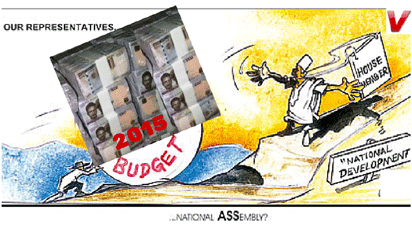
Budget
By Emeka Anaeto, Economy Editor
Amidst sustained high liquidity in the banking system financial experts are expecting developments in Nigeria’s fiscal policy 2016 and the international financial markets to shape investment yields positively in December 2015 and first quarter 2016. A total inflow of about N890billion is expected to hit the money market from the various maturing government securities and Federation Accounts Allocation Committee, FAAC, in the month of December 2015.
Expected outflows from the various sources such as government securities and statutory withdrawals are estimated at N577billion within this month, leading to a net inflow of about N312billion. Though, according to finance industry operators, this analysis does not include the CBN’s interventions at the inter-bank segment of the foreign exchange market by the Central Bank of Nigeria, CBN, and the Cash Reserve Requirement (CRR) total liquidity in the system is still expected to exceed N1.0 trillion except if the CBN conducts Open Market Operation, OMO, to mop up the excess cash during the month.
With this situation financial analysts expect yields on fix income securities to rise in the month of December. Analysts at FSDH Merchant Bank said during the weekend that higher increase in the longer dated securities is more likely than on the shorter dated securities. According to them ‘’the higher yields would be driven by the need to maintain positive real yield by the investors, the expectation of an increase in the Fed Rate in the United States of America and the impact of Nigeria’s fiscal deficit for 2016’’.
But with the implementation of the Treasury Single Account, TSA, yields in the Nigerian Treasury Bills, NTB, may be lower, according to the analysts. Consequently investors are seeking likely opportunities at the longer end of the market while money traders may exit current position for profit-taking. Average yields on the FGN Eurobonds were higher in November 2015. Consequently, the prices of all the bonds closed lower in the month of November, compared with October 2015.
According to the analysts at FSDH Merchant Bank, ‘’we expect the yields to rise higher in the month of December because of the macroeconomic risks the Nigerian economy still faces in the short-term. This is in addition to our expectations that Dollar denominated yield may increase because of the possibility of rate hike in the U.S.’’ Meanwhile the banks are taking advantage of the huge liquidity to trade their excess cash instead of lending to the real sector of the economy as envisaged by CBN’s new expansionary monetary policy stance.
CBN’s Monetary Policy Committee, MPC, announced an expansionary monetary policy in November 2015, marking a departure from its tight policy. CBN’s intention is to stimulate lending to the real sector, agriculture, infrastructure and solid minerals sectors. At the end of its November 2015 meeting, the MPC reduced the Monetary Policy Rate (MPR) to 11% from 13%. The MPC also lowered the Cash Reserve Requirement (CRR) to 20% from 25%; and maintained the Liquidity Ratio (LR) at 30%.
Reacting to this development, however, FSDH said “while we support measures aimed at stimulating lending; our conversations with banks reveal that they are cautious about lending at the moment. This is because of the impact of the current economic conditions in Nigeria on the ability of banks’ customers to repay loans extended to them.
“Many of the banks prefer to play safe in the inter-bank market and government securities despite the low rates and yields. We believe that the current low rates in the financial system does not adequately compensate for the risks in the economy to encourage lending.
“We believe measures to de-risk the economy would likely stimulate lending. Some of these measures are: adequate security of lives and properties, improvement in infrastructure (roads, rails and power), enforcement of laws and order and diversification of the Nigerian economy from oil. This will reduce the adverse impact of low oil price on the economy.
“These measures are long term in nature and are outside the confine of the monetary authority. The proposed expansionary budget for 2016 may remove liquidity from the financial system. Necessary measures are required so that banks will not only have preference for government securities”.
Disclaimer
Comments expressed here do not reflect the opinions of Vanguard newspapers or any employee thereof.