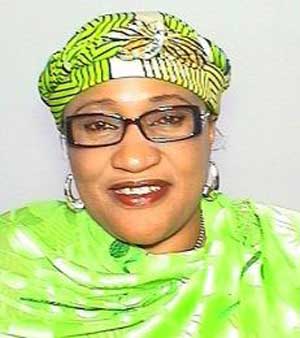
Alhassan
By Agaju Madugba
THE recent proclamation of Aisha Alhassan as the winner of the 2015 governorship election in Taraba State has attracted varied reactions from across the country more so as she gets the enviable position of the first woman to be elected governor in the history of Nigeria. Although President Muhammadu Buhari last Wednesday also inaugurated her as Minister of Women Affairs, Alhassan, fondly called Mama Taraba, is most likely to resume duties at the Government House, Jalingo, seat of the Taraba State government if the Appeal Court upholds the judgment of the Taraba State Elections Petitions Tribunal.

Alhassan
The Tribunal sitting in Abuja had nullified the election of Governor Darius Dickson Ishaku of the Peoples Democratic Party (PDP) during the April 11, 2015 election and declared Senator Aisha Jummai Alhassan of the All Progressives Congress (APC) as the duly elected governor in the state.
Aisha Alhassan, the Minister, Governor in waiting
Born on September 16, 1959 at Jalingo local government area, Aisha Alhassan has had a series of other “firsts” attached to her career having been the first female to contest a leadership position in the Students’ Union Government at the Ahmadu Bello University, Zaria in 1978 as a student in that institution’s School of Basic Studies and later became the first female acting President of the union.
After her studies, qualifying as a lawyer, Alhassan was admitted to the Fijian Bar and enrolled as a Barrister and Solicitor of the High Court of Fiji in 1991and later, having returned to Nigeria, she rose through the ranks to become the first female Deputy Chief Registrar and Director Litigation, High Court of the FCT Abuja in 1997. She was consequently appointed the first female Attorney General and Commissioner for Justice of Taraba State and later appointed the first female Secretary of the FCT Judicial Service Committee in November, 2002 and then,
the first female Chief Registrar of the High Court of the FCT in December 2003. Joining the PDP in 2005, Alhassan contested and won her senatorial seat election in 2011 and was subsequently sworn-in as member of the Seventh Senate.
The challenges of girl-child education in the north
Alhassan’s rise to power and fame may be considered phenomenal given her northern background as the area has been considered over several years as not only lagging behind the other parts of the country in educational development but virtually all other indices of socio-economic development seem skewed against the north. Alhassan joins the ranks of the revered Queen Amina of Zaria and late politician and women’s rights activist, Hajiya Gambo Sawaba, as well as the immediate past Chief Justice of Nigeria, Hon. Justice Alooma Muktar, who braced what is regarded as the hostile northern environment against the girl-child, to attain their full potentials.
Although a number of women from southern and northern Nigeria have attained high level positions in their various fields of endeavour, achievements recorded by their female counterparts from the north appear to dwarf privileged efforts of the celebrated late Mrs. Margret Ekpo, Mrs. Janet Mokelu (both of the defunct Eastern House of Assembly), Mrs. Funmilayo Ransome-Kuti (mother of the late Afro Beat King, Fela Anikulapo). Mrs. Ransome-Kuti, was a foremost woman leader from the defunct western region and among the few highly educated women in Africa of her generation and reportedly, the first African woman to drive a car.
But unlike their counterparts from the other parts of the country, girls and women from the north have had to contend with certain socio-cultural inhibitions in their efforts to make any meaningful impact on their immediate environment and the Nigerian society at large. At the time of her birth in 1933, education for the girl-child in northern Nigeria was virtually non-existent even though Usman Dan Fodio who conquered the north encouraged girl-child education, to the extent that one of his daughters, Asmau, was considered highly educated writer and a poet during that period.
And, earlier around the 15th century, Queen Amina of Zazzau (Zaria) was known as a great military strategist, the cavalry-trained Queen Amina fought many wars that expanded this southern-most Hausa kingdom. According to the Sankore Institute of Islamic–African Studies International, “Amina of Zaria commonly known as the warrior Queen expanded the territory of the Hausa people of north Africa to the largest borders in history.”
It is debatable if any female from northern Nigeria of today may have the opportunity to attain such a feat in an environment that tends to restrict activities of the girl-child who is often married off at a tender age.
According to a report by the Africa Health, Human and Social Development Information Service, although the problem also affects a number of states in southern Nigeria, eight states in northern Nigeria have the country’s worst girl-child and health and identified the states as Kebbi, Sokoto, Bauchi, Jigawa, Yobe, Zamfara, Katsina, and Gombe states also with equally the country’s worst girl-child education, highest female illiteracy, highest adolescent girl marriage, highest under 15 child bearing, and highest risk of maternal death and injury.
The same states, along with Kano state, have the highest percentage of females aged between 15 and 24 years who cannot read or write. The states also account for the highest cases of adolescent marriage and adolescent child bearing (15 to 19 years old). The highest number of women who gave birth before age of 18 years was found there. “The scale of the problem is self-evident, and these are the kind of problems that the Northern States Governors’ Forum should be giving their most urgent attention to – especially from those eight northern states where it is obvious that the educational, health and overall human development of girls is key to their development,” said Rotimi Sankore, the Lead Advocate in the report.
In another recent report, the Research Associate, Education Policy and Data Center described school participation as a challenge across Nigeria while the obstacles are particularly severe in northern states. In addition to issues of school access, family and school resources and attitudes towards education, “school attendance in northern Nigeria is impeded by the increasingly brazen extremism of Boko Haram, an Islamist militant group, and its target of girls’ education.
The group opposes the Western-style education associated with formal schooling in Nigeria and seeks to relegate women exclusively to the household. As a result, risks associated with school-going are compounded for girls and young women in a context where female educational attainment is persistently low. Indeed, in many northern states more than 50 per cent of young women ages 15-24 have no experience with formal education.”
And, according to the Federal Ministry of Education, out of 6,468 secondary schools with a total enrolment of 4,448,869 students nationwide, only 2,419 (37 per cent) of the schools with an enrolment of 1, 4117,645 are from the north.
Equally frightening are admission figures showing the number of students admitted into universities in the country, from JAMB. In 2012, according to JAMB, a total of about 13,974 candidates from Anambra state gained admission to study various courses in the universities through the Joint Matriculation Examination (JME). Ogun state had 13,339, Abia state had 8,874. But for the same year, only 747 candidates from Borno state secured admission through the JME while Yobe state had 999 candidates, Kebbi state had 1,702 and Jigawa state had 1,305 candidates.
So, for Aloma Mariam Mukhtar from Kano who was born in 1944, and rising to become the Chief Justice of Nigeria between 2012 and 2014, may not have come on a platter of gold, given her northern background and the obstacles to the acquisition of Western Education especially for the girl-child.
Alhassan, the last hurdle
Reacting on her decision to protest the result of the governorship election at the tribunal, Alhassan had explained that, “I am challenging the process of the election and the result. We are challenging both the process and the result because the process was wrong and that is why INEC arrived at a wrong result,” even as she vowed to reclaim what she described as her mandate.
The Tribunal Judge, Justice Musa Danladi Abubakar, in his judgment ruled that Ishaku was not properly elected as PDP’s governorship candidate, pointing out that he was not adequately nominated by PDP due to its inability to conduct primaries in Jalingo, the state capital. The tribunal upheld testimonies of INEC head of election monitoring that the Commission was not aware of any primaries conducted by the party in line with the provision of the electoral act which produced Ishaku as the party’s flag bearer.
According to the Tribunal, the defence by the PDP that the primaries were shifted to Abuja because of security challenges in the state as untenable and adopted the the evidence of the INEC official that there was no primaries election in the state and the emergence of Ishaku through the purported election in Abuja was after the statutory stipulated time for party primaries had elapsed.
The Tribunal therefore held that since Ishaku was not duly sponsored by the PDP, the party had no candidate in the governorship election in the eyes of the law. The tribunal therefore voided the votes of the PDP and Ishaku in the election arguing that, “it is a waste,” as it declared the APC candidate who came second, as the valid winner of the April 11 election.
If the appeal court upholds the victory of Aisha Alhassan it will never be the same for women in politics in Nigeria. It will be some springboard for other women to aspire to win more elective positions in the country. And they will always be taken seriously. Alhassan is on the threshold of history that would be told and retold to generations in Nigeria. Time will tell.
Disclaimer
Comments expressed here do not reflect the opinions of Vanguard newspapers or any employee thereof.