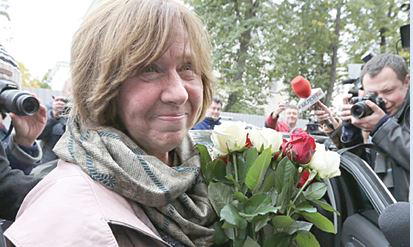
Nobel prize winner, Svetlana Alexievich
By Japhet Alakam & Prisca Sam-Duru, with agency reports
IN a centenary when female writers are struggling to match up with their male counterparts, Belarusian author of “The Unwomanly Face of the War’’, Svetlana Alexievich has added a push to actualising this dream after she became the 14th woman to win the Nobel Prize For Literature.

Nobel prize winner, Svetlana Alexievich
Out of the 111 winners of the Nobel Prize for Literature, 14 are now women.
Alexievich’s feat will hopefully lead to greater recognition for the female authors behind some of the world’s best novels, poems and plays.
Emerging winner in 2015, Alexievich joins the likes of the last female winner, Alice Munro (2013 winner), Herta Müller (2009), Doris Lessing (2007 etc, as female winners of the Nobel Prize in Literature.
She will receive her award alongside other winners on December 10, which is the anniversary of the Prize founder Alfred Nobel’s death.
Svetlana, the Belarusian writer’s oral histories were said to have recorded thousands of individual voices to map the implosion of the Soviet Union.
Polyphonic writings
The Swedish Academy, announcing her win, praised her “polyphonic writings”, describing them as a “monument to suffering and courage in our time”.
Alexievich, writer and journalist who has pricked the conscience of Russia with her accounts of ‘suffering and courage in our time’ becomes the 14th woman to win the prize since it was first awarded in 1901. The last woman to win, Canada’s Alice Munro, was handed the award in 2013.
Speaking by phone to the Swedish broadcaster SVT, Svetlana Alexievich said that the award left her with a “complicated” feeling.
“It immediately evokes such great names as [Ivan] Bunin, [Boris] Pasternak,” she said, and referring to Russian writers who have won the prize. “On the one hand, it’s such a fantastic feeling, but it’s also a bit disturbing.”
The academy called while she was at home, “doing the ironing,” she said, adding that the 8m Swedish krona (£775,000) prize would “buy her freedom”.
“It takes me a long time to write my books, from five to 10 years. I have two ideas for new books so I’m pleased that I will now have the freedom to work on them.”
Alexievich was born on the 31 May 1948 in the Ukrainian town of Ivano-Frankovsk into a family of a serviceman. Her father is Belarusian and her mother is Ukrainian. After her father’s demobilisation from the army the family returned to his native Belorussia and settled in a village where both parents worked as schoolteachers. She left school to work as a reporter on the local paper in the town of Narovl.
She has written short stories, essays and reportage but says she found her voice under the influence of the Belorusian writer Ales Adamovich, who developed a genre which he variously called the “collective novel”, “novel-oratorio”, “novel-evidence”, “people talking about themselves” and the “epic chorus”.
According to Sara Danius, the permanent secretary of the Swedish Academy, Alexeivich is an “extraordinary” writer. “For the past 30 or 40 years she’s been busy mapping the Soviet and post soviet individual,” Danius said, “but it’s not really about a history of events. It’s a history of emotions – what she’s offering us is really an emotional world, so these historical events she’s covering in her various books, for example the Chernobyl disaster, the Soviet war in Afghanistan, these are in a way just pretexts for exploring the Soviet individual and the post-Soviet individual.”
Bela Shayevich, who is currently translating Alexievich into English for Fitzcarraldo, also paid tribute to her skills as an interviewer which leave her work “resounding with nothing but the truth”.
Disclaimer
Comments expressed here do not reflect the opinions of Vanguard newspapers or any employee thereof.