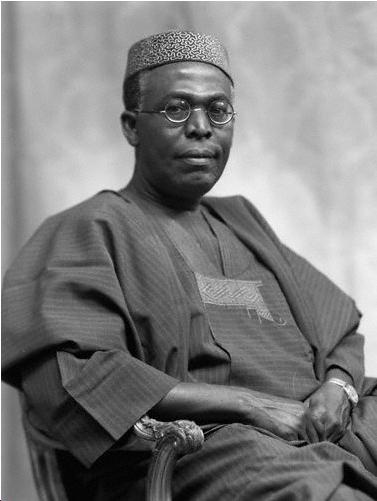
Chief Awolowo
By Henry Boyo
Nigerians across divides still continue to extol the sterling performance of the defunct Western region’s economy under the governance of Chief Obafemi Awolowo and his Political Party, the Action Group. Indeed, in a recent lecture titled “The Awo legacy and the Challenges of political leadership and governance in present day Nigeria”, an erudite scholar, Prof Akin Mabogunje noted as follows:
“The evergreen legacy of Chief Obafemi Awolowo has been based on how he harnessed the residual powers of his regional government to dramatically enhance the welfare and wellbeing of his people, in such areas, as education and healthcare and to systematically transform the socioeconomic conditions of his people”.

Chief Awolowo
For example, according to Mabogunje, “when the idea of free primary education was first mooted by Chief Adekunle Ajasin at a party meeting in 1951, it sounded so impractical and impracticable”.
Incidentally, there was no petroleum or gas export revenue to rely on at that time, and “government had to depend on taxation and its ability to persuade the majority of the populace of the critical importance of this programme for the development of the region and their children”; consequently, “capitation tax was raised from six pence to ten shillings and six pence for all adult males”.
In the area of agricultural development, the Western Regional Government, reportedly, assiduously, nurtured marketing, consumer, thrift, credit and craft value chains and also diligently trained farmers to produce their cocoa to best quality standards for export.
The robust synergy with government made “life more abundant” for more farmers, so much so that the movement, eventually, successfully established its own Co-operative Bank with an initial capital of £1m (Sterling) by 1953.
The Co-operative also progressed to develop a “one-in-town” ten storey office block by 1957. Incidentally, the Co-operative building remains a striking architectural landmark, to this day, in Ibadan.
Furthermore, when the Federal Government developed a cement factory at Nkalagu in Eastern Nigeria in 1957, plans were also made for another cement factory in Northern Nigeria, but unexpectedly, the Federal Government insisted that their own geological Survey indicated that there was no limestone deposit in the Western Region to support such industry”.
Nonetheless, undeterred, the Western Regional Government hired its own consultants whose investigations revealed a wider and thicker limestone belt extending from Dahomey (now Benin Republic) eastward into Western Nigeria. Consequently the Ewekoro Cement Factory was commissioned in 1960, surprisingly, “well before the proposed Federally sponsored Northern Nigeria Cement company”.
Instructively, the Awolowo led Government also made giant strides in establishing industrial estates under the WEMABOD/ODUA umbrella and also encouraged private sector driven industrial interventions, which ultimately embellished the tax revenue base which enabled Awo to fund other remarkable programmes such as the first Television Station in Africa and the equally prestigious Liberty Stadium which made the Federally owned National Stadium in Lagos look like a poor cousin.
The Ikeja Arms (now Ikeja Airport Hotel) and other investments in several businesses including, banking, insurance and real estate developments still thrive to this day. However, in his recent lecture under reference, Prof Mabogunje stressed that the Awo Legacy, both in the area of political leadership and governance could only be possible under the existing arrangement of relative fiscal federalism.
Regrettably, according to Mabogunje, the inappropriate imposition of a unified military command structure as from 1966, on a supposedly federally articulated governance system, greatly challenged the principle “whereby regional governments kept 50% of royalties from mineral development in their area and remit the remaining 50% to the Federal government to support even development in all parts of the country”.
Clearly, as oil revenue became as high as over 70% of annual federal budgets, the sustenance of fiscal federalism would have made some of the oil producing states vastly richer than the federal government itself, and therefore discomfortingly undermine the hierarchical discipline of military administrations. Consequently, the military readily abolished the derivation principle and instead, created a central federation account to receive all revenue (including mineral receipts) from which state allocations were arbitrarily determined and disbursed.
This arrangement, unfortunately, according to Mobogunje reduced the enthusiasm and capability of states to be pro-active in seeking new sources of revenue to successfully drive laudable social programmes; regrettably, thereafter, state governments became inevitably, increasingly dependent on the federation account for their survival.
Thus, in essence, “for the Federal Government, the more states that are created, the more they would become dependent on revenue allocations”. Unfortunately, this situation played into the hands of the military government which could create more states and local governments by fiat.
Furthermore, “the operation of a seemingly federating system of states and local governments based on monthly financial allocation from a federation account has done a lot to wean the population from their civic responsibility of paying personal income tax to provide funding for the services for which they crave as was the case in Awolowo’s Western Region; consequently, citizens lost the authority to insist on good governance or accountability from their political leaders, so that, widespread corruption in governance, invariably, quickly gained more ground.
Worse still, instead of funding economic exchange value to the land of citizens, especially, in the rural areas, the land use decree of 1978, which attempted to unify land administration nationwide, simply made citizens tenants in their own land, with ownership now vested with state governors.
Ultimately, alienation of citizen according to Mabogunje, presently constitutes one of the greatest challenges to political leadership and governance in Nigeria today. Drawing from the proceeding narrative, Mabogunje therefore concluded that ‘the present political arrangement of an over centralized federal government cannot lead Nigeria to a new and progressive path of economic and social development.
He consequently recommended, therefore that, the struggle must continue as in Chief Awolowo’s day to secure a truly federal constitution which allows the states greater control over their resources and the opportunity to compete with one another for the overall growth and development of the Nation. He insists that we must end the fiscal distortion of the military era and move nearer to the provision of the 1963 constitution which conceded 50% of the proceeds of royalty in respect of minerals, and mining rents to states.
Clearly, Awo could not have recorded the laudable programmes in the Western Region without the accommodation of fiscal federalism prior to military rule. Thus, the Action Group leader’s real legacy is possibly the early recognition of this reality which undoubtedly spurred his dogged determination between 1952-9 in several constitutional conferences, for the adoption and serious commitment to a federal system of government as the only path to Nigerian’s freedom and development.
SAVE THE NAIRA!! SAVE NIGERIA!!
Disclaimer
Comments expressed here do not reflect the opinions of Vanguard newspapers or any employee thereof.