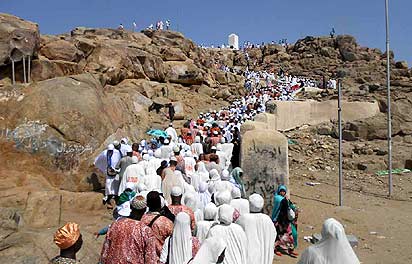
*Ogun Pilgrims at Mount Jabalithaor one of the holy sites in Makkah
Ahmed Solate is the CEO/Managin Director of Hajj Mabrur, one of the popular Hajj agencies in the country founded by The Muslim Council, TMC. He shares his views on the ways of reducing crowd at the Jamarah, during the annual pilgrimage. Excerpts.
By Aderonke Adeyeri
A LOT of people have given accounts of the stampede that led to the death of many pilgrims, yet some are still missing, what do you think went wrong?
When things like this happened to us as Muslims, we should understand that it did not happen outside the Will of Allah. But from the human perspective, the Saudi Arabian government had arranged that when you are going for the Jamarah, you take a particular route in and another for exit.
But unfortunately, some people whose tents were nearer to the exit route felt going through the entrance meant trekking a long distance under the sun. They wanted to avoid the stress, save time and energy. This led to a gridlock and in situations like that, it could be chaotic. People behind could hardly see what was happening ahead of them. This led to the stampede as everybody struggled to survive.
Wrong decision
I think the heat also contributed to the problem. Summarily, the wrong decision by some pilgrims led to the stampede.
Were there no security officials on ground to prevent the crowd from taking the route?
For nine years, Jamarah has always been smooth. We only experienced stampede on the road to Jamarah. So the officials concentrated more on the road to Jamarah. Also, pilgrims walked in group. So stopping one or two persons from a group will likely not make a difference. The security officials also made sure pilgrims didn’t take any item that could hurt others to Jamarah. Many pilgrims were illiterates and there was also a language barrier.
Also, people like to be with their group in order not to miss their way. In fact, there was little the security officials could do. Their police are matured in their approach, they don’t harass pilgrims unlike what we have in Nigeria. This means they have to let pilgrims have their way most of the time. The security officials were overwhelmed by the pilgrims. Another factor perhaps was that there were tents around.
Pilgrims in their tents were afraid and began to lock their tents. May be if the pilgrims had opened their tents, others will have access to it and that would have reduced the crowd. But, I can’t blame those who locked their tents because it was done out of fear.
What preventive measures should be taken to avert future re-occurrences?
I will advice the Saudi Arabia authority to pay more attention to the streets in order to control the crowd. If possible, they also need to do some reconstruction to create more space. Possibly remove some of the tents to avoid congestion. Also, I think reducing the number of pilgrims is also not out of place. It’s better than having casualties especially on the first day.
For the pilgrims, I advise all pilgrims to adhere strictly to instructions. Most pilgrims only do things that soothes them forgetting the effect on others. Pilgrims should obey the Saudi Arabia officials because they have a bigger picture. Some people died because of dehydration, fatigue and heat. Some people had even collapsed out of fear. All these led to the large number of casualties.
There is also a principle in Islam which most people don’t want to take. The elderly ones and children are allowed to go directly to their tents. The principle permits them to do the stoning rite by proxy, but we usually go against this, because everybody wants to have a feel of all the rites. What we usually do in our group is to take the elderly ones in a bus at night and take them back to their tents from Muzdalifa. If others also do this, it will reduce the crowd to a certain level.
What makes Hajj Mabrur different?
Hajj Mabrur started not with the intention of making money but rendering services to the Muslim faithful. We started 2001 when we saw how some pilgrim agencies were poorly treating pilgrims. They were not seeing to the welfare of pilgrims during hajj. My first time in Hajj was in 1997 through one pilgrim agency. We were left to struggle on our own. Personally, I didn’t see any of their officials throughout. There was no one to direct or guide. After this
Disclaimer
Comments expressed here do not reflect the opinions of Vanguard newspapers or any employee thereof.