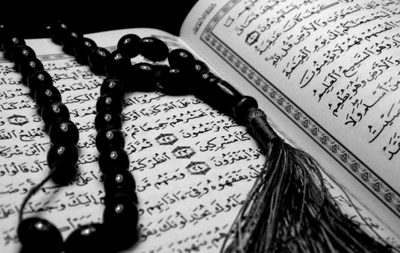
Quran
THE Qur’an explains: No kind of calamity can occur except by the leave of Allah ; if anyone believes in Allah, Allah guides his heart , for Allah knows all things “ At-Taghabun 64 : 11 . We also learn from Prophet Muhammad ( PBUH ) to place our priorities correctly. The most important thing is to live our lives upright and straight , obeying Allah and seeking His pleasure , and to do the best job possible , each in his area or specialization .
It is not how much money or power or fame that we have , but it is how sincere and devoted we are to Allah and how much effort we spend in order to help others and improve their life and guide them to Allah . The Qur’an is clear that we should live our lives as true and upright individuals and not wrong ourselves , nor wrong others :
“Therefore stand firm (in the straight path) as you are commanded ,you and those with you who turn to Allah , and transgress not , for He sees all that you do . “ Hud 11 : 112 . It is very easy to get distracted by the pleasures of this life and to be fooled and set our priorities wrongly.
Selfishpleasures
We may loose sight of what is really important : doing good , helping others and serving Allah , and replace that with the pursuit of selfish pleasures , power , money or fame . The Qur’an reminds us that all these material things are transient and their value is not as great as Allah’s pleasure or His reward : “The material things which you are given are but the conveniences of this life and the glitter thereof . But that which is with Allah is better and more enduring . Will you not then be wise ? “Al-Qasas 28 : 60 .
We learn from the prophet of Allah the importance of hard work and doing our work to the best of our ability . Amana (being trustworthy ) implies that we watch our behavior and that we do our work as best as we can . We do not need someone to watch over us , because we understand that Allah is watching and that whatever we do is recorded . Also we feel responsible and we are honest and do not cheat anyone . We try to improve and do not lie or cheat or cut corners , for our goal is to please Allah and do an honest day work .
This is what will count in our favor on the Day of Judgment , not how much money we got for our work . The Prophet (s.a.w) said : (Allah loves for each one of you , when he works to do the best possible job possible and to perfect his work ). We also learn from Allah’s prophet not to harm others in word or deed , but to help them . If we have nothing good to say , we should keep quiet and control our tongue . Words can cause a great deal of harm . The Prophet (s.a.w) said : (Whoever believes in Allah and the Last Day , let him say something that is good or he should keep quiet) .
He also said : (The Muslim is he who other Muslims feel no harm from his tongue or hand ) . It is easy to talk about other people especially behind their backs . Most of the time , what is said is not complimentary or is harmful . Many talk without thinking or realizing that their words can cause a great deal of harm to the feelings or reputation of other people . They take it lightly and as a joke. Following the example of Prophet Muhammad (s.a.w) :The Prophet of Allah was a father and a husband . He was a friend to his companions . He was a teacher and educator He was a leader of a nation and a statesman
He was a judge: How he faced and solved the problems that he encountered ? What can we learn from him in all these roles that he played.
This aspect of the Prophet’s life is less well understood or commented upon . It is important to study and learn from his example since he was guided by Allah and had the strength of character and morals to behave admirably under different circumstances . This is the meaning of the Qur’anic order : “ You have indeed in the messenger of Allah a beautiful example of conduct for he who rests his hope in meeting Allah , and in the Last Day , and engages often in the remembrance of Allah “ Al-Ahzab 33 : 21 .
We learn from the prophet as a husband the importance of treating our wives well and that we should be patient and tolerant . He emphasized that the best is he who is best in treating his wife . He advised the Muslims to take good care of their wives and to provide for them and support them . He himself was not above working at his home and helping in dusting the floor or mending the clothes or milking the goat . As Aisha said : ( He used to help his wife and family at home ).
Milkingthe goat
He was kind and tender and tolerated the arguments and jealousy exhibited by his wives . He never raised his voice nor hit any woman or a servant, nor said anything indecent. He accepted whatever food was offered to him and thanked Allah for His blessing . He was content in living as a poor Muslim and did not long for money or other material things in life .
As a father he was kind and loving . He wept when his son died but accepted Allah’s decree and sought patience . He was kind with the orphans , as he was an orphan himself . He taught us to be just and equitable and not differentiate in our treatment nor favor one child over another . He emphasized the importance of raising our children well aware of their duty in serving Allah.
He also told us that each person is a guardian and is responsible for and accountable for those under him . The husband is a guardian in his home , and the wife is a guardian also . They work together and cooperate so that their family may succeed and prosper .
As a friend to his companions he was close to them and never separated nor elevated himself . He was always available and visited them during happy and sad occasions . They celebrated together and fought together . He listened to their opinions and took their advice . He emphasized that Muslims must care for each other and help one another . He said : (Allah will continue to help the servant who is helping his brother).
He said : (A Muslim is the brother of another Muslim : he does not wrong him , nor leave him alone to his enemy . Whoever shields another Muslim , Allah will shield him on the Day of Judgment ; whoever helps another Muslim , Allah will help him ) . As a leader of a nation and a statesman , he taught us the importance of diagnosing the ills and problems that face and afflict our community , then coming up with the right solution . He put into action a plan that solved many of the problems that faced the Muslims in Madinah and his plan was ingenious .
Instead of adding more economic burden on Madina’s meager resources , he placed the burden on individual Muslims and asked each one to adopt a brother and help him and treat him as such . The resources were used efficiently and cooperation , friendship and love developed , rather than mistrust or enmity or division . The Mosque became the focal point in the lives of Muslims ; the place where they would meet , pray together , know one another and help each other .
Law and order and equality governed the lives of Muslims . They cooperated with their non-Muslim neighbors who were guaranteed the same rights as Muslims and their freedom and liberties safeguarded , as long they lived in peace and cooperated with their Muslim brothers As a teacher he placed emphasis on teaching by example and spreading useful knowledge . He was particularly interested in nourishing up young minds and preparing them to take their place as future leaders .
Most of his companions were young men and women eager to learn and apply what they learned . He encouraged questions and spoke in short clear sentences , easy to understand and remember . He encouraged us to seek knowledge and to teach others , starting with our families . As a judge in disputes among contenders , he taught us to listen to both sides and not jump to conclusions and to always seek the truth and be just and wise .
We should not favor those whom we love , or rule against those whom we may dislike , but judge according to the merit of the case and be objective . We should remember that one day we too have to answer to Allah and await His judgment . He gave us the example of the three judges : two in Hell and one heaven : those in Hell are those who ruled in ignorance or followed their desires and not the truth . The one in heaven is he who learned and followed the truth .
Muhammad ( PBUH ) was human:
There is a tendency to glorify leaders and make them more real than life . In the case of Prophet Muhammad (s.a.w) some ignorant Muslims have elevated his status to above that of a prophet and even almost worshipped him . The Qur’an is very clear that Muhammad is only a human being and as such is subject to all the laws that govern human beings . He was born and he died ; he reacted to events around him . He made the best possible judgment when he received no divine inspiration .
His judgment was correct most of the time , but on few occasions he erred . An error of a prophet is always corrected by Allah , otherwise his action becomes law . The Qur’an mentions few instances in which divine inspiration came down to correct the prophet’s action . For example accepting ransom from the captives of Badr , or allowing the hypocrites to join in the battle field , or frowning upon the blind man , or staying away from his wives for a long time . Obviously these are minor mistakes . Under no circumstance does a prophet commit major mistakes or indulge in sinful acts .
The prophet was very keen on guiding his people and was deeply hurt that they did not believe in his message. This shows his humanity and how much he cared . Allah stresses in the Qur’an that He sends to each community one of their own . Someone they knew and trust. He applies the message in his behavior and becomes an example to follow . Allah does not send angels as messengers o human beings otherwise they are held to standards beyond their ability .
Some ignorant Muslims believe that going to the prophet’s grave in Madinah and asking him for help is useful, for it will gain them his intercession. The prophet (s.a.w) is dead and as such he cannot help anyone in our life time . If we do good, obey Allah and obey Allah’s messenger , then we may gain the prophet’s intercession on the Day of Judgment .
Our duty towards prophet Muhammad (s.a.w):
Is to obey His orders and follow his example . Obeying the prophet means that we obey Allah , Who sent His prophet and inspired to him divine revelation. The Qur’an is very clear that obeying the prophet of Allah is a sign of belief and a sign that we indeed love Allah: “ Say : “ if you do love Allah follow me : Allah will love you and forgive you your sins , for Allah is often forgiving , most-merciful . “ Al-Imran 3:31 .
We are also commanded in the Qur’an to follow the example of Prophet Muhammad (s.a.w) character and proper behavior ; and to send peace and greetings on Allah’s prophet as a sign of respect . Another important duty is to study his life story and his sayings and use them as guidelines in our life . He was a mercy from Allah to the worlds . He is dead , but his example and teachings are alive Then it is our duty to spread the message of Islam that prophet Muhammad (s.a.w) started .
His message is alive and contains many answers to the ills that afflict mankind today . We will be asked on the Day of Judgment whether we delivered the message of Islam or not “ Say : “ This is my way , I do invite to Allah with knowledge and conviction , I and those who follow me . “ Yusuf 12 : 108 .
Prayer: ‘O Allah make our hearts believe; our tongues always remembers You; and make our deeds good and acceptable to You. Give us knowledge that is useful; and make our souls to be contented and blissful.’
Disclaimer
Comments expressed here do not reflect the opinions of Vanguard newspapers or any employee thereof.