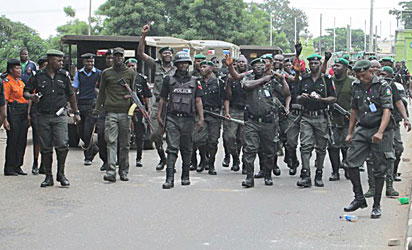
Policeman get sets to quell protect of students of Olabisi Onabanjo University Ago-Iwoye in Abeokuta
By Owei Lakemfa
THE Presidency in announcing that 10,000 more policemen and women are to be recruited, accompanied it with a warning that there must be no extortion of potential recruits. This is not only an indictment, but also a vote of no confidence in the police. The public Presidential warning, tears away at the self-esteem of the police.
I understand the police a bit. This, and my sympathy for it, partly stems from my experience growing up in Obalende, an area on Lagos Island surrounded by police barracks; Obalende, Ijeh, MOPOL, Canine and Police Mounted Troop.
The neglect of the police since colonial times, is responsible for its rot. The Force is used by successive governments to do dirty jobs, and abandoned. So you have a disoriented and demoralised police, with unsanitary training schools and barracks mainly unfit for human habitation. It is seen, and unfortunately, presents itself a lot of times as a lawless body that can even kill citizens at will. Far back in the 1970s, the anti-riot police was known as ‘Kill-and-Go’ while in areas like Benin where citizens believed that policemen and armed robbers colluded, they were called
‘Share and Divide”. The Police had tried to redeem its image, telling the populace, “The police is your friend” and that “Bail is free”.
Another problem of the police is that it is over burdened with unnecessary tasks including settling family disagreements, domestic disputes, juvenile delinquency and other issues which in our traditional societies, families and communities solved. So much is expected from the police, but the State gives it so little.
The fundamental problem of the police stems from its British colonial birth. The British police was set up as the enforcement arm of the State; a body, responsible not to the people, but to the sovereign lord, the rich and powerful. In our own case, the police was established as a colonial force to oppress and repress the colonised and ensure the perpetuity of colonialism.
Because it was essentially an arm of repression, the populace viewed it with suspicion. The Yorubas for instance, call the police, Olopa; the man who wields the stick or the baton. The Hausa word for it, Dansada, virtually means the same. The Ijaws call the policeman, kemekoruowei; the man who effects arrests.
Like the British and American police, the Nigeria Police, profiles the poor as criminally-minded people who need to be closely monitored. When the police patrol affluent neigbourhoods, it is to protect life and property, but when it patrols poor neigbourhoods, it is to detect crime and maintain law and order.
That was why until a few years ago, when a person, seen as poor, is found in an affluent neigbourhood, he could be detained for ‘wandering’ and charged and sentenced. Poor neigbourhoods are classified as crime prone, or black spots. So part of police mentality is to protect the rich from the poor; the powerful, from the powerless. The policeman is like an enforcer in the Mafia family. Therefore, a primary orientation of the Force, is to police the people, not to protect the citizenry, prevent or detect crime.
So the policeman becomes a symbol of oppression and injustice. He believes he is protected by the State and that he has immunity. When he physically assaults a citizen, he does not expect retaliation because he is in uniform.
The lower ranks of the police, is like a disoriented mob. A youngman from the creeks, who joins the police, finds himself far away from home on the streets of Sokoto, wielding a gun under the hot sun; cannot communicate with the local populace, does not understand their culture and religion, and of course, is unfamiliar with the environment.
How is such an alienated man expected to respond to the people or a distress call? The Investigating Police Officer in a case in Ikot Ekpene, is on posting to Zungeru, how can such a case be diligently prosecuted? Some years ago, I had a discussion with a young corporal from the North East, who said after moving his family around due to transfers, he decided that they stay put in Kano.
He was required to go to his old posting to sign for his salary; the cost of transportation was enough to wipe out his salary. So he allows it to accumulate, and he is worried he hardly gets to see his family or send them upkeep regularly. How can we expect the best from him?
The police does not seem to have much self-esteem, good public image or support; it may be decrepit and in urgent need of rebuilding, restructuring and reformation, but the reformers must themselves be reformed. So when the ruling APC party promises to recruit 100,000 new policemen and women, it needs to answer the question, into what Police Force?
Beyond employment and boosting numbers, very little will be gained unless there is a complete reformation of the police. It would just be garbage in, garbage out; no quality improvement.
Our policing system has failed; whether it is typified in setting up road blocks, doing stop-and-search or vigilantes and ethnic militia taking over the security of the populace.
We need a civil police, not a ‘force’ A reorientation and better training, not more sophisticated arms like the American police which is hardly distinguishable from the army and whose mentality like the latter, is to shoot to kill. We need a police for all, not a section. Also, government needs to check the needless proliferation of agencies essentially doing police work such as the Civil Defence, Road Safety and the anti-corruption agencies; ICPC and EFCC.
The confidence of the police need to be rebuilt; better pay and welfare, adequate life insurance, better equipment including CCTV. More importantly, the citizenry need to be involved in policing. We need community policing, state police as well as Federal Police.
Since this is said to be a democracy, we should elect the top hierarchy of the police including the Inspector General of Police and his lieutenants which will make it loyal to the people not the appointing authority.
Disclaimer
Comments expressed here do not reflect the opinions of Vanguard newspapers or any employee thereof.