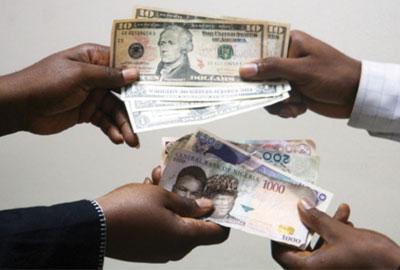
Naira-Dollar
By Henry Boyo
The Punch edition of 16th July, 2015, carried an Agency report titled “CBN has no option but to devalue Naira”; in which, Ravi Bhatia, a Director in ‘Standard and Poors’, an International Rating Agency, observed that inspite of the recent measures by the CBN, “another devaluation… possibly by more than 15%, is inevitable” to satisfy the expectations of overseas investors.

Naira-Dollar
In a Business Day report of 22/7/15, titled “CBN may fail Hedge fund speculators’ betting on Naira devaluation”, Sewa Wusa, Head of Research and Development of Sterling Capital observed that “the onus lies on the CBN to devalue the Naira before it is too late”; according to Wusa, “what is actually pushing the Naira southward is the banning of 41 items from the forex market”.
Similarly, research analysts at FBN Capital Plc also counseled that “devaluation fears are discouraging the offshore community from re entry”. Indeed, in the Punch edition of 26/6/15, in a report titled “Bank CEOs call for further Naira devaluation”, the Group Managing Director of First Bank Plc, Bisi Onasanya, warned, that “the banks could not support the Naira at the present artificial level of less than N200 in the official market”, and therefore called “for further devaluation of the currency”.
Onasanya insisted that “the rate is not sustainable, and the longer we continue to hold unto this, the more we send signals to the international market that we are not serious as a country”. Besides, according to Onasanya, “the economy will be at a standstill unless there is some adjustment to the present level of the Naira”.
Similarly, Mr. Femi Olalokun, the Executive Director, Treasury and International Business of UBA, also chorused that “there should be a little adjustment in the currency”…..and therefore suggested that “interest rates would have to be increased for (external) funds to come in, to support our quest for diversifying our economy, broaden the base of income and restore liquidity in the forex market”.
Indeed, some financial interest groups have uncharitably engaged in an open smear campaign to rubbish CBN’s efforts to maintain sanity in the forex market; for example, “The Economist” brazenly questioned the competence of Godwin Enefiele as CBN Governor and in a venomously simplistic article titled “Nigeria’s Currency: Toothpick alert”, also ridiculed his attempt to control forex demand.
The overriding message, nonetheless, is loud and clear; speculative overseas investors and their media organs are in agreement with the movers and shakers in Nigeria’s banking industry to demand further reduction in the Naira’s exchange rate beyond N199=$1; additionally, these interest groups want CBN to also instigate higher rates of interest within the Nigerian economy, so as to promote the profitability of speculative foreign investors.
But the question is, what would happen to Nigeria’s economy and the social welfare of our people, if Emefiele and the CBN are intimidated and stampeded by the clarion call of these financial hawks, to further devalue the Naira and also increase domestic rates of interest, for government borrowings and real sector credit?
Indeed, Naira devaluation is probably the most potent weapon against the prosperity of Nigerians. Nigeria’s migration from a potential industrial power house with bustling social affluence, to a subdued and stumbling economy clearly began with the adoption of IMF’s Structural Adjustment Programme during Babangida’s regime: the chorus from International Agencies, at that time, was also that falling oil prices with an unserviced debt burden and the consequent restriction of trade credit to Nigeria, were the products of an allegedly overvalued Naira exchange rate.
Ultimately, the overwhelming pressure from International Finance Agencies, with the governments’ craving for international support for an illegal military junta, precipitated serial Naira devaluations from less than N2 to over N22=$1 by 1993. This rash decapitation of the naira exchange rate pauperized Nigerians, including University professors and technocrats and tragically triggered the brain drain to more stable economies in Europe and America; sadly this disenabling phenomenon has gathered speed and persists till date, as beneficiaries of our individual and collective sacrifices still abandon serving their country in preference for dollar pay packets abroad.
Indeed, wages soon became decimated by unyielding devaluation, such that it became necessary for most Nigerians, particularly civil servants to make awkward adjustments and engage in ‘Extra-curricular’ activities to supplement their paltry incomes; although the impact of Naira devaluation may not have been the origin of corruption in Nigeria, it certainly contributed to its spread and public apathy to the disease as more Nigerians became beneficiaries of the wages of corruption.
Clearly, Babangida’s decision to drastically devalue the Naira did not recognize its impact on fuel price; indeed, the notion of fuel subsidy apparently became inevitable with Naira devaluation. Regrettably, successive administrations have remained in denial of this relationship and the most recent devaluations from N155 to N199=$1 within 4 months also triggered another 20% rise in fuel prices despite the irony of prevailing lower crude oil prices.
Consequently, additional Naira devaluation above 20% as demanded by overseas ‘investors’ would only stoke fuel prices and make subsidy removal a major challenge for Buhari’s administration; ultimately, fuel subsidy will exceed the alleged burden of about N1tn annually and account for over 20% of expenditure, if Federal budgets remain below N5tn.
Furthermore, an additional 20% devaluation, will also reduce minimum monthly wage to about $75, down from almost $120 only 5 years ago; indeed, with inflation consistently nearer 10%, the current minimum wage undeniably buys much less than was earlier possible, with a collateral reduction in consumer demand.
Consequently, if CBN now yields to the current pressure to promote higher interest rates, the rate for government borrowings will inch closer to 20% to impress overseas investors; in this event, cost of funds to the real sector may approach 30% to further discourage investments, reduce capacity utilization and employment opportunities, and also turn the possibility of diversifying our economy to a mirage.
In other words, higher interest rates will constrain job creation and also increase a debt burden that will be serviced by future generations at oppressive and anti-growth interest rates. Nonetheless, some analysts still suggest that weaker Naira exchange rates will promote Nigerian exports; regrettably, Nigeria’s non oil exports have continued to dwindle as the Naira collapsed overtime from stronger than N1=$1 to N200=$1!
Instructively, the strategies to rescue the Naira Exchange rate has consistently related to the reduction of dollar demand; however in view of the apparent failures, it may now be time to recognize the unceasing systemic excess supply of Naira as the actual villain; clearly, a market with surplus Naira constantly chasing rations of dollar supply will always constrain Naira appreciation.
Disclaimer
Comments expressed here do not reflect the opinions of Vanguard newspapers or any employee thereof.