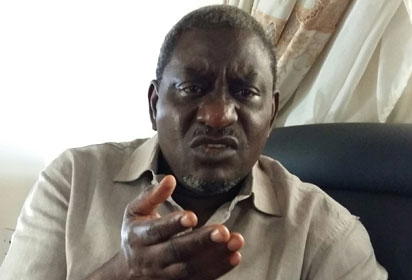
Obayuwana
By Simeon Ebegbul
Osagie Obayuwana is a former Attorney General and Commissioner for Justice in Edo state. He was also Vice President, Committee for Defence of Human Rights, CDHR.

Obayuwana
In this interview with Vanguard Law and Human Rights, he reviewed President Muhammadu Buhari’s anti-corruption war.
He also noted the need for some big names to be in jail and his expectations at the on-going Nigerian Bar Association, NBA, annual conference in Abuja. Excerpts:
WHAT do you think lawyers will take away from this year’s NBA conference?
President Buhari has set the tone about what the nation expects from our profession at this time, but I think the profession is already engaged in soul searching. We (lawyers) must define our role in the scheme of things. Matters of human rights, rule of law and independence of the judiciary, need to be deepened. There are aspects of our professional ethics that imposed obligations on us as ministers in the temple of justice.
I think the conference is geared towards confronting lawyers with these issues and engaging in self-criticisms and sharpening our tools, so that lawyers cannot be obstacles in the part of the socio-economic progress in the country. The rule of law is not one to be subverted by the law itself. We want to be true ministers in the temple of justice and the assemblage of lawyers periodically at our conference is geared towards achieving that.
Professional duties
So, I have no doubt that at the end of this conference, our people will be better equipped to discharge our professional duties more honourably.
How would you review President Buhari’s corruption policy?
It is a good start, there is no doubt about the direction he is going, which is to meet the expectations of the Nigerian people. We know he has set up a few committees, which I believe members of these committees will put their experience to bare, as far as, formulating general guidelines.
Of course, by the time various agencies and ministries are fully manned, the implementation of these policy guidelines will commence in earnest. The only thing I wish to say is that the Nigerian people should begin to create a role for themselves; it is not a matter of being on lookers or cheer leaders.
The Nigerian people must recognise that what is at stake is their interest. There are dynamics that will come to play. If contradictory policies are formulated, that emasculates the people and their wellbeing, then you cannot be assured of this critical mass support. So, I think it is a balancing act and a lot is yet to be done.
Do you support the establishment of a special court to prosecute corrupt Nigerians?
It is going to be the product of collaboration between the executive and the judicial arms at all levels. It is still the prerogative of Mr President to reorder the affairs of the nation, geared towards enhancing service delivery. A lot is being said now about past efforts.
We should also take a cue from the admonitions of Mr President at the Bar conference, it is also in the direction we have spoken. Even, professionals have to define their roles in all of these. Other arms of government, beyond the executive, also have to define their roles in a way that is complimentary.
So the signals we get from the head of the judicial gives us hope that we are dealing with a serious leadership in-charge of that arm of government. I believe that the executive arm and the legislative arm are also inclined as arms of government collectively, not to pay a political price of appearing not to be in harmony with the initiative spearheaded by the executive arm.
It is not a question of whether the authority is there or not, it is summoning the will, not just at the level of the leadership of the various arms of government, but even key operatives of various arms. Every judge has to know that it is a new day. There are expectations, not just from the Nigerian people, but the international community that has indicated willingness to support our move.
Laudable policies
A situation where the law is used to frustrate the realization of laudable policies will not augur well for our aspiration. There used to be a time when election petitions dragged on indefinitely. But at a point, the leadership of the judiciary had to say let us give priority to these matters. Delay tactics will no longer be tolerated, which does not go against the grain of the traditional norms of the right to fair hearing.
The EFCC was not biting enough under President Jonathan but suddenly woke up under current government. What do you think motivated the current force?
Well, body language is as important as words that actually come out from a man’s leadership style. What is current is perhaps a more thorough assessment of the initiatives displayed during the tenure of President Jonathan. Perhaps, a lot was done without much fanfare accompanying it. Any semblance of favouritism will tend to demobilize enthusiasm on the part of the enforcers.
That is why, sometimes, you find policemen accusing the judiciary of frustrating their efforts. They (police) have done their bits but the cases drag on without end.
So, once the suspect enjoys bail, it is adjournment upon adjournment, the investigators are transferred and no provision made for them to come and give evidence in court on the investigations they carried out.
I think everybody realises that the nation is on the march. What we are talking about now can also be extended to the refineries. All of a sudden, we heard that the refineries are working at some level, where as the leadership of the country then gave the impression that their preoccupation was the importation of fuel because of the benefits that accrued to some of them.
Of course, our local engineers will be demobilized. Same goes for the power sector, a situation where distribution companies are just fixing charges and the incentives are missing. All of that underscores the importance of the leadership. People in retrospect are acknowledging that every leader is entitled to his or her style.
Quite honestly, the body language from former President Jonathan, in matters concerning corruption, was very discouraging. Even his pronouncements during his campaign, “the attempts to recognize that corruption is a natural phenomenon, if you put a goat and yam in the same room what do you expect?”
That is capable of being interpreted to justify corruption. Whereas the issue is that how do you curb that natural tendency, if you say it exists? But former President Jonathan did not appear to have displayed a lot of enthusiasm in that regard.
Public scrutiny
Even in his manner of speech, Mr President is supposed to be an embodiment of the nation as a whole. He is supposed to feel a sense of pride when talking locally or internationally, but the man was always stumbling over his words and smiling, as if all was well.
What is your view on the constitutional amendment and confab report?
Given the history, timing, composition of those that partook in the confab, mere none existence of public scrutiny of that report, reservations expressed from the beginning that it was just a public relations gimmick to buy time and be seen to be yielding to popular expectations, yes, we cannot run away from the fact that the confab took place and certain positions were taken by Nigerians despite all the limitations.
delegation, said “it is gratifying to note that the issue has drawn the attention of the Commission, the era where people are just killed indiscriminatingly is over.”
A Professor of Morbid Anatomy who is in charge of the hospital’s morgue, Prof. Martins Nzegwu, stated that the hospital had in its morgue a total of 97 shot robbers who were brought to the hospital, by the police, over a period of two years.
“We have no fifty bodies from the police, we are over congested. Before we do the mass burial, the SSS comes to supervise. The bodies we have in our morgue are not less than two years old. There is the need for the police to keep proper record of the persons shot by the police because, at times, they shoot innocent people and tag them as armed robbers. There is the need to have checks and balances in the police, Commission and hospitals.
97 corpses for mass: “At times, we have had to go to court to get injunctions from courts to give them decent burials. We have 97 corpses which we have slated for mass burial as we have to decongest. We have had to embalm the bodies with the hospital bearing the cost of N25,000 per body.
“We also have about 90 babies who were abandoned by their parents because there is a practice of not taking dead bodies home. For those bodies to be identified, there is the need to do DNA typing which costs an average of $2,5000, so this has brought to the fore the need for an accurate data base in this country . There should be a central data system where the forensics of every Nigerian is stored,” Nzegwu added.
Dumping of corpses
Speaking when he visited the State’s Commissioner of Police, Mohammed Adamu, in his office, Angwe stated that “we are over on an inquiry. The principal aim is to unravel the facts behind the alleged dumping of corpses at the UNTH Enugu to enable government put in policies that would stem the tide. The Commission has received reports of the indiscriminate dumping of corpses of person who have had interaction with the police, people who were either extra-judicially executed.
Indiscriminate dumping of
corpses in hospitals: “We have also received reports from hospital management boards across the country of harassment by the police and indiscriminate dumping of corpses in hospitals, some of these happenings the police high command may not be aware.
We received the report from a group of lawyers on the dumping of over 50 bodies at the UNTH and I led an investigative team which showed that there are over 97 bodies have been deposited there over time, arising from encounters with the police, sometimes with armed robbers and kidnappers.
There are also over 70 bodies of babies who have been abandoned by their parents as the parents refused to take them home and give them decent burials. It is an issue that the Commission is taking seriously and would sensitize Nigerians. Some of the bodies, according to the hospital register, are not properly identified by the police.
Hospital register
He further noted that, “We are not saying that these people may not be armed robbers but it is necessary to know if the police keep an appropriate record of the people and even that of police officers who die in the course of duty. There is also the need to make it mandatory for these issues to be recorded to prevent the rampant cases of impunity and extra judicial killings as a result of some police officers not applying good judgment and have recklessly carried out killing of innocent citizens because where you have a proper data, you can easily go to the data and trace the persons.
The finger prints would also make it possible for identifying such persons who are killed and abandoned. I know that the police does not have a deliberate policy of extra judicial killings, so the inquiry will also help the police in keeping tabs on the activities of its officers.
We would be requesting that the office here furnish us with a list of the bodies dumped and the officers who dumped these corpses for the police to investigate the incidents. It’s so bad that the UNTH had to go to court to get an order to conduct a mass burial and even went on to advertise the mass burial for the bodies.”
The Commissioner of Police Enugu State, Mohammed Adamu, while responding, said “We appreciate your visit which has shown us that you want to be fair. You are all aware of the roles of the police to protect lives and property and every police man is committed to that and no right thinking police man can go about committing crimes.
Like I tell my officers, if you protect a life you are doing the work of God. Under my watch, I would never support anybody to take the laws into his hands. Any case of human rights abuses that comes to my attention is investigated.
We saw in the newspapers the issue that you raised, the matter was investigated by the state CID and was also investigated by Abuja, concerning procedure in the police. Whenever there is an issue of dead bodies, the first people that are called is the police. When you get to a mortuary, there are records and procedures; all these deaths are incidented, so as you are going you will be able to go with records- officers go but records remain.
“This command, under my watch, will give you all the necessary support. We even investigate accidental deaths. We should use a criminal data base at the national level to keep track of criminals, I hope the Nigerian Police will get to that stage and every leadership of the police is conscious of that. We will avail you of our team and be rest assured that we will not cover anything, even if some of the officers have left on transfer, we would invite them.
In Benue State, Angwe and his team met with the Governor, Samuel Ortom and the Chief Judge of the state, Justice Iorhemen Hwande.
Governor Ortom pledged to work with the Commission to ensure that the rule of law is followed by security agencies and to end extra judicial executions by the police.
His words: “We will not tolerate extra judicial killings by the police or any other security agency as we are in democracy and every accused person must be taken to court for trial. I commend the National Human Rights Commission for the wonderful work it has been doing. We will not encourage extra judicial execution under any guise and we are willing to work with the Commission to see that the rights of citizens are protected.
Justice Hwande, while receiving the delegation, acceded to the request of the Commission for the setting up of a coroner’s inquest into the cause of death of the identified corpses allegedly dumped by the police at the Gboko General Hospital over time.
It would be recalled that the Commission had requested the Chief Judge of Enugu State to convene a coroner’s inquest into the cause of death of one Chukwuma Ihezie who was allegedly extra-judicially killed by personnel of the state’s Special Anti-robbery Squad and 50 other corpses allegedly deposited by the police at the University of Nigeria Teaching Hospital (UNTH) Enugu.
The Commission had in 2014 received a complaint from the Enugu office of CLO alleging that the late Iheizie, a 30 year old male, was extra-judicially killed by one Mr. Bolu of the Special Anti-robbery Squad of Enugu State Police Command.
In line with the Commission’s Standing Order and Rules of Procedure, the Commission undertook a preliminary investigation into the complaint and discovered additional human remains of about fifty men, with red marker on them, at the same mortuary where Ihezie’s body was deposited.
Statutory mandate
According to a statement by the Chief Press Officer in the Commission, Fatimah Agwai Mohammed, in the exercise of its statutory mandate, Prof. Angwe has requested for the coroner’s inquest into the alleged killings to enable the Commission determine whether or not a systemic case of extra-judicial execution has occurred in the circumstance.
Prof Angwe stated that extra-judicial execution is a violation of right to life contrary to Section 33 of the Constitution of the Federal Republic of Nigeria, 1999, (as amended); Article 4, of the African Charter on Human and Peoples Rights (ACHPR) and Article 6 of the International Covenant on Civil and Political Rights (ICCPR).
He further assured members of the public that the Commission will remain focused in its fight against impunity and will ensure that law enforcement agencies adhere to principle of accountability and best practices in the discharge of their duties.
Failure to bring perpetrators of abuse to account sustains the climate of impunity that encourages others to commit abuse.
There is the need to streamline the various internal disciplinary procedures in the Nigerian Police Force into a manageable framework that could easily be used by aggrieved citizens seeking redress for police misconduct, as well as using data emanating from such mechanisms in tracking police officials who are subjects of unusually high numbers of citizens’ complaints.
There is also the need to strengthen external oversight of the police. One of the principal external police oversight mechanisms is the Police Service Commission (PSC). The PSC, evinced under the Constitution and the PSC Act of 2001, is an independent and impartial institution. A body which is established with the constitutional mandate to recruit, promote and discipline all police personnel other than the IGP in an independent and impartial manner, is expected to be composed and headed by non partisan individuals of unquestionable integrity.
What the nation need is a civilian-led PSC that has the courage to investigate all public complaints and cases of police abuse. Appointing a retired Inspector-General undermines and subverts this mission and renders the PSC ultimately into another department of the NPF. This is not good for the Police; it is inconsistent with the structure and purpose of the Constitution and the PSC Act of 2001; and defeats the whole essence of the establishment of the PSC as a civilian oversight body on policing in Nigeria.
Disclaimer
Comments expressed here do not reflect the opinions of Vanguard newspapers or any employee thereof.