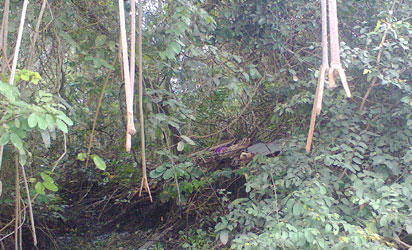
Evil forest
By Oghene Omonisa
It is the strong belief among black Africans that not every death is natural, especially if the person dies at a young age or at the height of his prosperity. Naturally, the Itsekiris are also of this belief. But they go beyond suspicion to bife in order to determine if the person has actually died through acts of witchcraft, black magic or sorcery.
If the person has died through witchcraft or similar means, says Pa Peduru, his spirit or the spirits of the ancestors could avenge his death with or without any form of invocation. “That is why you see some people going mad or dying mysteriously.”
He adds that Ife bibi could also determine if somebody has died as a repercussion for his own evil deed.

Evil forest
The definition of witchcraft in ife bibi practice encompasses every evil deed through supernatural means, says Rev. Dr. Jackson Ireyefoju, an Itsekiri retired senior lecturer at the Delta State University, Abraka and founder and pastor of the Evangelical Spiritual Church of Christ, Okere, Warri.
“As far as the Itsekiris are concerned, any evil act through spiritual form that leads to the death of a fellow human is regarded as witchcraft”, he says.
Most Itsekiris agreed with Rev. Ireyefoju, including Rev. Dr. Stephen Gbejoro, founder and pastor of Christ the Lord Church of God, Warri, and also a radical televangelist who preaches on ABN International and Delta Rainbow Television (DRTV), the local state-owned television station. Rev. Gbejoro adds that even physical killing of a fellow human is regarded as witchcraft as far as ife bibi is concerned. “It is now you see people killing their fellow humans and getting away with it.” He adds that in Itsekiri land in those days, except during inter-tribal wars, which he says are understandable, if one killed his fellow human, his hands were dirty and such a person did not deserve to be buried in town among clean people. The person would be thrown into “igbele to be eaten by vultures and monkeys.”
Ife bibi is performed on every corpse before burial, and not even the corpses of children that have not grown teeth are exempted. “Of course, it is not only about finding out if somebody was a witch or not when alive”, explains Engr. Esimijemiyotan Jakpa, a Warri-based businessman and president of Otu-Oma Iwere, an Itsekiri socio-cultural group. “Yes, a baby could be innocent, but she could have been killed through spiritual means, which could be determined by ife bibi, and the obi ife would know if the baby has died a natural death.” He says a baby’s life is equal to any other life.
Conflict between Traditionalists, Christians
Ife bibi has withstood the spread of Christianity in Itsekiri land. This is clearly because the Itsekiris have very strong traditional base, where even professed Christians continue to consult oracles and engage in other traditional religious practices.
Christianity was well established in Itsekiri land nearly 500 years ago. “For nearly 150 years from Olu Atonrongboye to Olu Akengbuwa (1597–1735), eight Christian Olus in a row reigned in Itsekiri land,” says Chief J.O.S. Ayomike, an Itsekiri leader in his book, A History of Warri. He however adds that these kings “are believed to have partially practiced fetish rites as well.”
Chief Ayomike continues: “It is known that Olu Atogbuwa who reigned between 1735 and 1760 abolished Christianity in Itsekiri land. He closed down churches and sent the missionaries packing. Thereafter, he filled his palace with pagan idols and juju men.”
Thus, traditional religion blossomed again, and the church and monastery known as St. Anthony, that was built at Ode-Itsekiri by Olu Adejeoye before 1700 became derelict due to lack of use.
It was not until the last decade of the 19th century that effective revival of Christianity began.
Chief Ayomike says today, “Christianity in its various denominations is growing amidst the still-revered indigenous fetish practices of the Itsekiri people.”
Many Christian Itsekiris are believed to hold the view that if the pace with which the Christian religion was promoted by Olu Atonrongboye had been maintained till date, Christianity would have been well established in Itsekiri land today, drastically reducing traditional religious practices. And perhaps ife bibi would have been a thing of the past by now.
“We believed and practiced the worship of our various traditional gods, a belief which many of us still hold dear till date”, says Pa Peduru.
“I don’t find anything wrong with traditional religion, especially the Itsekiri traditional religion”, says Rev. Ireyefoju. “Traditional religion is not bad. I am only against the mode and not the intention.” He says no traditional religion or custom tolerates evil acts which Christian rules go against. “Name them: Thou shall not kill; Thou shall not commit adultery; Thou shall not steal.”
When reminded that the First and Second Commandments are against having any other god but Jehovah and bowing before any other god, the Reverend rationalizes: “Those rules are strictly for Christians.” He explains that as a Christian, he obeys all the Ten Commandments, but that he is only explaining the morality aspects of the Christian laws, which are also being observed by traditionalists. “You cannot expect a traditionalist not to bow down to his own god.”
“Itsekiris do not completely give up their traditional beliefs for Christianity”, says Engr. Jakpa. But not every Itsekiri Christian shares this view. “I‘m a Christian and I respect the age-long ife bibi practice”, says Mr. Terry Awala, president of the National Association of Itsekiri Students (NAIS), Delta State University chapter. “I don’t believe it because it is fetish and spiritual.” He says he obeys the bible which teaches against consulting spirits and obi ifes consult spirits to get their results.
The Itsekiri Christian community has been vehemently fighting a strong battle against the Traditionalists over ife bibi practice and other burial practices like burying without coffin. In its August 1998 edition, Itsekiri Christian Challenge, a monthly publication of the Evangelize Itsekiri Now Association wrote an editorial calling for the end of ife bibi on Christian corpses, and against burying without coffin.
“Itsekiri burial tradition demands that all burials must be preceded with the casting of the oracle to determine the cause of death and whether such a person has been a witch or wizard during his lifetime”, the editorial began, and went on to state that while “the custodians of our beautiful traditions maintain that all corpses must be subjected to oracle test”, the publication was calling for the end of the practice for Itsekiri Christians as they have “accepted the Lord Jesus Christ as saviour, and are no longer bound by ancestral laws, traditions or customs.” The editorial quoted copiously from the bible to support its position.
It ended with a call for the establishment of a general Christian cemetery at Ode-Itsekiri.
Traditional and Christian conflict over ife bibi came to the fore in 2000 when Mr. Samuel Mode, a Christian and deacon of Assemblies of God Church died in a motor cycle (okada) accident. Ubeji, an Itsekiri town in Warri South LGA where he resided and hailed from became the theatre of conflict when his family stood against ife bibi for his corpse.
The community leaders, reported Itsekiri Chronicle of August 2000, insisted on the oracle before the 56-year-old father of 9 children could be buried in the town.
The family eventually held a Christian wake-keeping and nothing was heard thereafter, whether they secretly bife for the traditional burial or buried him outside Itsekiri land.
In its battle against ife bibi, the Itsekiri Christian community has unfortunately found opponents even among its fold. One of such is Rev. Gbejoro who says bife is “perfectly in order and must be maintained.” He questions the decision of his fellow Itsekiri Christians to oppose it. “Are they telling us that ife bibi is evil? If they think so, let them go and bury their dead in Itsekiri land without bife. If that person was evil and his hands were not clean, I assure them, the corpse will not last more than 24 hours under Itsekiri soil. That grave will either cave in or erupt, and calamity will befall his family.”
Quoting Matthew 25 verse 3, the pulpit radical declares that Jesus Christ has decreed that the sheep will be separated from the goats. “The Itsekiri culture abhors killing. It is a perfect culture, a golden culture. But those who have committed murder, the killers and witches and wizards in our midst want to hide under Christianity to cover their evil deeds. What is evil is evil, and what is righteous is righteous.”
He submits that the Itsekiri nation is a “clean nation, a righteous nation”, so the wicked should not be buried among the righteous.
The Warri Monarch, Ogiame Atuwatse II has not been spared in the religious brouhaha between Traditionalists and Christians in his kingdom, which was engulfed in controversy in 2013, when he, a Christian attempted to renounce his title, Ogiame, which he claimed was associated with the “Sea goddess” and he had nothing to do with the deity.
But he bowed to the wishes of his subjects after 4 days of intense protests, even from among his chiefs.
A visit to the Olu Palace in Warri (Aghofen) reveals the 2,000-seat memorial church the Monarch built and named after his father and predecessor, Erejuwa II. The church is run by Four Square Gospel Church, and the Monarch worships there.
This reporter was reliably informed that there is no shrine inside the palace premises. This is in contrast to the palace at Ode-Itsekiri, which was used by past Olus until Olu Erejuwa built the new one in Warri and moved down. The old palace at Ode-Itsekiri houses a shrine as well as a church. The church, said to have been built nearly 500 years ago by Olu Adejeoye is derelict, overgrown with weeds and unkempt, while the shrine, originally built with red mud and thatched roof, has a modern concrete structure over it, apparently as a shield from the sun. A guide attributes the sharp contrast in the two houses of worship to the traditional leaning of the elders who still visit the palace, as residents hardly visit, except during royal ceremonies.
Origin of ife bibi
It is not well known where ife bibi originated from and where it all began. “It is associated with oracle, which is only one form of traditional rites in Itsekiri land”, says Pa Peduru. He identifies the other forms as sea-god (Umale–okun), ancestral worship (Ebura), protection (Osan) and belief in witchcraft (Olotso).
He believes consultation of oracle could have been brought from Yoruba land through Benin Kingdom by Ginuwa, the Benin prince who established the Warri Kingdom and became the first Olu. Tracing the history of Warri as a kingdom, he says in his expedition, Prince Ginuwa had an oracle priest in his entourage, who consulted the oracle to determine the direction they were to take.
Disclaimer
Comments expressed here do not reflect the opinions of Vanguard newspapers or any employee thereof.