By Emem Idio
On January 21, 2025, Niger-Delta Voice (NDV), a publication of Vanguard Newspapers, published an exclusive report titled: Tension as Christians, Traditional Groups Lock Horns in Delta.
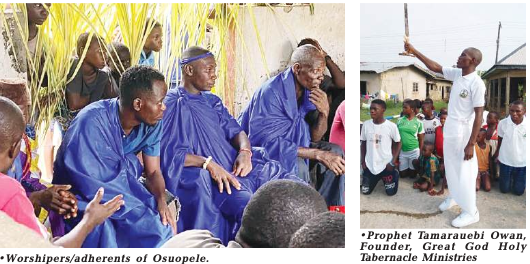
The story chronicled rising religious tension in Ozobo community, Burutu Local Government Area of Delta State, after Prophet Tamarauebi Elisha Owan, founder of Great God Holy Tabernacle Ministry, led members of his church to demolish and burn the Osuopele Beniseide Opu-Oru Temple, a revered traditional place of worship.
At the time, the incident sparked outrage across the riverine Ijaw community. Traditional worshippers accused the cleric of repeatedly attacking their sacred shrine over several years, while the Prophet openly admitted to carrying out the demolition, insisting that if the traditional deities possessed any power, they should defend themselves.
The report also captured growing fears that the destruction of the shrine could ignite an inter-religious crisis if authorities failed to intervene.
Eighteen months later, those warnings have culminated in a landmark judgment.
In what legal observers have described as one of the most consequential court decisions on religious freedom and the protection of indigenous beliefs in recent years, the Federal High Court sitting in Warri has found Prophet Owan and members of his church liable for violating the constitutional rights of traditional worshippers.
The court ordered the respondents to pay N205 million in damages and costs, rebuild the destroyed shrine, tender a public apology, and stay away from the worshippers and their place of worship.
The story that started it all
When NDV visited Ozobo in January 2025, anxiety had gripped the community following the destruction of the Osuopele Temple, the spiritual home of worshippers of the Osuopele deity.
Residents narrated how Prophet Owan personally led members of his congregation to invade and raze the shrine during an evangelical crusade.
Community members told NDV that the attack was not an isolated incident but part of a series of assaults allegedly carried out by the cleric over several years.
They invaded and burned our temple
The newly installed High Priest of the Osuopele deity, Timipre Ndoni, told NDV that the attacks dated back to 2019 or thereabouts.
According to him, Prophet Owan first invaded the shrine during a crusade tagged Jesu Ode, cutting down what he described as a 150-year-old healing tree regarded as the spiritual symbol of the Osuopele deity.
Ndoni said the attacks continued because there was no recognised chief priest to defend the interests of the traditional worshippers at the time.
He explained that after his installation as High Priest in March 2024, he immediately informed the community’s traditional leadership, including the paramount ruler and Community Development Committee to prevail on the prophet to desist from further attacks.
Those appeals, he said, yielded no result. Instead, on December 19, 2024, the cleric allegedly returned with members of his church, invaded the shrine again and burned it down.
Ndoni recalled that many adherents wanted to retaliate but were restrained in the interest of peace. “We decided to seek justice through lawful means because the Nigerian Constitution guarantees freedom of religion and worship,” he said at the time.
He disclosed that the matter had been reported to relevant authorities and that legal action would be pursued to enforce their constitutional rights.
Prophet remained defiant
When contacted by NDV in January 2025, Prophet Owan neither denied nor expressed regret over the destruction. Rather, he defended his actions.
“I have no case with anybody. If a human being destroys idols or the property of a deity, it is left for those things to fight for themselves. If they cannot fight for themselves, why should human beings fight for them?” he said.
He maintained that he had demolished the shrine on previous occasions and insisted that he would never apologise. According to him, the shrine belonged to the community and not to any particular group of worshippers. Describing the conflict as “a battle between darkness and light,” he declared that no amount of pressure would make him seek forgiveness.
Call for peace
Following the incident, the Izon Cultural Heritage Centre (ICHC) condemned the attack, describing it as a clear violation of the constitutional rights of traditional worshippers.
The organisation warned that failure by security agencies to act could trigger avoidable religious tension within the community.
Its Chairman, Apostle Bodmas Kemepadei, urged the Nigeria Police Force and other relevant authorities to intervene promptly, insisting that freedom of worship, guaranteed under Section 38 of the 1999 Constitution, must be respected irrespective of religious affiliation.
Court delivers landmark judgment
Eighteen months after the NDV report, the Federal High Court sitting in Warri delivered judgment on 29 June 2026.
The court held that Prophet Tamarauebi Elisha Owan and members of his church unlawfully invaded and destroyed the Osuopele Beniseide Opu-Oru Temple in Ojobo community under the guise of combating evil spirits.
The court ruled that their actions constituted a flagrant violation of the constitutional rights of the traditional worshippers to freedom of thought, conscience and religion.
The judge further held that the respondents’ conduct was discriminatory, unconstitutional and inconsistent with Sections 10 and 38 of the Constitution of the Federal Republic of Nigeria, 1999 (as amended).
Orders of the court
In one of the most far-reaching remedies granted in a religious rights case, the court ordered the respondents to:
·Rebuild the Osuopele Beniseide Opu-Oru Temple destroyed during the December 2024 invasion.
Pay N100 million as exemplary damages for the unlawful destruction of the shrine and sacred objects.
Pay another N100 million as general damages for violating the constitutional rights of the traditional worshippers and the humiliation they suffered.
Pay N5 million as litigation costs
Publish a formal apology in two national newspapers circulating across Nigeria.
Stay at least 10 kilometres away from the temple and its worshippers by a perpetual restraining order.
Reactions
The High Priest of the Osuopele Opu-Oru/Beniseide deities of Ojobo Federated Communities, Operemor Kingdom, Burutu Local Government Area, Delta State, Timipre Ndoni, thanked the court for a befitting judgment. He also thanked the Izon Cultural Heritage Centre (ICHC), the people of Ozobo Federated Community, and Osuopele adherents for standing behind him throughout the trial.
For the traditional worshippers in Ozobo community, the judgment marks the end of an eighteen-month legal journey that began with the destruction of their shrine and the public appeals captured in NDV’s January 2025 report.
Also reacting, the Secretary of ICHC, Ellington Bakumo, said: “We commend the learned trial judge for demonstrating that the judiciary remains the last hope of a lawful and civilized society.
This landmark decision reinforces the constitutional guarantees of freedom of religion and the equality of all faiths before the law. It further strengthens public confidence that justice will always prevail where constitutional rights are violated.”
Disclaimer
Comments expressed here do not reflect the opinions of Vanguard newspapers or any employee thereof.