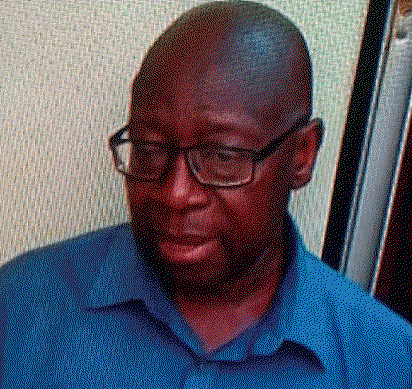
Dr. Victor Oke….Nigeria needs at least 40,000 megawatts; 10 times what we are producing now and probably, within 50 years, we will need 200,000 mw
By Ebele Orakpo

Dr. Victor Oke….Nigeria needs at least 40,000 megawatts; 10 times what we are producing now and probably, within 50 years, we will need 200,000 mw
Nigeria’s gross domestic product (GDP) data was rebased in April 2014 and the country became Africa’s biggest economy as a result. This meant nothing to the common man as his life did not improve in any way by the new status. It is not enough to wear fancy tags; they want to see it translated in improved livelihoods. The truth is that wearing the tag of the biggest economy in Africa without the technological power to back it up, is akin to a dog with bark and no bite.
Stakeholders are of the opinion that the biggest economy tag will not be sustainable unless Nigeria becomes an export-driven nation which will only happen if its industries are operational and that will come with constant electricity supply. The issue of epileptic power supply has been a recurring decimal in Nigeria and successive governments have been unable to solve the problem. With the new administration, there is hope of resuscitating identified power projects.
In this interview with Financial Vanguard, an ex-staff of the Nigeria Electric Power Authority, NEPA (1977 1995) and a lecturer in University of West London’s Dept. of Civil and Environmental Engineering, Dr. Victor Onosaghogho Oke, takes a look at Nigeria’s power sector since inception and proffers solutions to the lingering power instability; he makes a case for hydro power.
Excerpts:
What do you think of the Nigerian Power sector 20 years after you left?
I left Nigeria in 1995 to lecture in universities in the UK. Today, on visiting Nigeria, I noticed the power situation has worsened in the last two decades. Many problems are responsible for this worsening situation vis-a-vis Nigeria’s power grid. In the 1960, Nigeria became independent and the colonial masters envisaged that power would be required considering the large population of the country so studies were done for the Kainji dam through the Niger Dams Authority (NDA).
At the time, we had the Electricity Corporation of Nigeria (ECN) which ran series of thermal stations in various cities across the country. With the construction of the Kainji dam, completed in December 1968, it was thought that the whole country could be interconnected with this huge supply from Kainji into a national grid. This was successfully done and the power situation improved.
Genesis of the power problem:
In 1972, ECN and NDA were merged to become NEPA by a decree. At this time, the country was very wealthy and some people began to say that the country was too rich. The then government had to share part of this wealth by giving the Udoji Award. This afforded many families across the country the opportunity to acquire electrical gadgets like television sets, washing machines, fans etc., which they never had before. That suddenly raised the national load and from 1975, with increased load, the country began to suffer power problems.
So what solutions were proffered at that point because I believe if they had done something at that early stage, Nigeria would not have been in this situation now
NEPA started commissioning more studies on hydro power stations since Kainji was successful. So Jebba and Shiroro and a few other sites were identified through some consultants such as Surmont of Canada. When they studied these sites, they came out with very prospective hydropower potentials like Jebba (540mw) and Shiroro (600mw). They studied up to 15 sites across Nigeria including Lokoja, Makurdi, Onitsha, Yola, Gembu (Mambila Plateau), Katsina-Ala, the ZCN scheme and others.
All these sites if developed, will provide over 20,000mw of electricity. However, due to financial constraints and lack of foresight at the time, these were not developed. The country decided to look towards gas projects implementation which was to provide what they call hydro-thermal mix (thermal – gas and hydro – water) so if we have a balanced hydro-thermal mix, there will be system stability.
But because of the high cost of dam projects, the thermal aspect was more favoured. One of the main thermal projects is the Egbin Power station and those in Sapele, Ughelli and so on. So hydro was kind of left in the back burner but the three that were developed – Jebba (1970s), Shiroro (1980s) and Kainji, have been the backbone of Nigeria’s power system. The thermal stations were built but they had maintenance problems after the first six months to one year and running costs are high.
As an expert, what should government do now?
The country decided to go for more thermal stations, probably because they are easier and faster to build but faced with a lot of problems like insecurity of gas pipelines and inadequacies linked to thermal power schemes across the country. The nation needs to urgently resuscitate these hydro power projects, especially the ones named already, from Lokoja, to Taraba.

Power
They have great potential and they will stabilise the country for the next 50 years. A fast hydro project can take between five and six years but the potential is huge, it can last up to 50 years, so the country should think about that as a matter of urgency.
Are you saying that hydro power generation is the way to go?
Yes. The proposed Kastina-Ala-Makurdi hydro power system is prominent and outstanding and can be optimised to generate as much as 4,000 mw with minimised environmental consequences emanating from a combination of optimised reservoirs sizing and a high head from a lowered tail race elevation near the Niger/Benue confluence.
This scheme will also act to neutralise the devastating effects of the possible collapse of Lake Nyos in Cameroon with dire environmental consequences. This should be constructed as soon as possible. The focus on hydro must come into play immediately if Nigeria is to survive as a leading nation in Africa. Being the largest economy now; we need to also be the largest industrial nation in Africa. So certain recommendations are required.
What are the recommendations?
*We must consider the Public-Private Partnership of Build-Operate-Own and Build-Operate-Transfer models. The companies can build, own and then sell or transfer to government. *The Electric Power Sector Reform (ESPR) Act and Water Use License regulations must be incorporated and the challenges addressed accordingly.
*The National Academy of Engineering (NAE) has some guidelines for the Power Sector. They should be brought in and some of their guidelines incorporated and the prospects involved should be considered. *The Power Sector Act came into being a couple of years ago and we should follow that Act.
*Also there are discussions on hydropower issues in the epilogue of a recent book, The Development of The Nigerian Electric Power System 1973-1990, by former Operations Manager, NDA, Engr. Lawrence Amu, and former president of the Nigerian Society of Engineers, Engr. Foluseke Somolu.
*The book, 1990 to 2015 Power Development Overviews by Engr. Jerome Umolu, another ex-NEPA staff, should be looked at. *I think a national media outfit like Vanguard Newspapers, in collaboration with others, can play a major role by hosting some kind of talk shop where relevant stakeholders/experts, will be invited. The talk shop is very important because we had one in 1994 on the Impact of Climate Change on Energy Development. It was well attended by people across the world.
What is the cost of a hydropower station?
I studied the economic cost of hydro power stations. At that time in the late 80s and 90s, it cost between $400 and $600 million but it’s like $1 million per mw. The benefit is that you can get a lot out of it over an extended period of time. It can pay its way within 10 to 20 years. So it is worth investing in hydro power. Initial costs are high but running costs are very low unlike thermal plants where initial costs are moderate but running costs are very high.
But many people think solar is the best option
Solar is good but the scale of solar power these days is at a low level and the initial cost is high though it is coming down. It will involve installing it in all the houses or estates across the country. There are experimental solar places across Nigeria, but again, it will not solve the overall national problem in the short to medium term. That is like many years from now so we should look more at base low environment-friendly hydropower.
Nigeria has not been able to get the power sector right and as a result, many of the industries have either packed up or moved to neighbouring countries, what should be done in the short term?
There is something we call mini hydropower projects. We identified 32 sites where people can get very quick short-term generation. Some sites can give one, five or 10mw. We have some examples in Jos run by NESCO. They have been running them for about 100 years so if we can build mini hydropower sites in the 32 identified areas across the country;
they can come on line within three to six months and a good mini hydropower site can serve a small town like Sapele or Surulere in Lagos. So if we can find a way of quickly incorporating them into the grid, we can build up to 12 or more within the next two to three years. From the thermal side, thermal turbines can be installed here and there, but again, they are costly and difficult to run. For mini hydropower stations, you can get one for £50,000 to £ 100,000. I will recommend these for the short-term while we build bigger ones.
There were protests in Akwa Ibom State recently over alleged plan by the FG to site a nuclear power station there. Is that feasible in Nigeria?
It is feasible because it is the in thing globally. The problem is nuclear safety and nuclear waste. What they could do is if they can find a safe ground, far from population centres, where they could install the power plant, like the one we have at Three Mile Island in the US, an isolated place. I hear there are some islands off Badagry;
we can then put local security to protect the plant. But nuclear accidents are very rare, the last one was in Chernobyl Nuclear Power Plant in Ukraine in 1986. Generally, the accidents happen in submarines and not in power stations so I will recommend it but it should be moved away from population centres. Like hydropower stations, they have very high initial cost but very high generation.
Apart from the annual flooding experienced in Lagos, Nigeria experienced a very serious flooding in 2012 that affected almost every part of the country. What should be done to stem the tide?
Flood hydrology is my specialty and flood studies have been done and warnings are given to government. Government should set up experts to actually look into these studies and link to planners to know what parts should be developed and what parts should be evacuated. It is very important. Again, there are some projects we can install to reduce the impact of floods. This is where the dams come in, like the mini hydropower stations I talked about.
We can set up run-off river plants so we can control the flow of water. When the water is much, we can hold it and release it gradually so that the flood will be less. The 2012 flood was as a result of water released from the Lagdo Dam in Cameroun which found its way into Nigeria, flooding and submerging several settlements.
Because of over-flooding upstream, water was released from the dam so we need to build reservoirs to hold the water when such things happen. It hardly happens on the Niger side because there are many reservoirs. We don’t have any reservoirs on this side to hold the water. Kainji dam is protecting Jebba, and other reservoirs upstream Niger.
Lake Nyos: Another explosive environmental powder keg is Lake Nyos also in Cameroun. The Lake Nyos problem involves carbon dioxide emissions from under the water, and this affects the profile and cause overtopping. The lake is being created by some natural land mass/ embankment which is likely to collapse and cause a dam break. The water runs down the valleys and actually wash off communities with terrible consequences.
Carbon dioxide itself kills because when it is released, it removes all the oxygen in the air and everything around dies. It happened almost 30 years ago, I was still at NEPA then and a study was commissioned and it was suggested that a dam be built to hold it but again, I don’t think anybody has done anything about it, what I call lack of foresight.
On the Nigerian side?
Yes. It is very near the Cameroonian border so what happens downstream does not concern them. If that embankment breaks down naturally, then we are in trouble. But if we build a reservoir like the Makurdi-Katsina-Ala I talked about on the upper Benue to block the flood, it can absorb such a flood and save the rest of the country. Lake Nyos dam break is likely to occur very soon because it has a 30-year cycle and we are in the 30th year.
So what is the ZCN scheme all about?
ZCN stands for Zaire, Chad and Niger Basin inter-basin water transfer. The Zaire river is in Congo and we want to link it to Lake Chad, which is about 10 per cent of its original volume now. We then link them through some kind of river diversion. From Chad, we link the rivers flowing into the Niger Basin to reinforce our dams on the Niger Basin. This system will have a lot of power output if we decide to tap the power in the system, but more importantly, it is good for irrigation, water supply and will solve the drought problem.
This Boko Haram insurgency is partly due to economic problems in that zone. If we build the ZCN, there will be a lot of water and people will be busy with agriculture and a lot of other things and will not have time for terrorism. That is why the ZCN thing is so important. It was started by the Canadians but it is just at the feasibility level. My boss at NEPA, Engr. Jerome Umolu has already done a deeper study and wrote a joint paper with me which was published in many local and international journals.
Talks are going on among the Lake Chad countries about this project, trying to bring in water to revamp that zone. That place is like a desert now and it is no wonder it is the source of Boko Haram. If we have a way of moving water into that area to boost agricultural production and related agro-allied industries, people there will be so rich they will not even think of fighting or killing anybody. It is a very powerful project and it will double the country’s hydropower supply.
Apart from generation, there are also issues with distribution
The purpose of transmission lines is to move the power from generation source to the point where it is needed. In transmission, we normally step up the power from power stations from say a few hundred or a few tens of megawatts to 330,000 kilo volts so from a few kilo volts at the power station level to 330,000 kilo volts. We make the voltage very high so that the current can be low.
Power = current x voltage so when you make the voltage high, the current will be low and when the current is low, it is easier to transmit because the losses will be minimised. Power loss is given by P = I2R ie square of the current times the resistance along the line. So if the current is low, the I2 value will become lower so the loss is minimised. But unfortunately, we are using very old equipment and the minimisation situation is greatly hampered, therefore, we have a lot of losses in our transmission lines.
They need to be revamped, improved upon and extended. It is a very sad situation to have so much power generated and you cannot transmit and if you transmit, you lose over half of it. Under normal circumstances, we should not lose more than five or 10 per cent. So transmission is a big problem.
The sub-stations are very important too because you need a substation to step up the power to a very high voltage, so if the substation is good, the losses will be minimal but along the line itself, there may be losses when you are stepping down. Nigeria should invest in mini hydropower for the short-term as this will help stabilise the power system. The hydro-thermal mix should be skewed towards hydro.
With the insecurity linked to thermal – vandalisation of gas pipelines and gas flaring are still on, coupled with the high maintenance cost makes the whole thermal system unfavourable compared to hydro. Hydro should be the main thing, then renewables. Government should improve the hydro system, expand it, build all the identified sites in stages for the medium to long-term, and then for the short-term, the mini hydro sites can be constructed and get the country going again.
How many megawatts would be enough for Nigeria with its population?
At least 40,000 megawatts; 10 times what we are producing now and probably, within 50 years, we will need 200,000 megawatts. Shiroro cost about $600 million, Jebba cost about $500 million at the time and Nigeria had the money and should have built more dams back then and we would have had no problems now. In the short-term, each of the 36 states could quickly build mini hydropower plants.
But with the electricity law in Nigeria, states cannot just start generating power without permission
Yes, but with mini hydropower plant, they don’t need permission from the FG, they can use the independent power project scheme. Some states are doing it already. That is a short-term solution because it is very cheap and fast to install. With mini hydropower stations, we can solve little, little problems and then relieve the national grid of a lot of energy and power.
Disclaimer
Comments expressed here do not reflect the opinions of Vanguard newspapers or any employee thereof.