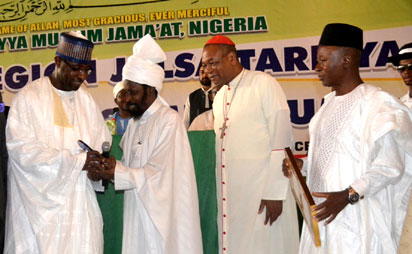
From left, Representative of former Head of State, General Abubakar Salami, Dr. Tanko Yinusa; Amir, Ahmadiyya Muslim Jamaát Nigeria, Dr. Mashhud Adenrele Fashola; Cardinal John Onayikan and Naib Amir, Northern Zone, Dr. Yeqeen Habibu, during the presentation of peace award for General Abubakar Salami, at the 4th Northern Region Jalsa Tarbiyya and 1st National Peace Symposium in Abuja.
By Haroon Balogun
The issue of unity of Muslims in Nigeria came to the fore again last Sunday during the 2015 pre-Ramadan annual conferrernce and lecture, organised by the Jama’atu Nasril Islam (JNI) in Kaduna. Presenting a report on the 2014 Ramadan fasting, the JNI Secretary-General, Dr. Khalid Abubakar Aliyu, lamented what he described as the rise in cases of “uncharitable, excessive and indecorous utterances,” on the part of some preachers during Ramadan lectures, popularly called Tafsir.

From left, Representative of former Head of State, General Abubakar Salami, Dr. Tanko Yinusa; Amir, Ahmadiyya Muslim Jamaát Nigeria, Dr. Mashhud Adenrele Fashola; Cardinal John Onayikan and Naib Amir, Northern Zone, Dr. Yeqeen Habibu, during the presentation of peace award for General Abubakar Salami, at the 4th Northern Region Jalsa Tarbiyya and 1st National Peace Symposium in Abuja.
Chaired by the Sultan of Sokoto, Alhaji Muhammad Sa’ad Abubakar, who also doubles as President-General of both the JNI and the Nigerian Supreme Council for Islamic Affairs, the programme attracted Muslim traditional rulers from across the north, along with prominent Islamic scholars.
“Dangerous Tafsir sessions”
According to Aliyu, during the 2014 Tafsir sessions, “some preachers delved into unnecessary juristic arguments which are categorically clear and in which there is consensus. There were also some scholars whose sessions were insightful and the truth is that if such utterances were to come from non-Muslims, the story would have been different now.
The most dangerous session of Tafsir which has surfaced recently in the public domain is the Shiite Tafsir which is being aired by some radio and television stations. Its negative impact on the established creed of Islamic faith is gradually crawling into the Muslim community.”
One faith, diverse views
It is not unusual to have Muslims belonging to different sects and they tend to follow different schools of thought when it comes to taking certain positions on particular issues. However, irrespective of their sectarian leanings, all Muslims believe that there is only One God and that Muhammad is His Prophet and they all subscribe to the five pillars of Islam.
But over time, the religion has had series of challenges not only in Nigeria but across the world and in the process people have tended to read different interpretations to a number of issues. It is perhaps for this reason, to check the intensity of the divergent views, that the late Premier of the defunct Northern Region, Sir Ahmadu Bello, the Sardauna Sokoto, inaugurated the JNI over 50 years ago, on March 9, 1963, “as the mouthpiece and umbrella body for Muslims and Islamic organisations in Nigeria.”
But certain developments within the nation’s Muslim community in the last three decades show a clear gulf indicating that the religious leaders have apparent irreconciliable views on certain fundamental matters concerning Islam. In 1981, the Maitatsine uprising, reportedly traced to religious extremism, virtually overran Kano and some other parts of the north while disagreements relating to the adoption of the Muslim Shariah legal system resulted in bloodbath in Kaduna in 2000.
And, in recent years, the seemingly irresolvable Boko Haram phenomenon has become as controversial as the identities and objectives of the insurgent group. “The Nigerian situation today has degenerated to such a level that some other people look at Muslims in the face and call them terrorists,” a Muslim cleric, Alhaji Hassan Ibrahim, who is the Sarduana Hayin Banki, told Vanguard in an interview.
According to Ibrahim, the JNI may have indeed failed in its self-imposed task of uniting Muslims and the various Muslim groups in the country. Arguing on the premise that persons or groups claiming to be Muslims engineer some of the religious crises, Ibrahim said that, “the JNI is the umbrella body of all Muslims in Nigeria but today we have more divisions than ever within the Muslim community.
If there was a sense of purpose on the part of the JNI and other Muslim organisations, they should have been able to resolve the problems, after all, the entire thing started on the platform of Islam. Although the insurgents are extremists and they have of course overstepped their bounds but with good guidance and counselling from the Ulama under the leadership of the JNI, they should have been able to curb the violence currently going on.”
The 2015 Ramadan fasting
Subject to confirmation by the Sultanate and other relevant authorities, the 2015 month-long Muslim Ramadan fasting is expected to begin around June 17. Aliyu in his report last Sunday urged the Nigerian Muslim community to be united, relating to the issue of Moon Sighting in the country, “due to the controversies it has generated in the recent past.”
Disclaimer
Comments expressed here do not reflect the opinions of Vanguard newspapers or any employee thereof.