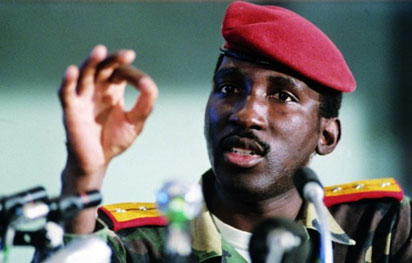
Sankara
When Captain Thomas Sankara was assassinated on October 15, 1987, it was a dark testimony regime he had instituted in former Upper Volta which he changed to “Burkina Faso”, meaning “Fatherland of Upright Men.”
But his countrymen were not so upright as his childhood friend Captain Blaise Campaore conspired with local and external forces to kill him.
Three days before his death, a French journalist had asked Sankara if he ever feared for his life and how much trust he had for Campaore, his second in command and childhood friend. Sankara had given Campaore visible position and power in running one of the world’s poorest countries. Sankara told the reporter that ‘’if Campaore plots against him, there was nothing that could save him or frustrate the plot”.

Sankara
Unknown to Sankara, Campaore was the insider in the conspiracy between France and Cote d’Ivoire to stop his’s four year Socialist-Marxist revolution that was hitting at the root of poverty and underdevelopment in Burkina Faso and West Africa as a whole.
Three days later, gun men busted into his presidential office where he was in a meeting with his aides. The armed men were later found to have been trained in Cote Dvoire from where they moved in to Quagadogou for the operation.
The armed men were later identified to be members of Charles Taylor’s National Patriotic Front of Liberia (NPFL). Sankara tried to ran away but he was caught on the staircase and rained with bullets. That was the end of the Sankara revolution and the eventual 27 year reign of Blaise Campaore who became one of the disastrous examples of leaders in Africa.
Campaore prevented the family of Sankara from taking his body as he was buried along with other loyal solders that tried to fight back. Campaore, the son-in-law of the Felix Houphouet Boigny, then president of Cote d’Iovire were the strongest supporters of Mr. Charles Taylor who invaded Liberia from Nimba country in December 1989.
It is instructive to note that the invasion of Liberia from the border with Cote d’Ivoire came two years after the assassination of Thomas Sankara.
Both Campaore and late Boigny were stoutly opposed to the military mission of West African States (ECOMOG) which was set up in 1991 to put a halt to the barbaric execution of the civil war in Liberia.
The outcome of the Liberian war which lasted for 13 years shifted attention away from Sankara and the infamy of Blaise Campaore. Blaise Campaore met his own waterloo last year when angry protests by the citizens of Burkina Faso forced him to abandon his plan to perpetuate himself in power pressures from the family of Sankara has forced the new helmsman in Ouagadougou to Mr. Michael Kafando to order that the body of Sankara should be exhumed for examination and to be given a befitting burial.
Kafando has also ordered a full investigation into the plot that led to the death of Captain Thomas Sankara who was hailed as Africa’s Che Guevara.
The Sankara Revolution
At 33, Captain Thomas Sankara launched a revolution to transform Burkina Faso. He launched nationalisation and land distribution programmes in the country. He pushed up school enrolment from 6% to 22% and increased the national vaccination programme to 2.5 million. Several health centres were opened while massive construction of road and rail transport were embarked upon. Sankara ordered the planting of 10 million trees to combat drought and desertification in his country. He declared war on corruption by placing himself on less than $500 a month. His ministers were on low pay as well. Low profile was maintained in public life. He strongly opposed foreign aid.
Under Sankara the government also prioritised gender equality, working towards the end of female genital mutilation, forced marriages and polygamy. The tragedy that robbed ‘Africa’s Che’ from his family may also have preserved his place among the stars as Sankara is still much revered across Africa today.
Discontent with the Revolution
Discontent with the revolution set in when he tried to alter the traditional institutions. Sankara stripped traditional chiefs of their rights and privileges. He set up “revolutionary people’s tribunals” to try former public officials charged with political crimes. Opposition parties and unions were banned and media freedoms curtailed. Striking teachers were fired and replaced by young people with no experience.
The people became suspicious of his political philosophy. Sankara was caught off guard when gunmen burst into his office and gunned him down along with 12 aides. His body was unceremoniously dumped in a makeshift grave in the dead of the night, which quickly became a shrine for thousands of people who filed past it to pay their respects. There has been popular feelings that the new regime should give Sankara a decent burial.
Exiled Compaoré, has always denied involvement in the killing, insisting that the “facts are known” and he has “nothing to hide”.
But whatever the outcome of the exhumation, a deeper, more troubling mystery will remain: whether Thomas Sankara’s revolution would have survived.
Fear of Domino effect
Watchers of international politics have argued that Sankara led one of the most creative and radical reforms in Africa from 1983 to 1987. There were fears that the success of his revolution might be followed in the other African countries. Many believed that this led to his early death which France was suspected to have spearheaded using Houphouet Boigny as the arrow head.
In 1985 Sankara said”‘I would like to leave behind me the conviction that if we maintain a certain amount of caution and organization we deserve victory… You cannot carry out fundamental change without a certain amount of madness. In this case, it comes from nonconformity, the courage to turn your back on the old formulas, the courage to invent the future. It took the madmen of yesterday for us to be able to act with extreme clarity today. I want to be one of those madmen. We must dare to invent the future.’
Legacy of an incorruptible man
A major anti-corruption drive began in 1987. The tribunal showed Captain Thomas Sankara to have a salary of only $450 a month and his most valuable possessions to be a car, four bikes, three guitars, a fridge and a broken freezer. He was the world’s poorest president.
Sankara refused to use the air conditioning in his office on the grounds that such luxury was not available to anyone but a handful of Burkinabes.
When asked why he had let it be known that he did not want his portrait hung in public places, as is the norm for other African leaders (and as Blaise Compaoré does now), Sankara said ‘There are seven million Thomas Sankaras’.
Landmarks of Sankara revolution
Feb 1984 Tribute payments to and obligatory labour for the traditional village chiefs are outlawed.
4 Aug 1984 All land and mineral wealth are nationalized. The country’s name is changed from the colonial Upper Volta to Burkina Faso, words from two different local languages meaning ‘Land of the Incorruptible’.
22 Sept 1984 A day of solidarity: men are encouraged to go to market and prepare meals to experience for themselves the conditions faced by women.
Oct 1984 The rural poll tax is abolished.
Nov 1984 ‘Vaccination Commando’. In 15 days 2.5 million children are immunized against meningitis, yellow fever and measles.
3 Dec 1984 Top civil servants and military officers are required to give one month’s pay and other civil servants to give half a month to help fund social development projects.
31 Dec 1984 All domestic rents are suspended for 1985 and a massive public housing construction program begins.
1 Jan 1985 Launch of a campaign to plant 10 million trees to slow the Sahara’s advance.
4 Aug 1985 An all-women parade marks the anniversary of the Revolution.
10 Sep 1985 The mounting hostility of the region’s conservative regimes is revealed at a meeting in Yamoussoukro, Côte d’Ivoire.
Feb-Apr 1986 ‘Alpha Commando’. A literacy campaign in nine indigenous languages involves 35,000 people.
End of 1986 A UN-assisted program brings river blindness under control.
15 Oct 1987 Sankara is assassinated in a coup d’état along with 12 aides.
Disclaimer
Comments expressed here do not reflect the opinions of Vanguard newspapers or any employee thereof.