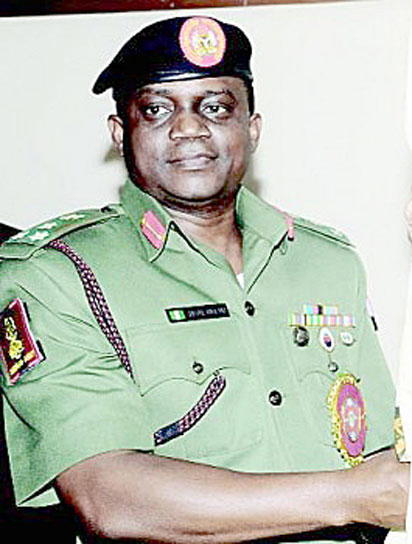
B rigadier-General Johnson Bamidele Olawumi is the Director-General of the National Youth Service Corps (NYSC). He has just clocked one year in office and recently shared his experience about the scheme. You have been the Director-General of NYSC for a year now. What will you consider the major achievements of the Scheme under your watch?
When I came on board, and after a careful study of the NYSC, I came up with my vision for the Scheme and with that vision came a four-point agenda. For me, everything centres on the welfare of corps members and staff. What I consider my biggest achievement is the increased focus that the welfare of corps members now enjoys from the Scheme. I will break this into three categories:
 Before the corps members come in, during their service year, and after they leave us. We started the online mobilisation last year because we found out that in the past we had lost some prospective corps members to accidents on their way to collect their call-up letters. That was one of the main reasons why we started e-mobilisation and online processing and printing of call-up letters.
For me, this is looking out for them even before they become corps members. During the service year, the most critical thing in terms of welfare of corps members is their safety and security, and this starts from when they are in camp. We now have enhanced safety and security of our corps members through increased collaboration with all security agencies.
And I will tell you that in spite of the numerous security challenges that we have had in the country, our orientation camps have been well protected and free of any ugly incident. Outside of camps, we are focused on using technology to quickly reach and assist corps members who might be in danger. Apart from the physical inspectorate mechanism, which we have at the local government level, we have the NYSC mobile apps and social media platforms to monitor and address, in real time, challenges faced by corps members.
For instance, I use Twitter to maintain daily interaction with corps members all over the country. They can reach me and that enables me to quickly respond to their problems. This is aside the fact that I made it mandatory that whenever a corps member is sick or is involved in an accident during the service year, we strictly follow the provision of the NYSC Act by ensuring that all their medical expenses are paid.
For those unfortunate to sustain one form of disability or the other during their service year, we have also inaugurated a programme to ensure that they are not abandoned or forgotten but are assisted to be productively engaged. Before now, all they were entitled to was an insurance payment. But we have introduced the NYSC Hope Alive Programme, graciously launched recently by President Goodluck Jonathan, to give them additional succour and support, and reassure them that they are not forgotten. We have also not forgotten about the welfare of NYSC staff.
What are the major challenges that you have encountered in the last one year and what are your plans to surmount them?
NYSC is an agency that depends almost solely on government subvention. That is a major challenge. We all know that because of competing needs, government cannot do everything, even if it loves to do so. One has to commend the government for sustaining the scheme because a lot of money goes into it. The fact remains that a lot of things need to be done but budgetary allocation to the scheme might not allow us to do them.
So that’s one major challenge for the Scheme. We are however looking at ways to mitigate the shortcomings. One thing we are considering is the need to get the private sector to be more involved in funding the Scheme.
You mentioned your vision and your 4-point Agenda which you have unveiled. Why did you think the Scheme needed a new vision and agenda?
You will recall that there was a time when there was a lot of discussions about the relevance of NYSC. Those questioning the Scheme wanted to be sure that NYSC was still useful, that there was value for the scarce resources spent on it by government, and that the corps members served in safety. I did some research and discussed with a lot of people within and outside NYSC after my appointment to see how to address these concerns.
So I came up with my vision, which is: ‘to increase the impact of the Scheme and expand its value to critical stakeholders.’ The vision was designed to address the observed gaps and challenges. I believe that no one will be talking about the relevance of NYSC or not if they can feel its impact and if the various stakeholders get more value from the Scheme.
I further broke down the vision into a four-point agenda, which is: to improve the service content of the Scheme; to enhance the welfare and safety of corps members and staff; to expand partnership for greater impact, funding and support; and to increase the visibility and relevance of the Scheme.
So, how far have you gone in the implementation of the four-point agenda?

*NYSC members
The four-point agenda has been our road map. And it has helped in keeping us on track, especially in terms of increasing the service content of the Scheme and improving the welfare of corps members. I will give you a few examples.
Now, corps members participate in monthly sanitation exercises across the country, not only for cleaning but more importantly by sensitizing the people on the need for them to come out and clean their surroundings.
Then we came up with another programme tagged Health Initiative for Rural Dwellers. We realised that there are some communities across the country that do not have health facilities. These are remote communities.
We have launched that programme in Kwara State and as we speak, there are five other states in the waiting. We launched the pilot scheme in a place called Igbo Owu in Kwara State.
What we did was that we partnered with the state government and an NGO, Royal Health Foundation. The state government gave us the location and some drugs, the NGO provided ambulance and drugs too and mobilized the community, while NYSC mobilized the manpower such as corps doctors, pharmacists, laboratory scientists and others. The launching was very successful.
You talked about NYSC Hope Alive Programme. Why was it established and what purpose does it serve?
The motivating factor in our establishing the NYSC Hope Alive Programme stems from the fact that when I came into the Scheme most times I read in the media about the plight of corps members who in the course of service yet get permanently disabled. And I felt that there should be a way we can address this. Yes, government has made provision for an insurance cover for anybody who dies or who incurs permanent disability during the course of the service year.
The insurance cover is now N1,000,000. But we have also recognised that this money is not sufficient. We realised that we must give these young men and women something that will give them hope about our country. And one way we could start is to make sure no one who suffers disability in the course of service is abandoned. That was what led to the establishment of the NYSC Hope Alive Programme.
It is a public-private sector driven empowerment programme designed to provide succour to corps members who become disabled during the course of the service year. It has been flagged off. Heritage Bank gave the first beneficiaries N1.5 million each. The governor of Akwa Ibom and Ibeto Group also chipped in. Mr President specifically said the NYSC Hope Alive Progamme is very dear to his heart.
Will the post-service medical treatment include things like prosthetics, wheelchairs and some other things that will make people whole or aid them to function better?
Hopefully it should because we want to make that person to get integrated into the society and we want such a person to see that there is ability even in their disability.
There are people who believe that the Scheme is still running largely on the 1973 template and that the times have changed. Whereas some people are saying it should be scrapped, some people are saying it has outlived its usefulness and it needs to be completely restructured. How may you react?
First, those saying the scheme should be scrapped are far away from reality. When we proposed last year that due to insecurity some corps members should not go to camp, in some states some corps members nearly went out demonstrating. These young men and women look forward to service with lots of interest and passion. That aside, that stipend they get during the service year goes a long way to sustain them for that period.
And you can imagine when there is no such a scheme to cushion them after leaving higher institutions. Another aspect is that if you go to some states in the country, their educational system would collapse if there are no corps members. We have had cases where corps members were made acting vice principals in some schools because there are no teachers.So those saying the Scheme Should be scrapped should look at such situations.
When you say nothing has changed in the scheme, I don’t think that is correct. For example in 1973 when the scheme started, there was no skill acquisition training. But now there is. That is part of the restructuring. We are still thinking of ways we can use the scheme to address present challenges beyond the original challenge of national unity and integration. We are now looking at how we can help with the issue of unemployment. We have been doing that with the SAED programme but we feel with more funding we can still do more.
Disclaimer
Comments expressed here do not reflect the opinions of Vanguard newspapers or any employee thereof.