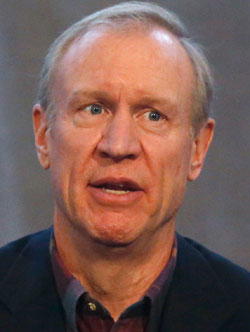
Bruce Rauner
By Uche Onyebadi
YOU may not have heard of a man called Bruce Rauner. Well, there isn’t anything so exceptional about him that he should command international attention. He is the current elected governor of the state of Illinois in the U.S., and he assumed office in January this year. Governor Rauner is a Republican who campaigned on the values of cleaning up the bad governance Illinois has been associated with in past years. He pledged to trim the size of government, save costs and return the state to a state of glory. Voters trusted and rewarded him with victory over the then incumbent and Democrat, Pat Quinn, in a tightly contested election.
Even before he was sworn into office, the people of Illinois began to catch a whiff of the governor-elect’s plan of action.
Budget cutting measures
In a nutshell, Rauner’s lieutenants dropped hints that their boss would embark on root-and-branch budget-cutting measures. One of the things that came onto the would-be governor’s radar was education. In his budget speech later, Governor Rauner cut higher education budget by 32 percent. There was outrage across the state. Higher education

Bruce Rauner
in Illinois had taken a battering over the years. Universities and other educational institutions had been over-taxing themselves to survive. Freezes on new faculty hires were rampant. Retiring professors were hardly replaced. Fees generally went up for in-coming students. And in the midst of this belt-tightening budgetary situation, the governor unleashed his 32 percent cut.
This is the backdrop to the row over the governor’s invitation to be one of the speakers at the commencement (graduation) ceremony by Southern Illinois University in Carbondale, one of the prominent public universities in the state. The invitation was sent out by the university. But, some students in the same university did not think it was appropriate, even commonsensical, for a governor whom they perceive to be manifestly anti-education to be given the opportunity to be a guest at their commencement ceremony. So, one of the students, Emily Neal, came up with a plan to scuttle the governor’s proposed graduation speech. She originated a petition to drop Governor Rauner as one of the commencement speakers. The ceremony will take place in mid-May, just a matter of weeks away. So far, the petition has attracted about 2,000 supporters.
Here is what Emily wrote in her petition: “Rauner’s budget proposal would set SIU back to funding levels comparable to the 1985-86 school year, and potentially cause up to a six per cent increase in tuition. Choosing him as a keynote speaker is a slap in the face to SIU students and faculty who already deal with underfunded programs and facilities. Graduation should celebrate not only the achievements of students as individuals, but the institution of SIU as a whole. How can anyone be expected to celebrate progress when our keynote speaker is someone who only intends to set us back?”
The university’s spokesperson, Rae Goldsmith, explained the invitation this way: “We really believe it’s an important way for the governor to come to southern Illinois to get to see what goes on here and it has the potential to help us build a positive relationship.” It is interesting that a student in the university where Governor Rauner is expected to make his speech is driving this petition to prevent the governor from doing exactly that. It is also interesting that the student has the right of free speech to initiate her petition in a university where she is currently a student, and the school’s authorities cannot stop her exercise of that right granted her by the U.S. constitution. It is even more interesting that in the exercise of her right to freedom of speech, Emily is essentially advocating that another person, the governor, be denied his own freedom of speech.
Therein lies one of the attractions and gray areas in the provision of free speech in the U.S. constitution, and the nature of the U.S. system of government. Emily could have done exactly the same thing if President Obama was the invitee, and she felt that it was inappropriate for him to come and speak at the occasion. I shudder to think of what might happen to a university student in Egypt who goes to tahrir square to promote a petition that President Abdel Fattah el-Sisi should not be allowed to address students of Cairo University. That student’s fate will be no different from that of his or her counterpart who does the same thing in Nigeria, South Africa, Zimbabwe, Ghana, etc.
Nonetheless, the row over Governor Rauner’s invitation to speak at Southern Illinois University’s graduation ceremony puts the freedom of speech on the burner of public debate over what such freedoms actually entail, especially where to draw the line on its limits. Why would Emily’s exercise of her free speech result in the denial of Governor Rauner’s freedom of speech, if her petition becomes such an effective weapon that the university decides to cancel the invitation to the governor? If the governor’s invitation stands and he actually speaks at the occasion, does that imply that his freedom of speech is more important to the university than that of Emily? Would it be a fair situation for Emily to exercise her freedom of speech while the university goes ahead to allow the governor to exercise the same freedom, since no one’s freedom of speech is more important than that of another?
If the idea of freedom of speech is to allow individuals to exercise it unimpeded, then Emily has the right to mount her campaign as much as the governor has the right to speak at a forum where he has been legitimately invited as a keynote speaker. The proposition that in the process of wielding his budget axe and chopping off whatever he fancies, Governor Bruce Rauner will do huge damage to higher education in the State of Illinois has merit. But, that is another matter altogether. What do you think?
Disclaimer
Comments expressed here do not reflect the opinions of Vanguard newspapers or any employee thereof.