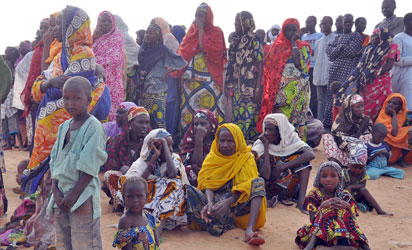
Women and children fleeing from Boko Haram attacks sit at Kabalewa Refugees Camp, Diffa in Niger Republic, on March 13, 2015. Governor of northeastern Nigerian Borno State Kashim Shettima recently visited refugee camps where Nigerians fleeing from Boko Haram Islamists attacks are sheltered in Diffa province of Niger Republic. More than 13,000 people have been killed and some 1.5 million made homeless in the Boko Haram conflict since 2009, while recent cross-border attacks from Boko Haram bases in Nigeria on neighbouring countries have increased security fears. AFP PHOTO
By AbdulSalam Muhammad, Kano
Until lately, little or no attention was paid to the plight of thousands of kids orphaned by six years of debilitating insurgency in the North-East of Nigeria. This explains why news of the Kano State Government’s decision to adopt 100 kids from the front line states last Tuesday made headlines around the world.

Women and children fleeing from Boko Haram attacks sit at Kabalewa Refugees Camp, Diffa in Niger Republic, on March 13, 2015. File Photo
The young lads, aged between three,four, five and six, were victims of insurgency that had torn family set-ups to shreds. Most of the kids are too young to remember their names, that of their parents and where they hail from. None of them could recall what led to their present fate.
Interestingly, their 750-kilometre journey from Maiduguri, in the North East to Kano in the North West where they were to begin a new life in a home far away from home was shrouded in top secrecy to ensure the safety of the already vulnerable children.
Although Kano had its own fair share of security challenges, but it was nothing compared to what has become the order of the day in the North East states of Borno, Adamawa and Yobe. While in Kano, they were treated to a brief colourful ceremony attended by a select audience in a highly but fortified government building.
Formal education
It was during the ceremony that the Kano State Government announced scholarship to each of the 100 kids who were to commence their formal education at a government-owned special boarding primary school up to the university. Explaining why his outgoing administration took the decision, Kano State Governor, Rabiu Musa Kwanwaso, said that “my administration was moved by the condition of the internally displaced children leading it to design the school to accommodate 100 pupils from the fronline states of Adamawa, Borno, and Yobe.”
Kwankwaso stated that “the special intervention programme is aimed at taking up full responsibilities of 100 children who are between ages of five and six whose parents are either dead,displaced or lost as a result of the insurgency”.
The Kano Governor further said that “under the boarding school arrangement, the state government will take care of the children’s education, training, upbringing, feeding, clothing, security, health care and accommodation”.
Kwankwaso noted that the state government would continue to look after the children until they complete their education, adding that if the security situation in the frontline states improves and it is certified safe for them to return home, they will go home.
Kwankwaso revealed that the plight of the children deprived of parental care and concerns as a result of the security challenges in the affected states was brought to his attention by the local National Emergency Management Agency, NEMA.
He revealed that the state Commissioner of Health has been directed to appraise the medical condition of each pupil with the view of identifying those that need special medical care. Kwankwaso advised the kids to pay attention to moral and academic excellence and should not allow their immediate past to weigh them down.
In separate remarks, three of the kids, Ibrahim Maina, Saidu Ishaku, and Muhammad Idris expressed joy for the love shown to them by Kano State Government, as they stressed that “this is life in a home faraway from home”.
Muhammad Idris, six years, in an interview explained thus: “I am number four in a family of six but I cannot tell the whereabouts of my father, my mum and others”. He added: “I hope they would join us one day here to enjoy this same privileges offered by the Kano Government”.
In an emotion-laden speech, Borno State Commissioner for Women Affairs, Hajiya Fanta Shehu, who played a key role in the handing over process said: “Out of the 100 orphans, 73 were selected from the motherless home, while 27 were from persons with disabilities.”
Security advice
Hajiya Shehu disclosed that under the arrangement, “Kano State Government had agreed to train the kids in special schools from primary to tertiary levels”.
Hajiya Shehu added thus: “On our part, we have provided the beneficiaries with books and other relevant materials to augment what their new host has provided.”
In line with security advice, the children are for now shielded from the public glare as the location of the school is shrouded in secrecy, and what happes in and around them would remain exclusive to both the officials of the Kano state Government and their Borno counterpart.
On his part, the Borno State Governor, Kashim Shettima, said: “Borno State would forever remain grateful for the gesture, and this singular gesture has given not only signs of relief to guardians, caregivers of the orphans but also sense of belonging to the people of Borno”. A top politician in Kano, Comrade Saidu Bello, said that the philanthropic gesture by the Kano State government would certainly open the door for others to emulate, adding that “in a every aspect of life, a noble example always comes from one man and others would follow suit.”
Disclaimer
Comments expressed here do not reflect the opinions of Vanguard newspapers or any employee thereof.