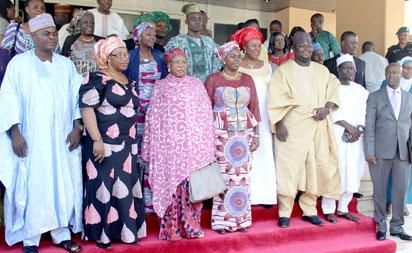
BY JOSEPHINE AGBONKHESE, who was in New York, USA.
Effective and accelerated implementation of the Beijing Declaration Platform for Action will be essential to the post-2015 sustainable development agenda expected to sum up all major issues of global progress for the next 15 years. United Nations, UN, Member States came to this conclusion at the UN headquarters in New York, USA, while adopting a political declaration during the just-concluded 59th Session on the Commission on the Status on Women, CSW59, which marked the 20th anniversary of the 1995 Beijing World Conference on Women.
The post-2015 development agenda which will succeed the expiring Millennium Development Goals, MDGs, is expected to be adopted by Heads of States and governments from every part of the world at a historic UN summit in September 2015.
Presently, a wide range of activities are being undertaken by UN Member States, the UN system, civil society organizations, academia, research institutions and others on identifying the shape and priorities of the post-2015 development agenda.
Already, high-level panel reports on the post-2015 agenda reveal that one of its utmost priorities is ensuring that no person, regardless of gender amongst others, is denied basic economic opportunities and human rights.
CSW59
The 10-day session which reviewed progress made on the Beijing Platform for Action as well as drawbacks in the last 20 years, had over 11,000 participants comprising delegates, ambassadors, experts and activists from around the world, a figure attributed to “the well-documented attempts to scale back women’s rights worldwide in the last year, including fundamentalist activities in the Middle East and Africa, the kidnapping of 270 Nigerian schoolgirls by Boko Haram, and a growing culture of hostility and harassment of women”, in the words of Soon-Young Yoon, UN Representative of the International Alliance of Women and Chair of the NGO Committee on the Status of Women.
Majority of the participants affirmed that progress has indeed been slow for women and girls worldwide, as, in 1995 when they had gathered for the Fourth World Conference in Beijing, China, hopes were high, following the adoption of the Beijing Declaration and Platform for Action, a 12-point document, by 189 UN Member States, including Nigeria, who pledged to improve the status of women ‘round-about’, in line with the stipulated Platform for Action.
That 12-point document, known today as the most progressive blueprint ever for advancing women’s rights and achieving gender equity, highlights concerns ranging from women and the environment to power and decision-making, girl-child, economy, poverty, violence, human rights, education, health, media, armed conflict and institutional mechanisms for advancement of women.
However, 20 years forward, none of those countries has achieved the envisioned ‘round-about’ gender equilibrium as statistics show that women still earn less than their male counterpart in most parts of the world, one-third suffer physical or sexual violence in their lifetime, gaps in reproductive rights and health care continue to shoot up with 800 women dying daily at childbirth worldwide.
This is with analysts estimating that it will take 81 years to achieve gender parity in economic participation and 50 years to reach parity in parliamentary representation.
Political declaration: Ngcuka calls for action
Pointing out that the disappointing gap between existing commitments to gender equity and their implementation points to a collective failure of leadership, Phumzile Mlambo-Ngcuka, UN Under-Secretary-General and Executive Director, UN Women, the global intergovernmental body exclusively dedicated to the promotion of gender equality and the empowerment of women, stressed that to prevent the forecast already made by analysts judging by current trends, “UN Member States must commence work immediately on the adopted Beijing 20th anniversary political declaration made at CSW59.”
The adopted political declaration, which contained actions towards achieving gender equality and women’s empowerment by 2030, had state parties pledging to take concrete action and efforts through six specific strategies.
The strategies are: do more to strengthen implementation of laws; bolster institutions vital to women’s empowerment; transform discriminatory norms and stereotypes; close resource gaps; boost accountability; and enhance capacities and data to track progress.
Ngcuka said: “The declaration says we will not continue to let down the women and girls of the world. It is time to step up commitment and action. You must all put to work our commitments to this political declaration immediately, and more intensely, so that in September we can hear about your ‘stepped up’ commitments.
“These must be building blocks to ending gender inequality as we implement the Sustainable Development Goals. We will need to see solid, measurable progress by 2020, and make sure that 2030 is the expiry date for gender inequality.”
Nigerian CSOs
The 59th session’s original programme was complemented by nearly 200 side events and 400 parallel events by Civil Society Organisations, CSOs, from different parts of the world, including Nigeria.
Among Nigerian CSOs that staged power-packed side events was the Women Advocates Research and Documentation Centre, WARDC, whose event, tagged Human Security, Maternal Health & Insurgency in Nigeria, was supported by the Embassy of the Kingdom of Netherlands. It drew participants from diverse nations.
Another is Partnership for Justice which, through a published shadow report on Beijing+20, presented a human rights situation report on Nigeria in coalition with five other CSOs; and the Women’s Consortium of Nigeria, whose event x-rayed the metamorphosis of the female gender from girlhood to womanhood.
Disclaimer
Comments expressed here do not reflect the opinions of Vanguard newspapers or any employee thereof.