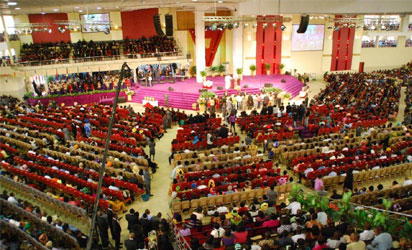
A cross section of worshippers at the closing service of Kingdom Life Conference.
By Ugoji Egbujo
‘Shoki’ has invaded the church and nearly every dance step is infected including choir members’. But Shoki, like skelewu before it, is perhaps harmless. Materialism, opportunism and vain glory have taken front pews and chased spirituality to the back benches, and that is trouble. Pre-occupation with prosperity and instantaneous gratifications and miracles has left no air for the Nigerian church to breathe.
The early missionaries left the relative comfort of Europe to evangelize men in the jungle who spoke languages they did not understand. Some say that the real motive of the missionaries was to further the imperialistic aims of the colonialists but even a cursory review of the works of those missionaries would reveal enormous personal sacrifice in what they did.
With painstaking diligence they waded through the forests breaking cultural barriers to win souls to their faith. The missionaries may have been insanely selfless but they were wise men. Because in giving up themselves and earthly cares they became in a sense transcendental beings. Because they extricated themselves from the rivalries and competitions and acquisitions of this world in furtherance of superior heavenly calling, they rendered themselves, to a great extent, immune to envy and greed and perhaps pride.
They understood that their rewards would come but not from the jungle, and not from the pauperized souls they had come to salvage, and not in the current earthly existence which they had surrendered to mosquitoes and tse tse flies. They trusted God and trusted that He alone would reward them. They didn’t look forward to material rewards and they didn’t seek instant gratification.
They were heavenly minded and so they stored up their wealth where their heart was. For the hope of eternity in the future they gave up their present. So how has the Nigerian church they birthed become so unlike them ?
The post colonial church at some point lost zeal and became cold. The revival of the late 60s and 70s and the advent of Pentecostalism spurred the Church and took it to new heights. Salvation and love were the focus of the church then. The church grew in leaps and bounds but since the 90s the growth in structures and numbers has been devoid of spirituality. The Nigerian society is now excessively religious but morally bankrupt. Part of the problem the church faces is that the degree of societal moral degeneration is so grave that the work needed to reform minds is enormous. Faced with such an enormous problem and zealous to make an impact , but lacking in spirituality , diligence and maturity the church, it would appear, lowered the bars. The church embraced worldly estimations of success rather than heavenly metrics.
So spirituality suffered while prosperity took pride of place. Charity became an enterprise for self or group aggrandizement and vainglory because superficiality dominated both society and church. People bragged not about learning but about properties and questionable wealth while the church chased structural expansion and left true discipleship and christian mentoring to suffer.
Titles proliferated in the society and everyone sought to be a boss or a chief and the scale of collective delusion became pitiable. And churches mushroomed as every brother saw an overseer in himself so he can be called ‘Daddy’ while he refers to all in his congregation as his ‘children’. And mere catechists wouldn’t have to wait to become bishops. That lure to be ‘free’ that makes meaningful long term apprenticeship difficult has afflicted the church too. So Lagos is filled with half baked artisans and a multitude of general overseers some of whom are mere baby Christians. And pastors put themselves beyond censure and beyond counsel like Obas.
And the only sense you get is that many are working for themselves more than they are working for the Lord. Sermons are drained of pungency so that rich and powerful are not embarrassed.
They have to be retained. Churches foist on themselves financial targets they exploit members to meet. And the church in furtherance of materialism embraces commercialism and exhibits the air of Coca cola company rather than the humanity of Red Cross. While one may understand how “shoki” and “skelewu” have come to affect every dance step during praise and worship now, it rankles to see pastors move around with lorry loads of policemen ostensibly for protection and perhaps as sign of some “arrival”.
The church literally bubbles on a sow and reap mentality that is so insistent on instantaneous gratification that a particular denomination couldn’t resist the temptation of the name – “Now Now Miracle Church”. I will come to miracles later. But miracles properly understood cannot substitute careful meticulous planning and deliberation and diligence and hardwork and scholarship.
A clear understanding of the Christian philosophy is needed for a good Christian race. Many Christians are often heard saying “ I am not a citizen of this world”. But in a lot of cases they do not understand the real meaning of that position. Like the society the church lives on jargons and clichés and vacuous mantras. The sin is not in reeling out these phrases but in the general indifference towards their proper understanding. A citizen of heaven would understand that earthly existence is ephemeral and that all focus must be on life in eternity. And while here on earth every ounce of energy must be spent on accumulating heavenly treasures. That can only be achieved by obeying God. A materialistic church is a shortsighted church
I do not intend to be condemnatory or judge-mental, for I cannot stand up to the standards I profess. I am not worthy to dwell on the sinfulness of individuals even if they are pastors for I am experientially acquainted with the daunting moral challenges of Christian living in Nigeria. It is however my belief that a change in attitudes and inclinations and values by the larger Christian body will do individual Christians so much good and help restore the society. A reset of values in the church will help the society in no small measure. Such a reset is by no means easy but is achievable if the church embraces wholeheartedly the role of a change agent. And that can only be achieved if the church is heavenly minded.
Obscene displays of wealth and shameless exhibitionism have all lost their vulgarity in this new accommodating church . What can the church then teach the society?
The church should be the salt of the world, so the Bible says. The salt was , in the days, used as a preservative. So in that sense the church should function to save the world from decay. But to save the world the church must be in contact with the world while being different from the world. Its unfortunate that Nigerian society has possessed the Nigerian church. The church struggles to make a difference in a land of widespread rot where a difference could be made by doing pretty little. The church is not failing because the church is not trying but the church is failing because the church has got its priorities wrong. And the church includes the congregations of the orthodox and the Pentecostals and all the other shades.
For Christianity to make any sense it must emphasize life after death. That is why Christ died. Pastors and members do not think about death sufficiently . And when they do they treat it with the disregard usually reserved for something that is too remote , too uncertain.
Consider the theological arguments about the existence of God. Atheists will argue that the problem of evil in the world is conclusive evidence of non existence of an omnipotent, omniscient and morally perfect God that Judeo Christian thought espouses. And all arguments by christian philosophers to support the existence of God inspite of monumental natural evil and widespread moral evil are premised on the ephemerality of our worldly existence and the promise of blissful life in eternity for the triumphant.
So you have to wonder why the church in Nigeria is so preoccupied with life on earth and has consequently elevated prosperous life to an enviable ideal. Jesus never promised every one life of opulence. You walk into the church and you immediately get the sense that one of the reasons people go to church is to acquire wealth. And I am as guilty as others. The pastors do a lot of hard work I must confess but the decay of societal values has been allowed affect the church.
The church has in trying to focus on the hopelessness and poverty of the present lost its primary focus. And its not the Nigerian church alone but the Nigerian church has taken materialism to a new level. Prayers are routinely offered to the effect that people will buy cars and have mansions and swim in wealth and not just to escape poverty and squalor . There is always this reference to becoming “ somebody” that literally suggests that being of low means is a curse. And many in the church have jobs that are good and clean but which will never afford them mansions and may always leave them as “nobody”s.
And these prayers , rather than extol spirituality, extol worldly estimations and collections. So the poor is a “ nobody”, cursed, and the rich is a “somebody”, blessed. If Christians always had death on their minds they will think less of earthly acquisitions. Crass materialism and consequent lack of contentment that rules the Nigerian polity also rules the Nigerian church . And churches now build schools the poor cannot afford. And defend such policy with enthusiasm.
The lives of Pastor Enoch Adeboye and Martin Luther reveal one secret, that the impactful Christian is one who has forsaken the world and is acutely heavenly minded. He trusts in God yet works and studies diligently. He stores up his wealth in heaven. Little wonder Pope Francis has inspired even non Christians.
We need not cut corners for God, just do your diligent bit and leave the rest. The Nigerian church must refocus and seek first the kingdom of God.
Disclaimer
Comments expressed here do not reflect the opinions of Vanguard newspapers or any employee thereof.