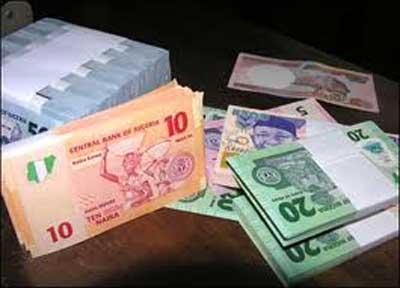
naira sign
By Henry Boyo
The Nigerian Stock Exchange was founded in 1960 to provide a platform for buying and selling of shares of listed public companies. Consequently, the size and vibrancy of domestic stock markets generally provide a bird’s eye view of the degree of confidence and scope of activities in an economy.

The forced consolidation of banks in 2005, increased the market value of shares by over 100% from $14bn in 2004 to over $32bn by 2006. Nonetheless, the obnoxious practices of insider and margin trading in a boisterous speculative market, eventually spurred capitalization beyond $80bn (N13.4Tn) in 2007.
However, the underlying unethical practices in the banking consolidation exercise and the selective covert operations of sponsored market makers became unexpectedly exposed by the international financial crisis of 2008 which led to the stock market shedding over half of its value to close below $34bn (N5.6Tn) by 2009. Sadly, the deflation in stock values resulted in extremely stressful consequences for everyone who had adopted the equities market as a safe financial refuge.
Nonetheless, the market never fully recovered until it was again lifted beyond N8Tn ($56bn) in 2010 with the listing of Dangote’s heavy investments, particularly, in the cement industrial subsector.
Former CBN Governor, Lamido Sanusi’s regulatory reforms, especially in the area of risk management, as well as the various internal reforms embarked upon by both the Securities and Exchange Commission and the Nigerian Stock Exchange sustained relative stability and confidence in the capital market and gradually pushed average market capitalisation beyond N12Tn ($72bn) until crude oil prices tumbled rapidly within the last six months to fan speculative embers which burned off almost a quarter of value to bring capitalization below N10tn by March 2015.
Ironically, however, the nominal N10Tn present market capitalization is not even a true reflection of the actual fall in value of equities, as the listed values camouflage the devasting impact of Naira devaluation; for instance, the 2014 1st quarter average market capitalization of about N12.5Tn was equal to about $75bn, when the Naira exchanged for less than N160=$1.
Ironically, however, even the N2.5Tn reduction in stock value in one year, is not also truly reflective of the real actual loss in market capitalization. Indeed, twelve months ago, the equity value of over N12.5Tn was valued at about $78b when the Naira exchanged for N160=$1. However, the current N10Tn market capitalization is barely $50b at current exchange rate of about N200=$1.
Instructively, if the Naira had remained stable at the old rate of N160=$1, the current market capitalization of N10Tn would command the higher value of about $60bn rather than $50bn with the reduced Naira exchange rate of N200=$1. Thus, the stock market lost about $30b from the speculative run instigated by falling crude prices and the double devaluation of the Naira between December 2014 and March 2015.
Similarly, the total market value of bonds (government debts) was over N4.25Tn or ($25.5bn) just a year ago, when Naira exchanged for about N160=$1. Today, regrettably, the same Bond value of N4.25Tn will barely command the dollar equivalent of about $21bn with N200=$1 exchange rate. Similarly, your investment in stocks would inevitably, lose over 20% of its purchasing value against the dollar equivalent barely 12 months ago because of Naira devaluation.
In effect, it is as if someone brazenly picked your pocket while you watched helplessly! Infact, if your share certificates served as collateral for any transaction, your bankers or creditors, most certainly, would already be making repeated calls for you to augment the value of your collateral or in the alternative, you may be forced to liquidate your debt and or lose your collateral.
Either way, these are trying times for all Nigerian income earners and stock market patrons, as the doors to distress and inevitable deepening poverty open wider and wider with a sliding Naira, which will in turn invariably instigate inflation beyond 10% to further reduce the real purchasing value of the N10Tn present stock market capitalization below $50bn.
Instructively, an annual inflation rate of 10%, means that the present market capitalization will additionally also lose about N1Tn ($5bn) of its domestic purchasing value every year. Thus, unless average annual dividends from equities exceed 10% annually, your investment in the stock market may ultimately be gradually whittled away to make your once valuable share certificate as worthless as a mere piece of paper.
Incidentally, the earliest stocks listed in the exchange were 50 kobo shares. For example, the 50 kobo UAC share was the equivalent of over $0.70 (70 US cents) at the time of issue about 40 years ago. However, the current market price of N36 for UAC PLC shares is barely equivalent to US $0.18 (18 US cents!). Nevertheless, even if the price remained at N36 per share, if the Naira further declines to say N300=$1 because of surplus naira, the real value of this share would fall below 12 US cents.
The above narrative is indicative of the plight of investors under the present unstable and hazy economic environment. Indeed, if in spite of an annual average inflation rate of 10%, the Naira further crashes because of the ever present burden of surplus Naira chasing dollars rationed from CBN, the dollar exchange rate could rise to N300 or above against the Naira, such that another 50% may be rubbed off the dollar value of market capitalization.
This is not a false cry of wolf, several countries who could not manage the same eternal burden of surplus cash have travelled this path; indeed Ghana, our sister nation in ECOWAS suffered a steady decline from one Cedi equals one dollar to the present 35,000 Cedis (or 3.5 New Ghana Cedis after redenomination) to the dollar.
Incidentally, in spite of media reports of increasing oil revenue and alleged better economic management, the Cedi lost almost 40% of its purchasing value against the dollar in the last 12 months; thus unless, we arrest the root cause of surplus cash , the Naira will inevitably travel the same path to challenge the virtue and economic significance of savings. Ultimately, since investments depend on availability of savings, the rate of investments will invariably also drop in response to the reduced level of savings.
Thus, the adverse impact of speculation, inflation, and unyielding Naira depreciation will ultimately strangle and reduce the enthusiasm for fresh investments, so that the flow of new equity into market will also be reduced, while the already listed existing shares may attract little interest from a suspicious and apprehensive public. In this event, the economy will unravel and deepen poverty nationwide.
SAVE THE NAIRA, SAVE NIGERIANS
Disclaimer
Comments expressed here do not reflect the opinions of Vanguard newspapers or any employee thereof.