By Olasunkanmi Akoni
CONTROVERSY has continued to trail water supply as organized Labour had condemned what it called planned privatization of water supply by the Lagos State Government, threatening industrial action among others to force the state government to abandon its plan.
In a swift reaction, the Managing Director of Lagos Water Corporation, LWC, Engr. Shayo Holloway, debunked the claim by the union, saying the state government had never at any time considered the sale or divestment of any LWC water assets. On the contrary, the LWC Water Law of 2004 only seeks to “partner” with the private sector for accelerated development of water infrastructure to meet the state’s current water demand, which presently stands at 540 Million Gallons per Day (MGD) for a population of over 21 million.
How it started
Potable water supply in Lagos started in 1910 with Iju Waterworks, with capacity of 2.42mgd and 28′ trunk main “A” was commissioned in1915 to serve Lagos Island (Old Lagos). Iju was later upgraded to 6 mgd with trunk main “B”, and 24′ to serve Lagos Island, Apapa and Ebutte-Metta. Further expansion of Iju works in 1954 to 11mgd with third trunk main “C”, and 42′ constructed in 1962 expanding coverage to residential/industrial areas of Ikeja, Ikorodu Road via Iddo and east of the metropolis.
 Iju waterworks was modernized in1982 to 45mgd to boost pressure in the existing mains with additional 10 mini-waterworks (Capacity 24.6mgd). Isashi waterworks was commissioned in 1977 to serve west of the metropolis–Isashi, Satellite Town and FESTAC town.
Later, Adiyan water works, Phase 1, was constructed and commissioned in 1992 under the Lagos Water Supply Expansion Project with 80km trunk mains, 284km Secondary trunk mains, 1600km tertiary mains and provision of 88,200 property connections.
Labour’s angst
The Labour Union, under the auspices of Amalgamated Union of Public Corporations, Civil Service Technical and Recreational Services Employees, AUPCTRE, had this week, in a statement by its President, Adelegan Solomon, called on well meaning citizens of the state to rise up against the plan to privatize water supply in the state.
“We condemn in strong terms the intention of Lagos State Government to go ahead with the planned privatization or commercialization of Lagos Water which in turn will further pauperize the down trodden people of Lagos. The union wishes to call on all well meaning Lagosians, in particular and Nigerians in general to join and support the union in this noble struggle,” the worker said.
11 million Lagosians don’t have potable water
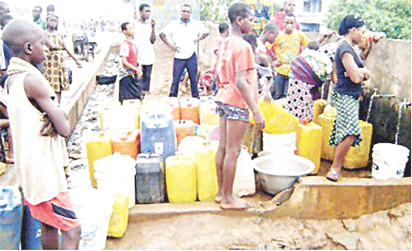
According to the World Health Organisation/UNESCO, 66 million Nigerians do not have access to potable water; premature death from water-related diseases cost the country $2.5billion, while $191 million was spent on healthcare for diarrhoea alone in 2012. It was gathered that the total available water assets in the state, even if run at 100 percent efficiency, stands at 210mgd, leaving a shortfall or deficit of 330mgd. Hence, only 9 million of the 20 million will get water, while 11 million will be without!. The current shortfall is characterized by the proliferation of boreholes all over the state, with its attendant environmental and health hazards.
It is projected that by year 2020, the population of Lagos State will be about 29 million, with a water demand of 733mgd, making Lagos the third largest mega city after Beijing and Mumbai. The studies have also indicated that if the proliferation of boreholes is not promptly addressed, Lagos runs the risk of saline water (salt water) from the Atlantic Ocean percolating inwards to pollute the aquifers (ground water). This will make all boreholes draw salt water.
According to LWC, this phenomenon is already happening in boreholes along Lekki and Victoria Island because majority of the domestic boreholes draw water from shallow unconfined aquifers, which are prone to pollution with attendant health hazards. Confined aquifers, which are protected from such pollution, run as deep as 200 meters and more.
AUPCTRE’s claims
The union in its claim, lamented that today, the World Bank is aggressively promoting private water contracts to governments through “Public Private Partnership, PPPs,” adding: “The experience of the past 30 years shows that PPPs in the water sector has failed all segments of the society. Look at cities that have decided to take back from public hands: In the North, you have Paris, Berlin, Budapest, Atlanta; Buenos Aires in Argentina; Bogota in Colombia and on our continent: Amman, Bamako, Rabat, Tanger, Johannesburg, Dares-Salaam. Jakarta in Indonesia will be next.
“In Nigeria, Lagos is among the many cities in the global South where investment in water supplies is desperately needed. There is no consensus on where the answer lies- in private management, public sector or a combination of both.” The union posited that the answer still lies in public ownership of water in view of its importance.
“As we speak, more than 80 percent of Lagos piped water supply are thought to be stolen; only five percent of people receive it in their houses, taps are often dry, sanitation is non-existent in most of the metropolis and the hospitals are full of people suffering from diarrhoea and other water-related diseases. “But we won’t stop there, we will continue our campaign to ensure that all levels of government deliver on their commitments and their obligations to all Nigerians, to implement the human right to water and sanitation, to invest our common resources in a transparent and corrupt free manner,” it maintained.
LWC insists on PPP for water supply/Lagos Master Plan
However, Holloway said to address the current water demand and meet the projection of the near future, LWC developed a Water Master plan to take the state from its current 210mgd to 745mgd by 2020, through the development of additional large water schemes taking raw water from Rivers and Lagoons for treatment into potable water.
He disclosed that the estimated cost is projected at $3.5billion. “This is an investment which the state government cannot solely undertake as this will take the state government two and a half years to fund it with every Naira income going into the water sector only! With other equally demanding sectors (health, education, security, social services, among others), no state can undertake this financial burden on its own.
“We have commenced the implementation of the Master Plan with the on-going construction of Adiyan Phase 2, which will give us additional 70mgd. It will be completed in 2016. It is noteworthy that this is coming 23 years after Adiyan Phase 1 due to the huge investment required. In addition to this, the state government completed the Otta-Ikosi water works this year, ready for commissioning soon.”
Holloway continued: “ Consequently, in view of the growing population, the state thus seeks to partner with the private sector, to develop existing water assets with private capital to make water available to all. Such investments typically are recovered over a negotiated concession period over several years in order to make water tariff affordable to the public. Concessions usually range from about 25 to 30 years, depending on the size of investment, and financial model.
“Through cross-subsidization, the vulnerable segment of the society is protected as the more affluent pay more for water use. A win-win situation whereby water of good quality and regularity is made available to all.” However, superintending over such transactions with LWC, are; The Lagos State Public Procurement Agency; Office of PPP, Lagos Water Regulatory Agency and Lagos State Ministry of Justice to ensure due diligence, transparency and fairness both to the investor and the public.
Holloway concluded, “The management of Lagos Water Corporation unequivocally reiterates that the state government is not divesting or selling off water assets. On the contrary, it is a strategy to grow our existing water assets to make water available to all while LWC remains a holding company, with LWC staff managing the various PPP contracts thereof.’’
Disclaimer
Comments expressed here do not reflect the opinions of Vanguard newspapers or any employee thereof.