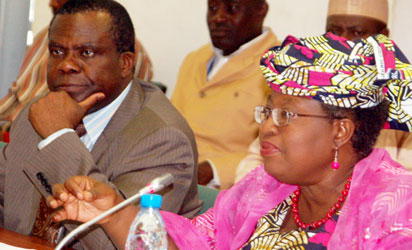
From left, Director General, Budget Office of the Federation, Dr. Bright Okogu , Minister of Finance, Dr. Ngozi Okonjo-Iweala and Accountant General of Federation Mr Joseph Otunla addressing House of Representatives Committee on Appropriation on Budget Performance, at the National Assembly, in Abuja. Photo by Gbemiga Olamikan.
By Joesf Omorotionmwan
AT creation, God blessed Nigeria. All the necessities of life, He gave to us freely and in abundance – the precious air we breathe; the water we drink; and the expanse of fertile land – were just there. Where the terrain was difficult, He tucked underneath the earth, the wherewithal for its development.
This explains why, in the beginning, agriculture formed the mainstay of Nigeria’s economy. Before the advent of the oil boom of the 1970s, the nation’s economy was largely dependent on revenue from this sector.
We recollect, with nostalgia, that Nigeria’s palm oil seedling was adjudged the best the world-over and that was when Malaysia and other countries came to collect the seedlings as the nucleus for their own production. In whichever direction we turned, we were blessed – the groundnut pyramid of the North; the cocoa, rubber and timber of the West; and the palm produce of the East – all of which have today gone virtually into extinction. Nigeria has never had any reason to be broke.
Then came the oil regime, which was supposed to bring greater prosperity and enhanced economic boom; but which has ended up spelling doom for us. As it were, this was the opportunity to abandon our original pursuits in agriculture and we then put all our eggs in a single basket – the oil basket.
In the new frontier, we met easy money. Things became so rosy to the extent that money was not our problem but how to spend it. We quickly imbibed the habit of throwing money around the world. In perspective, one is reminded of a quick sequence: God made man; man made money and money made man mad.
And this is the point at which we have been fixated for some decades now. This point has since become the natural habitat of everything evil – laziness, stealing, corruption, unemployment, growth and development retardation, crime and criminality; and so on. That’s where we have found ourselves, no thanks to the discovery of oil.
In the process, the system has thrown up a few fat cows, who besides being richer then the country; are also intent on continuously bullying the rest of us with their part of the loot from our common wealth.
Contrary to natural expectation, Nigeria is today skint at every bend. On Wednesday, 11 March 2015, an international rating agency, Standard & Poor’s, warned that Nigeria’s economy was in “clear and present danger”.
What makes the situation more confounding is that in the face of this damning report, the National Bureau of Statistics, NBS, also revealed that “On annual basis, the total exports of Nigeria stood at N17.204 trillion at the end of 2014, representing a rise of N2.959 billion or 20.8% over the level of 2013”, even when the nation’s budgetary outlay for 2014 was less than N5 trillion.
Where will the impending fight against poverty begin? We earn so much money and yet we are perpetually broke. This is perhaps another good case of a man who lives inside water but has no water to drink. This is where corruption and other associated evils have led us. It is a sad affair.
The presidential candidate of the All Progressives Congress, APC, Alhaji Muhammadu Buhari releases the first salvo by asserting that if elected, he was not going to spend time looking at the misdeeds of past leaders. Rather, he would wage the war against corruption with effect from 29 May 2015.
This is perhaps in accord with modern practice – that leaders must be forward and not backward looking. And coming from a man who has been hounded, harassed and abused over his draconian past; and who has vowed publicly that he is a “born again democrat”, his current statement could be taken for a goodwill message.
Beyond that point, Buhari should know that the new change must come into play. The task of deciding what happens to the stolen or misappropriated trillions is collectively for Nigerians.
The new change reminds us that there are institutions on ground that decide such questions. In essence, if we must move forward, there is hardly a way we can completely divorce the future from the present and the past.
We see a holistic fight in which the Executive branch of government, the legislature, the judiciary, the political parties and the citizenry will all come into the equation to play their little roles that ultimately form the whole. Democracy removes it all from the purview of a one-man-show.
The concentration of too much power in the hands of a single individual or in a single institution is a direct invitation to tyranny. The journey for our return to a healthy economic state must start in earnest. All that is required is the discipline and the political will to push through.
For one thing, the diversification of our economy must not be in abstraction, it must be real. While not discarding the oil sector totally, we must quickly beat a retreat to agriculture. The land is still there; let’s till it!
For another, the attempt to separate the office of the Accountant-General of the Federation from that of the Accountant-General of the Federal Government must be fast-tracked. For too long, we left our fate in the hands of the Federal Government who used the Federation Account and the excess crude account as veritable sources of slush funds of every description, including electioneering campaigns and other sundries.
Again, the War against Indiscipline and Corruption must be quickly re-invigorated. We must go to equity in clean hands. For example, there is a subsisting Supreme Court order, which declared the Excess Crude Account illegal. Close that account and transfer its balance to the Federation Account.
Luckily, the good Lord who created us and endowed us bountifully with the good things of life is still very much around. We really have no reason to be poor. With a bit of honesty and diligence, we can turn this economy around. Yes, we can!
Disclaimer
Comments expressed here do not reflect the opinions of Vanguard newspapers or any employee thereof.