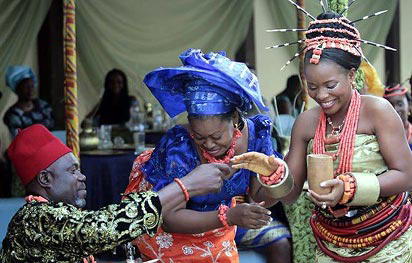
*The fanfare of `a hole in the pocket’
By Francis Ewherido
Erecting a building starts with planning, design, construction, financing and continues until the structure is ready for occupation. Thereafter, the building should be occupied and maintained. If not, it becomes dilapidated and may collapse over time. Normally, a marriage starts with courtship, agreement to get married, planning and the marriage ceremony. Thereafter, the couple comes together and continue work on their marriage. If not it deteriorates and may collapse.
But if marriage is a building, what kind of building; a bungalow? A bungalow is relatively easy to build. An inexperienced architect can design and successfully supervise the building of a bungalow. Even quacks get away with building of bungalows. In spite of these, of all the buildings that have been collapsing over time, very few are bungalows and such collapse results from torrential rains, erosions and storms. So, it is unlikely that marriages are bungalows, at least majority of them. Many marriages do not live to see their first anniversary; many more collapse before fifth anniversary, some before 10th anniversary and others sometime thereafter. A bungalow is too simple for a marriage; bungalow-marriages must be few.
Can we then say a marriage is a one or two-storey building? Perhaps many marriages are. They are more difficult to build than bungalows. They carry more weight and therefore require stronger foundations than a bungalow. If the area is swampy, you do a raft foundation. More iron rods are needed for support and reinforcement. Here the building professionals and workmen need to be experienced, lest you would be penny-wise and pound-foolish. I will put many marriages in this bracket. Would-be couples should have acquired some level of experience and understood each other reasonably well during courtship before jumping into marriage. If your fiancé(e) is “swampy”( slippery, unstable, difficult or volatile) you should know you need a raft foundation (deeper understanding, patience and more grace). Just like buildings, some marriages sink and ultimately collapse when you do an ordinary foundation instead of a raft foundation. A time comes when the foundation (your knowledge and patience) can no longer cope with the weight of the building (burden of matrimony).
Next are multi-storey marriages. Just like buildings, a multi-storey marriage is even more difficult to build. It is expensive, requires more experience, more building professionals, takes longer time to build and expensive to maintain (numerous domestic staff). So if you want to have a multi-storey marriage, are you rich enough to lay the foundation strong enough to support the superstructure? Do you have the money to build the superstructure? Do you have the money to install befitting finishing and furnishing (good things of life)? Will you have the resources to maintain this elaborate structure? Remember Jesus’ admonition that before you commence construction (marriage): sit down and do your projections to be sure you have enough resources from start to finish, lest you would be stuck midway and become a laughing stock ( Luke 14: 28-30). Beyond this admonition, do not develop habits you cannot sustain. That is the bane of many marriages. Husbands expose their wives and children to unsustainable lifestyles—first class air tickets, five star hotels, very expensive schools, designer clothes, expensive holidays, etc. All of a sudden, money dries up and the family is forced to commit class suicide. Not all spouses have the capacity or want to adjust. Resentment, infidelity, constant bickering, divorce, among other divisive tendencies are the byproducts. Apart from the financial capacity, you also need the emotional capacity to sustain a multi-storey marriage.
Finally, you have the
skyscraper-marriage. A skyscraper-marriage is the same as a multi-storey marriage, although just as in buildings, skyscrapers are taller buildings that go on and on into the sky. Skyscraper-weddings are extensive, expensive and need careful coordination. Nothing comes cheap: wedding dress, shoes, suits, food, drinks, venue, décor, etc. The marriage ceremony involves an assemblage of various professionals to handle all aspects of the wedding. You can handle the assemblage or contract it out to an event planner, just as in building skyscrapers where you either get a project manager to assemble a team of professionals or you assemble these professionals yourself.
The foundation of a skyscraper is serious business. Skyscrapers typically employ foundations, such as driven piles and caissons, which are not usually used in bungalows and one-storey buildings, to enable them carry the enormous weight and height of the superstructure. The superstructure is constructed of reinforced concrete and steel framing to enable it withstand extremely strong winds and other elements. Skyscraper-marriages require not only deep pockets but steel character. A person going into a skyscraper-marriage must be of very strong character to withstand whatever that tricky institution called matrimony throws at him/her. A deep pocket without a strong character is not good enough. You should also have in mind emergency situations. For instance, if a fire breaks out(crisis) do you have water sprinklers and other firefighting equipment( conflict resolution mechanisms) to put out the fire before it causes irreparable damage?
Skyscrapers are built to last “forever”; collapse is a rarity in skyscrapers, because it is meticulously put together, with attention to the minutest details; so should your marriage if it is a skyscraper. Just like skyscrapers, the cost of collapse of skyscraper-marriages is enormous and the collateral damage gargantuan.
Now, which category does your marriage fall into? Is it just possible that some marriages have two faces: bungalow financially and skyscraper emotionally or other combinations? If we accept, marriages are buildings; shouldn’t more efforts be put into planning and execution? Shouldn’t more efforts be put into maintenance to avoid dilapidation and eventual collapse? Shouldn’t we be more concerned about what is sustainable and what is not? Shouldn’t there be more consideration for nature (God, in case of marriage) when putting it together and during its lifespan. What about the materials (behavior and habits) we use in construction and maintenance? Happily it is all in your hands.
Disclaimer
Comments expressed here do not reflect the opinions of Vanguard newspapers or any employee thereof.