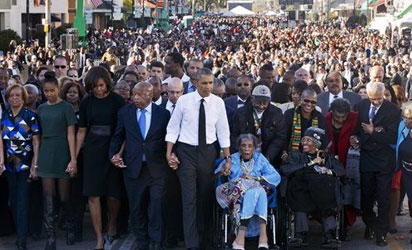
US President Barack Obama (4L), First Lady Michelle Obama (2L), former US President George W. Bush (2R), Laura Bush (3R), and US Representative John Lewis (3L), Democrat of Georgia and one of the original marchers, lead a walk across the Edmund Pettus Bridge to mark the 50th Anniversary of the Selma to Montgomery civil rights marches in Selma, Alabama, March 7, 2015. US President Barack Obama rallied a new generation of Americans to the spirit of the civil rights struggle, warning their march for freedom “is not yet finished.” In a forceful speech in Selma, Alabama on the 50th anniversary of the brutal repression of a peaceful protest, America’s first black president denounced new attempts to restrict voting rights. AFP PHOTO
By Uche Onyebadi
BARACK Obama was just about three years old when the police in Selma, Alabama, unleashed unprecedented brutality on a group of “Negroes” marching across the Edmund Pettus Bridge in Selma, to assert their rights as human beings and demanded to be treated as full American citizens.
Ironically, the same Barack Obama stood at the threshold of that bridge last week in his capacity as an African American president of the United States. Several people who participated in the march at Selma fifty years ago could not contain their emotions at the unbelievable twist of fate before their eyes.

US President Barack Obama (4L), First Lady Michelle Obama (2L), former US President George W. Bush (2R), Laura Bush (3R), and US Representative John Lewis (3L), Democrat of Georgia and one of the original marchers, lead a walk across the Edmund Pettus Bridge to mark the 50th Anniversary of the Selma to Montgomery civil rights marches in Selma, Alabama, March 7, 2015. US President Barack Obama rallied a new generation of Americans to the spirit of the civil rights struggle, warning their march for freedom “is not yet finished.” In a forceful speech in Selma, Alabama on the 50th anniversary of the brutal repression of a peaceful protest, America’s first black president denounced new attempts to restrict voting rights. AFP PHOTO
One of them is John Lewis, currently a member of the U.S. House of Representatives. Almost with tears in his eyes, Representative Lewis had the honour to introduce President Obama at the occasion. An emotional Lewis told the 40,000 crowd that never in his imagination did he envisage that he would be standing on the same bridge, not being hounded by the police as it was 50 years ego, but introducing the president of the United States, an African American.
President Obama lived up to expectation in his speech. Saluting his forebears who challenged the system that made them second class citizens, the president said: “The Americans who crossed this bridge were not physically imposing. But they gave courage to millions.
They held no elected office. But they led a nation. They marched as Americans who had endured hundreds of years of brutal violence, and countless daily indignities – but they didn’t seek special treatment, just the equal treatment promised to them almost a century before.”
That courage was marching from Selma to Montgomery to demand that they be accorded voting rights, and despite the police beatings, shootings and dog bites, they got the 1965 Voting Rights Act. In the same speech, President Obama admitted that a lot had been achieved on the American civil rights front, but much more needed to be accomplished.
He told the crowd that “We just need to open our eyes and our ears and our hearts to know that this nation’s racial history still casts its long shadow upon us. We know the march is not yet over; we know the race is not yet won.”
Parts of the “long shadow” can still be seen in modern American society. And one large “shadow” has to do with voting rights, 50 years after Selma. In July, 2013, the U.S. Supreme Court handed down a 5-4 majority decision that pulled the rug from under the voting rights act.
The Act had required parts of the U.S. with a history of denying minorities their voting rights, to get clearance from the federal government before effecting any change in their local voting laws. The court felt that the requirement was no longer tenable in modern America.
The aftermath of that ruling was that some conservative states have gone ahead to modify voting laws, such as requiring voter ID before casting ballots. On the face of it, the law appears quite innocuous. But, the reality is that such voter ID requirements weigh heavily on minorities, most whom cannot afford the cost of obtaining the official state ID required to vote.
The Ferguson cop, Darren Wilson, went scot-free because of insufficient evidence to even bring him before a grand jury for an indictment. But, last week, as “Bloody Sunday” was being celebrated, the U.S. Attorney General’s office released its investigation into policing and law enforcement in Ferguson, Missouri.
Evidence of racism
Outgoing Attorney Eric Holder was so furious with evidence of racism and injustice in the Ferguson police department that he said this: “We are prepared to use all the powers that we have, all the power that we have, to ensure that the situation changes there. That means everything from working with them to coming up with an entirely new structure … If [dismantling the Ferguson Police Department is] what’s necessary, we’re prepared to do that.”
Why this outrage? Here are some of the contents of the report about that police department: black people are about 67 percent of the Ferguson population, but in the 2012-2014 period, they had 85 percent of all police traffic stops, 90 percent of citations issued by the police and 93 percent of all police arrests; the city’s municipal courts are routinely used by the city as a revenue earner as blacks are likely to be more heavily charged for crimes and other violations; 90 percent of all incidents of police use of force were against African Americans; only 3 out of some 50 plus police officers are African Americans; some e-mail messages exchanged by officials of the city and police, according to the report, referred to Obama as a chimpanzee and a photograph of some Africans dancing was captioned “Michelle Obama’s High School Reunion.”
Another message joked about a black woman who received a $5,000 cheque in the mail for terminating her pregnancy. When she wondered where it came from, she learnt it was sent by the police “crime stoppers” (for getting rid of a potential criminal).
The gains which minorities in America have recorded since the “Bloody Sunday” march in Selma, have been substantial. But, as Obama noted in his speech: “Fifty years from Bloody Sunday, our march is not yet finished. But we are getting closer…. Our job’s easier because somebody already got us through that first mile. Somebody already got us over that bridge…..We honor those who walked so we could run. We must run so our children soar. And we will not grow weary.”
Disclaimer
Comments expressed here do not reflect the opinions of Vanguard newspapers or any employee thereof.