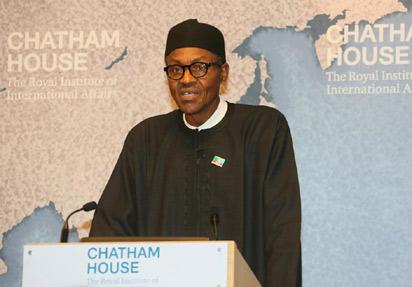
Gen Buhari at Chatham House
By Donu Kogbara
Chatham House, a prestigious independent policy institute in London, engages government, private sector and civil society people in open debates and confidential discussions about issues relating to international affairs.
Chatham House attracts world leaders and premier league analysts from many different fields. And I’ve just watched – via an online live stream – Major-General Muhammadu Buhari addressing a gathering at this distinguished venue.
He looked and sounded positively presidential. He spoke well and his body language was relaxed. He oozed seriousness but also displayed an endearing sense of humour. He was confident as well as self-deprecating. And inspiring.
Here was a cool, calm, collected and super-mature man at the peak of his game, a disciplined ex-soldier who has seen and heard it all and is ready to face up to the tough challenge of leading a struggling nation he TRULY loves towards a more ethical, more secure, more respectable and more productive future.
The event was chaired by Sir Richard Gozney, the British High Commissioner to Nigeria between 2004 and 2007. When Gozney was introducing Buhari to the audience, he admiringly referred to Buhari’s legendarily modest lifestyle (which he had personally witnessed, having once paid an official visit to his home).
When Buhari stuck to the talking time that he’d been allotted by the organisers of the event – unlike many VIPs who take delight in rambling on for as long as possible the minute they gain access to a microphone! – Gozney approvingly said that he had known all along that Buhari would stick to the timing deal.
It was obvious that Gozney regarded the General as someone who deserves praise and can be trusted – on some levels at least.
A European journalist friend was there and called me to say that Buhari’s performance impressed him and everyone he’d chatted to after the event.
It has to be said that the ability to impress senior foreigners is a useful attribute for those who want to be Heads of State. When almost everyone who matters outside your country views you with contempt or doubt, wahala dey!
Anyway, my favourite excerpts from Buhari’s speech – titled “Prospects for Democratic Consolidation In Africa: Nigeria’s Transition” – include:
Buhari’s speech
With the fall of the Berlin Wall in 1989, the dissolution of the USSR in 1991, the collapse of communism and the end of the Cold War, democracy became the dominant and most preferred system of government across the globe.
On a personal note, the phased end of the USSR was a turning point for me. It convinced me that change can be brought about without firing a single shot.
The global triumph of democracy has shown that another and a preferable path to change is possible. It is an important lesson I have carried with me since.
Boko Haram has sadly put Nigeria on the terrorism map, killing more than 13,000 of our nationals, displacing millions internally and externally, and at a time holding on to portions of our territory the size of Belgium. What has been consistently lacking is the required leadership in our battle against insurgency.
…I have always known about our soldiers: they are capable, well trained, patriotic, brave and always ready to do their duty in the service of our country.
You all can bear witness to the gallant role of our military in Burma, the Democratic Republic of Congo, Sierra Leone, Liberia, Darfur and in many other peacekeeping operations in several parts of the world.
But in the matter of this insurgency, our soldiers have neither received the necessary support nor the required incentives to tackle this problem. The government has also failed in any effort towards a multi-dimensional response to this problem leading to a situation in which we have now become dependent on our neighbours to come to our rescue.
Tough on terrorism
Let me assure you that if I am elected president, the world will have no cause to worry about Nigeria as it has had to recently….We will be tough on terrorism and tough on its root causes by initiating a comprehensive economic development plan promoting infrastructural development, job creation, agriculture and industry in the affected areas.
Our economy has grown at an average of 7% for about a decade. But it is more of paper growth, a growth that, on account of mismanagement, profligacy and corruption, has not translated to human development or shared prosperity.
A development economist once said three questions should be asked about a country’s development: one, what is happening to poverty? Two, what is happening to unemployment? And three, what is happening to inequality?
The answers to these questions in Nigeria show that the current administration has created two economies in one country, a sorry tale of two nations: one economy for a few who have so much in their tiny island of prosperity; and the other economy for the many who have so little in their vast ocean of misery.
Repositioning of Nigeria’s economy
In the face of dwindling revenues, a good place to start the repositioning of Nigeria’s economy is to swiftly tackle two ills that have ballooned under the present administration: waste and corruption. And in doing this, I will, if elected, lead the way, with the force of personal example.
On corruption, there will be no confusion as to where I stand. Corruption will have no place and the corrupt will not be appointed into my administration.
The institutions of state dedicated to fighting corruption will be given independence and prosecutorial authority without political interference.
But I must emphasise that any war waged on corruption should not be misconstrued as settling old scores or a witch-hunt. I’m running for President to lead Nigeria to prosperity and not adversity.
On March 28, Nigeria has a decision to make. To vote for the continuity of failure or to elect progressive change. I believe the people will choose wisely.
Permit me to close this discussion on a personal note. I have heard and read references to me as a former dictator in many respected British newspapers including the well regarded Economist. Let me say…that I take responsibility for whatever happened under my watch…[and that] I cannot change the past. But I can change the present and the future. So before you is a former military ruler and a converted democrat who is ready to operate under democratic norms and is subjecting himself to the rigours of democratic elections for the fourth time.
You may ask: why is he doing this? This is a question I ask myself all the time too. And here is my humble answer: because the work of making Nigeria great is not yet done, because I still believe that change is possible, this time through the ballot, and most importantly, because I still have the capacity and the passion to dream and work for Nigeria…
Disclaimer
Comments expressed here do not reflect the opinions of Vanguard newspapers or any employee thereof.