By Gabriel Olawale
Stroke is a leading cause of morbidity and mortality worldwide, and it is likely to worsen in developing countries such as Nigeria over the next two decades based on projections by the World Health Organisation.
 Experts say with the increasing prevalence of stroke and other cardiovascular diseases, the current prevalence of stroke in Nigeria is 1.14 per 1000 while the 30-day case fatality rate is as high as 40 percent. Management of stroke remains largely conservative and with little or no funding for high-quality research. Millions of those affected in Nigeria continually remain at risk.
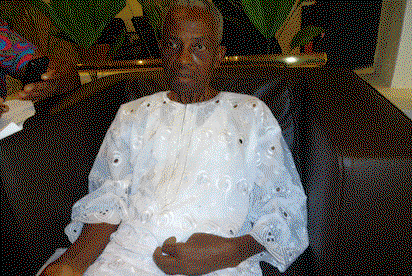
Ten years ago, precisely on November 8, 2004, Alexander suffered a stroke. He didn’t know it at that time, but he was destined to suffer several more strokes in the years ahead. The first experience was so traumatic it almost ended his life. Ever since, his wellbeing and state of health have been a serious challenge. Today, 64-year-old Alexander is still battling the adverse effects of recurrent stroke – an ailment that strikes suddenly, killing its victims or leaving them paralysed for life.
In an encounter with Features Health & Living at a fund raising dinner organised by Stroke Care International for rehabilitation and education of people affected by stroke and their families, he told a heart-rending tale of his travails. In tears, he recounted how it all began 10 years ago, precisely on November 8, 2004.
“On the fateful day, I went to visit a Church member in the hospital. Sometime during the visit, I developed a headache, so I excused myself and went home. At home, I decided to take a bath, but in the process, something strange happened. I felt a knock on my head and next thing I knew, I was on the floor. Later, Alexander got to know that he passed out for more than 20 minutes.
“When I regained consciousness, I called out for help. At that moment, there was no life again in my left hand and leg. It was then I realised I just suffered a stroke. One of my daughters who was in the kitchen heard my shouts and rushed to my aid.
“My wife later came in too and they both assisted me to the room. I lay on the bed helpless. My eyes were rolling round and round. At that moment, my mouth bent out of shape. I could not speak normally and I lost coordination.”
Alexander was admitted in the hospital so many times he lost count. “I have suffered stroke attacks at least 10 times on different occasions. Sometimes I would be in a coma and even when conscious, I could not coordinate my movement properly. Whenever the crisis was to start, my legs would vibrate and it would gradually spread to my heart and my head. My entire body would be shaking.”
Alexander has not desisted from taking his drugs, yet his health has not improved. The family has committed all it has towards his recovery to no avail. They are still running from pillar to post.
Before the advent of stroke, he suffered series of asthma attacks and became hypertensive. In the midst of all these, his wife lost her job and with five children still in school, life took a turn for the worse.
“In 2008, I lost my first daughter during her National service year as a youth corps member. Since then we have been like beggars. Two the remaining children have graduated without securing jobs. One is preparing to sit for the Senior Secondary School Certificate Examination, SSSCE. The burden of catering for the children has become unbearable, he lamented.
“So all these problems are there, sometimes my head feels as big as a pot and so heavy. My blood pressure monitoring device got damaged and I’m too poor to buy another one.”
Speaking about Alexander, Executive Director, Stroke Care International, Mrs. Gloria Nkeng described his case as pathetic. Nkeng, a Stroke Consultant at Kings College Hospital, London, and advocate of better life for stroke patients, regretted the high incidence of stroke in the country. She explained that stroke patients were often neglected and inadequately catered for, even when assistance could come in various forms.
“When stroke strikes, it affects the whole family. It is not compulsory that it must be money. People can give us land, buildings, drugs, or food items. There is no limit to what can be donated for these people.”
Nkeng who is also a member of the Board of Directors, World Stroke Organisation representing sub-Sahara Africa, regretted that currently, the organisation has no place where stroke patients can access care and support services.
Soliciting assistance from individuals, corporate organisations and government in the interest of stroke patients, she remarked: “We are looking for a place where comprehensive care and services can be administered. Such place needs to be suitable for therapists where people who have suffered stroke can go so that we can fast-track them, assess them and rehabilitate them.”
All forms of support and donations are to be sent to Stroke Care International, First Bank; 2002200729 or contact 07046153894 for further enquires.
Disclaimer
Comments expressed here do not reflect the opinions of Vanguard newspapers or any employee thereof.