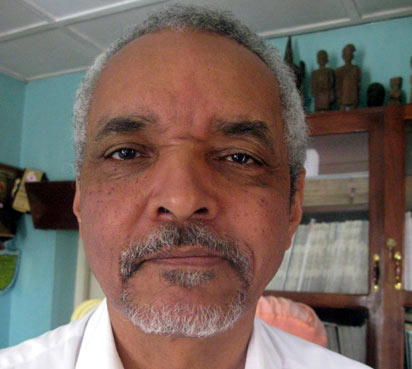
Dr. Tony Marinho
The renowned Obstetrician & Gynaecologist, Dr Anthony Olatokunbo Marinho, has conducted over 3000 C-sections. He is the author of over two dozen works of literature and the founder of Educare Trust, which has provided IT training to more than 6000 Nigerian youths. He dragged his first breath of air on January 8, 1949, and have continued a family tradition of service to humanity. In homage to his late wife, he also drives the Lola Marinho Breast Cancer Foundation. Vanguard Spark is proud to present this social crusader as our Sage of the Month (September Edition). In this interview with Amatesiro Dore, Dr Marinho personified wisdom and also provided very important articles on “The Future of Medical Practice in Nigeria”, “The Fear of Ebola”, “Time to Retire”, and “A Spark for the Rookie of the Month”.
Dr Marinho, how will you introduce yourself to someone from outer space?
With a smile, with open hands, silence, and with an exit strategy. Distrust may be mutual! Hopefully, a smile is universal and intergalactic. Open hands should signify an absence of threat. Words may be misinterpreted and misconstrued, so silence may be wisdom, assuming also that English may just not be the universal language. Nobody will believe I have just met you, so please let me take a selfie with you.
How have St. Gregory’s College, University of Ibadan, and Wole Soyinka influenced your worldview?
Greg’s gave me a day-student and boarding school foundation in arts and science; in literary and debating and library appreciation; in volunteering and Boy Scouting; in honesty and discipline; in honouring me by making me a Senior Prefect—the most important job of my life to date. UI taught me my craft—medicine—and also the responsibility of living in wider society—the ground floor of life. Both Greg’s and UI gave my life-long dependable friends. WS (Wole Soyinka) and his social contemporaries—Tai Solarin, Gani Fawehinmi, and a host of dead demonstrators against injustice—demonstrated to me what was possible, and not possible, with a will and a way; empowering generations to overcome adversity and man’s greedy corrupt inhumanity to man. WS helped, therefore, to provide the superstructure—the next floor, upstairs. But we are still not there yet, as the political yoke can be as oppressive, expensive and unproductive and corrupt, as the military yoke.
You once considered Carpentry and the Nigerian Police as a career path, what advise do you have for young people making career decisions today?
Do not rush into career choices. As I child, I saw the beauty of carpentry in the curves of the chairs and tables and the work of ‘Mr Fix It’ high demand carpenters. On the way to school, we saw Inspector Fine Country brilliantly supervising the historically disastrous Lagos traffic. Who would not be inspired to join the police force? In those days, we children did not see the demands for bribes that children of today are forced to witness at every junction. Many great professionals would have been even greater in other professions if only they had been told such profession exist. A cartoonist or writer will never draw or write stories if there are no paper and pencils in school and at home. Youth must remember that what they are good at may not pay bills. Sometimes what you are good at may become your hobby while you earn a living by what you are qualified at.
What role did your father play in your career decision?
My childhood memories of my father were of very hard work and constant charity. When I was older and he was studying psychiatry in the UK, I decided not to study medicine, as I could not see myself doing what he was doing—reading, day and night, all those huge books for the rest of my life even after qualifying. I was really, genuinely, terrified of giving the patients the wrong medicine. Well, the change came in Greg’s, where I chose Science over Arts, and I was not a mathematician, so inevitable Zoology, Chemistry, Physics became the A Level subjects. My father advised against other medical fields by suggesting I work very, very hard to get into the top bracket—medicine.

Dr. Tony Marinho
How did you manage to stay focused on Medicine during your play acting days at the University of Ibadan, did you ever consider abandoning Medicine for Art?
Although some Professors felt that medicine was all consuming without time for sport or recreation or acting, my classmate—Dr Cyril Idemudia Etomi—and I found time to act in numerous plays on the hallowed stage of Theatre Arts with many later greats like Taiwo Obileye and Ronny Omoregie to name a few. It helped bridge the gap that my uncle, Sunbo Marinho, was also in the Department. It was a triumphant pleasure to act in ‘The Medea’, ‘The Importance of Being Ernest’, and other plays, and to watch many hundreds of plays, as part of the ‘University passing through us’, as students, and not just ‘us passing through the University’. As to the choice between arts and medicine, we loved medicine and the learning of it, more. There was never any doubt about what we wanted to be—doctors in the line of Osler and Harvey but with an artistic bent.
Why did you opt for Obstetrics and Gynaecology rather than treading your father’s path in Psychiatry?
TM: Having two Doctor Marinhos was more than enough credit and confusion in one family. My father’s reputation was enormous and after joining him on the medical platform, it required me to carve my own area of influence. I was drawn to many specialties but especially O&G by the excellent teaching and practice of Professor Paul van Hendrickse and Professor Ojo, among others. It helped that I got a distinction in O&G which also influenced my decision and I love the care of the often downtrodden female. Delivery is the most dangerous day in the life of a mother and child. It is an honour to have participated.
Your children didn’t attend St Gregory’s College, unlike your ancestors; did any of them choose medicine?
My children could not follow my grandfather Mr Anthonio Joaquim Marinho, my father Dr A. Abayomi Marinho, and myself to Greg’s because of the deliberate destruction and decay of that missionary form of educational heritage by the take-over of schools by a negligent and, perhaps, mischievous government pursuing what we would, today, call a ‘Boko Haram-like’ agenda, in which sanitation, libraries, and moral upbringing were all destroyed. None of them did medicine though all considered it briefly. I think the long hours away from home and poor financial abilities compared to their friends’ parents, in other professions, may have influenced their choice. Funnily enough, they work long hours in their chosen careers anyway. And one married a doctor and psychiatrist, anyway.
Read the full text of Dr. Marinho’s interview on Vanguard Spark
Disclaimer
Comments expressed here do not reflect the opinions of Vanguard newspapers or any employee thereof.