By Bose Adelaja
Oko Baba, a slum turned commercial and residential area, is not new to many Lagosians, especially given its proximity to nature. Oko Baba which literally means ‘’Fathers’ settlement’’, was dominated by the Ijaws and Ilajes who were fishermen and timber dealers.

Initially, it was waterlogged but constant filling with sawdust enhanced accessibility until the land was effectively reclaimed from water through sand-filling. Until recently, it accommodated people from all walks of life, hence the popularity which it now enjoys in Lagos.
Curiously the place is subdivided in two parts: One side for the wealthy, while the other for the poor. The former is defined by magnificent buildings while the latter was so known by those who reside mainly in shanties. Investigations by Vanguard Metro revealed a plot of land was sold for N50m as soon as infrastructural amenities were introduced by the State government.
For instance, when VM visited the area on Tuesday, it was observed that most of the roads were tarred, though could do with a better drainage. Also, power supply is better there than most areas in Lagos. There was also a functional health centre as well as offices and banks. The proximity to the newly commissioned Tejuoso Market is also convenient for residents of the area.
However, the popularity of Oko Baba derives mainly from the sawmill located there. Indeed, it is considered the leading saw mill in the State owing to the fact that it deals on all types of woods and buyers throng the place on daily basis.
However, Oko Baba has over the years suffered several fire disasters, a reason for which the State government has for long considered relocating the saw millers to an expansive land in Agbowa-Ikosi area of Ikorodu.
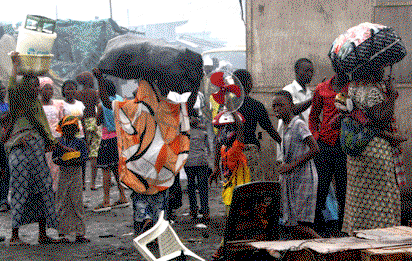
The latest and perhaps the most destructive fire incident occurred on Monday. The fire which later erupted into an inferno was said to have started in a bungalow near Osholake Street and razed five buildings, part of the sawmill and shanties. Over 5000 people were displaced.
One of the areas badly hit was Cole Street which is notable by reason of the high profile individuals residing there.
But walking down the street, one easily perceives the smell of Indian hemp being smoked by street urchins at various spots.
When VM demanded to speak with some of them, they looked at this reporter in amazement and chorused in Yoruba: ‘’Omo Fashola l’awa, a si n j’aye ori t’awa ni’bi yii. Nigba ti a wa o ti dii eni keni l’owo, a o le gba ki eniyan di wa l’owo. Ti ijoba ko ba le dun wa ninu, a o dun ara wa ninu.’’
Meaning: ‘’We are Fashola’s children and we have pitched our tent here, so nobody should disturb us because we don’t disturb anyone. Since the government does not take care of us, we shall make ourselves happy’’.
After much friendly persuasion, they decided to open up to this reporter; one of them even offered her a wrap of Indian hemp which was politely rejected. ‘’Awa oni nkan alejo o, oun t’a ni ni yii’’; meaning: ‘’We have nothing to offer you but this,…’’ one of them said jokingly.
VM later discovered that some of the area boys who take to menial jobs are also married with children and live in the shanties at Oko Baba.
According to them, they were victims of various demolition exercises which occurred in Lagos State before they found their way to Oko Baba and took up accommodation in the shanties. Some of them said they pay between N8,000 and N15,000 per annum.
‘’Madam, I am not used to smoking Indian hemp but this is the aftermath of the demolition exercise in year 2009 and I don’t want to go back to my home town, Ilorin, Kwara State,’’ one of them said.
Another, a salon operator, Risikat Ganiyu, said: ‘’My salon was thriving while at the old Tejuoso Market. But I can’t afford a shop at the new edifice built by the government. That is why my husband brought me here. I pay an annual rent of N13,500’’.
Another resident, a single parent who simply gave her name as Iya Isikilu, said she came to stay at the slum because of the astronomical rent charged by Lagos landlords and estate agents. ‘’I work as a shop attendant. Nobody collects agency and commission fees here, I only pay a quarterly rent of N2,800,’’ she informed.
Mrs and Mrs Kudus Mustapha, former residents of Anthony Village, have a different reason for seeking accommodation in the shanties. ‘’We have a joint business which was doing well in Anthony Village but armed robbers were the problem.
I remember a particular year when they burgled our shops on five occasions. Each time we reported to the Police, but nothing positive came out of it. A friend brought us here about four years ago, and since then, there has been no robbery attack.
It is a pity that the Lagos State government does not cater for the poor. This is unlike what was the case when Lateef Jakande was the governor many years ago. He built houses for the less-privileged, but this is not the case with the present government which only caters for the rich, building ultra-modern structures here and there.
How many of these structures are affordable by the average Lagosian? Simply put, can the less-privileged afford paying in millions? Anyway, many of you are to be blamed for not calling the government to order,’’ she submitted with feeling.
Disclaimer
Comments expressed here do not reflect the opinions of Vanguard newspapers or any employee thereof.