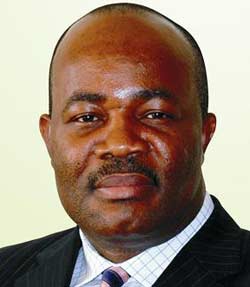
*Akpabio
By Hugo Odiogor
Hon. Emmanuel Udom has just marked his 100 days in office as the Secretary to Government of Akwa Ibom state where he has come to restore stability to the focus of governance of the nation’s fastest growing state.
The former banker is one of the hybrids of technocrats and bureaucrats which becoming the new face of political transformation in Nigeria. He brings his private sector perspective into public service. In this interview with Vanguard, Hon. Udom lists the challenges facing the Akpabio administration. Excerpts
What are the problems of the state from your perspective of a private sector person coming into the public service?
The main difference between the public and private sector experience is the same in Nigeria and in other climes. It is not is thick as the Chinese wall. The area of similarity is that they are both focused on service to the people and appropriate allocation and utilization of resources.
In the public service, there is a clear objective; the criteria for measurement of performance and reward are clearly defined. The private sector insists on getting result. There are clear cut expectations, objectives and unit of measurement of achievement. But in the public sector that unit of measurement is not clear, you cannot actually measure it. In life you are told that what gets measured gets rewarded.
In the Private sector you have the Service level Agreement, you have the LSS as units if measurement, in the public service it is not so.
But the principles are the same in terms of service to the people and management of resources to achieve certain result. They run on the same rules but in different directions, but to achieve one result of the well fare or well-being of the people. The question now is how do you bridge the gap? if at all the gap can be closed. First there are shared values which are like culture, which could be linked to attitude.
The attitude and orientation of the human capital must be changed to embrace the service culture, delivery culture and attitude.
They always say that your attitude will determine your altitude service. This is linked by the attitude of human beings as it is said that your attitude determines your altitude. Except we get the same units of performance measurement in the public sector, you cannot attain the same level of performance, which is what people are talking about.
What would you regard as the critical focus of government in the post Akpabio administration in Akwa Ibom State?
The problem of the state is not peculiar to Nigeria and indeed Africa and that problem is the decay or lack of infrastructure. These are manifest in areas of dearth in development of human capacity, especially in health and education sectors, as well as development of physical infrastructure.
The State has been lucky in the last seven years to have the persons of Obong Godswill Obot Akpabio as the governor who has invested so much time and resources into human capacity and infrastructure developments. These have been seen in the rate of developments in the health and education sectors. Like they say: “a healthy nation is a wealthy nation”.
Similarly, “an educated population is an asset to the nation.” This administration has taken various actions that have yielded positive results. The administration actually took the bull by the horn in terms of road construction where it has done 1,400 kilometers of roads, including 32 bridges, all handled by Julius Berger.
So, the main challenge facing any incoming administration is on how to sustain the momentum o development of this administration and build on the foundation that has been laid. It has to take decisions on the key focus areas of health, education and infrastructure but in addition to these, it has to focus on industrial development, our goal here is to create an Africa Dubai in Akwa Ibom State. Before now, you could not land in Uyo, but now, we have a functional airport which was started by the previous administration but the first aircraft landed under this administration.
As at today, the Akpabio administration is developing the Maritime sector and the ancillary infrastructure, with the construction of a deep sea port at Ibaka, in partnership with the federal government. Beyond oil and gas, Akwa Ibom is rich in agriculture.
Our farmers here do not require the use of fertilizer before they could be guaranteed of bumper harvest. But we are in the process of introducing mechanization into agriculture, to boost our output. As we speak today where have completed arrangement for Mr. President to come and perform the ground breaking ceremony of an Ethanol plant worth 41.8 billion. This is a private sector initiative. We need to develop the industrial sector to create jobs for our young people who are ready and willing to work. These are the ways to sustain the good work that the Akpabio administration has done.
Would you say the response of the investors is commensurate with the time and resources so far invested in prospecting them and building infrastructure?
Well as you know, all over the world, investors and investment drive take a process of due checks on the laws, security, business culture and environment. So far, the investors are coming I have just mentioned the ethanol plant, the truth of the matter is that investors are slow in taking investment decisions. This has to go through a process that may take up to five years.
Akwa Ibom Sate is very secure for investors because we have a zero tolerance on crime. When people from outside the state commit crime, it does not take much time to apprehend them and punish them accordingly. We also believe that if you are going to build something more enduring, it has to take a little long, the existence of these basic infrastructure is critical to any investment drive.
You can see the quality of the roads, schools, the Stadium which is designed like the Allianz stadium in Munich. He governor is building a hospital the will rank among the best in Africa. So, having laid down the foundation our next task is build Akwa Ibom into an industrial and tourism destination.
Disclaimer
Comments expressed here do not reflect the opinions of Vanguard newspapers or any employee thereof.