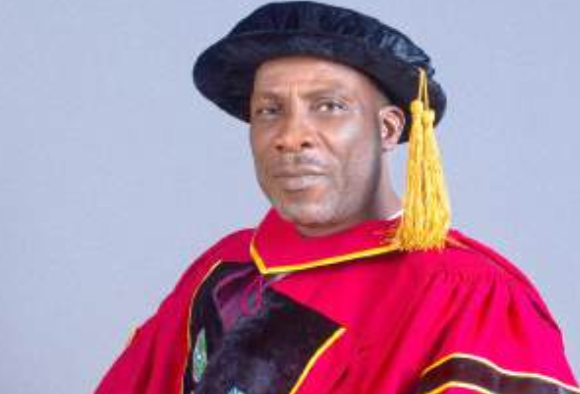
Onwe
By Kennedy Mbele
Professor Emmanuel Onwe is a lecturer in the Department of Mass Communication, Ebonyi State University, EBSU. As he prepares for his inaugural lecture coming up on Tuesday, September 29, he shares insights into the standard of education in Nigeria and what attaining the rank of professor means to him. Excerpts:
Can you tell us about yourself?
I am a Professor of Strategic Communication at Ebonyi State University, Abakaliki. Beyond my core teaching and research responsibilities at the university, I serve as the University Orator and the Executive Director of the Centre for Leadership and Strategic Communication, as well as Heartbeat Consult. Over the years, I have had the privilege of serving the public and institutional sectors in various capacities, including as Commissioner for Information and State Orientation in Ebonyi State, and through service on university governing councils such as the Federal University of Technology, Minna, and Bingham University, Karu. I am also a senior partner at the OASIS Research Institute and the Impact Makers Network, working broadly at the intersection of strategic communication, national reputation management, and public governance. My foundational education began humbly, navigating the early building blocks of primary school environments that instilled discipline and curiosity. I proceeded to PRESCO (Presco Old Students Association alumnus), which laid a solid secondary school foundation. From there, I transitioned into higher education, earning my B.Sc. in Mass Communication in 1995. Recognising the interconnectedness of global systems and communication, I pursued an M.Sc. in International Relations in 1999, followed later by another M.Sc. in Mass Communication with a specialisation in Public Relations and Advertising in 2008. The rigorous academic climb culminated in my Ph.D. in Strategic and Development Communication in 2014. Having been a faculty member at Ebonyi State University since 2000, that journey of continuous learning, rigorous research, and dedicated service ultimately led to my elevation to the rank of professor in 2024.
What does attaining the rank of professor mean to you?
Stepping into the rank of a professor evokes a profound sense of humility, gratitude, and deep responsibility. To me, professorship is not merely a terminal title or an elevation in academic status; it is a sacred trust. It means transitioning from being a consumer of knowledge to becoming a primary producer and custodian of solutions for society. It carries the weight of mentorship—knowing that young minds are watching, and that my words, research, and character have the power to shape trajectories. It is a call to higher service, urging me to deploy scholarship to solve practical national and global challenges rather than keeping knowledge locked within ivory tower walls.
Your first major public lecture, known as inaugural lecture, comes up soon. What is the title of the lecture and why did you choose it?
The title of the lecture is ‘The Muted Giant and the Borrowed Mirrors: Strategic Governance and Nigeria’s Global Reputation’. I chose this title because it captures the fundamental paradox of our nation. Nigeria is undeniably a demographic, economic, and cultural giant in Africa, yet we have frequently remained muted on the global stage, allowing external narratives to define us through borrowed mirrors—distorted lenses shaped by others. For decades, we have treated reputation management as an afterthought. This lecture is a deliberate call to shift from passive narrative defense to active, strategic stewardship of our national identity and global image.
Can you provide an insight to the lecture and how you think an average Nigerian, government, industry, and society can apply your findings?
At its core, the lecture interrogates how national reputation is constructed, weaponised, and managed in an interconnected world. It examines the disconnect between our domestic realities and international perception. Government must institutionalise strategic communication in public policy, moving away from reactive propaganda to proactive, value-driven statecraft. The industry and private sector must realise that every Nigerian brand is an ambassador; corporate governance and product excellence directly feed into our collective equity. Society and the average Nigerian must recognise that patriotism begins with everyday civic behaviour, because national reputation is ultimately the aggregate of individual actions. By aligning our policies, corporate actions and civic consciousness, we can rebrand Nigeria from the inside out.
Can you share with us specifically, the new knowledge or solution your research is bringing to your field of study and mankind, generally?
My research and inaugural lecture introduce SCALE (Stewardship, Coordination, Alignment, Legitimacy and Evaluation) as a strategic paradigm to shift our national and institutional communication from passive deficit to proactive agency. Rather than relying on superficial fixes, SCALE provides a diagnostic and operational roadmap that enables government, institutions, and society to systematically decode narrative challenges, align internal realities with external perceptions, and project authentic value. It equips scholars, policy architects, and practitioners with a practical framework to re-engineer how we manage reputation, ensuring that our collective voice and identity as a powerhouse are neither muted nor distorted by borrowed mirrors..
How long did it take you to arrive at the findings you’ll be presenting?
An inaugural lecture is rarely the product of a single night’s study; rather, it is the distillation of a lifetime of academic inquiry. Formally speaking, the specific empirical focus and synthesis for this lecture took over three years of intensive research, data gathering, and theoretical modelling. However, informally, it is built upon more than two decades of active scholarship, classroom interactions, consultancy work with international development organizations like UNICEF and PATHS 2, and practical public sector experience.
A project of this nature cannot succeed without challenges. What major challenges did you encounter during the research and how did you surmount them?
Every rigorous research endeavour faces hurdles, and mine was no exception. The primary challenges included navigating fragmented secondary data sources regarding institutional communication policies in West Africa and dealing with bureaucratic bottlenecks in accessing certain public governance archives. I surmounted these challenges by leveraging empirical triangulation—cross-verifying data across multiple independent sources—and tapping into a robust network of professional colleagues, institutional repositories, and interdisciplinary collaborations. Patience, resilience, and an unwavering commitment to empirical truth kept the project on track.
You are a mentor to many. Who are your own mentors and what can you say have been their contributions to the success you keep recording?
Mentorship is the invisible architecture behind every success story. I have been blessed to stand on the shoulders of intellectual giants and public service leaders who took a personal interest in my trajectory.
Academically, icons like Prof Sunny Udeze, Dr Hilary Ozoh, Prof Stella Chinyere Okunna, Prof. Basil Nwosu, and Prof Anthony Afoke provided rigorous intellectual grounding, shaping my commitment to scholarship, critical inquiry, and academic excellence. They taught me that true scholarship demands both discipline and humility. In the realm of public governance and statecraft, leaders like Chief Martin Elechi and Chief Matthew Uguru have been phenomenal pillars. Their wisdom, statesmanship, and unflinching dedication to community and institutional development taught me integrity in public service and the courage to navigate complex administrative environments. Their contributions go far beyond correcting drafts or guiding career choices; they have modeled what a balanced, purposeful life of service to academia and humanity truly looks like, and I am eternally grateful for their footprints on my path.
What can you say kept you going during difficult times in academia?
Academia is a demanding terrain characterised by delayed gratification, systemic funding constraints, and intense intellectual pressure. Above all else, my faith in God and the unwavering support of my family have been my greatest anchors through every storm. Beyond that, I view teaching and research not as a mere job, but as a ministry of human capital development. When institutional challenges arise, I anchor my focus on the students whose lives are transformed by a single well-taught lecture, and on the deep conviction that ideas have the power to change societies. That spiritual grounding, combined with a supportive home front and a long-term vision, is what sustains you when short-term frustrations threaten to weigh you down.
How did your work address current national problems such as insecurity, economy, health, education, etc?
Communication is the lifeblood of any social system; when communication fails, trust collapses, and crises multiply. My work addresses these national challenges by demonstrating that insecurity, economic instability, and educational deficits are often exacerbated by communication and narrative failures. For instance, insecurity thrives in environments where state communication lacks credibility or where public engagement is weak. By deploying strategic communication frameworks, government can build social cohesion, restore public trust, optimize health-communication campaigns, and align national economic policies with public understanding and buy-in.
What advice do you have for young scholars who want to follow your path?
To young scholars, I say this: embrace patience, read voraciously, and refuse to take shortcuts. Academic excellence is built on consistency and intellectual honesty. Do not merely write to fulfill promotion criteria; write to solve problems. Cultivate a reading habit that extends far beyond your immediate discipline—strategic communication requires an understanding of history, politics, economics, and human psychology. Above all, maintain your integrity; an academic name takes decades to build and only a moment to destroy.
What can you say about research funding and professors’ remuneration in Nigerian universities?
The state of research funding and professorial remuneration in Nigerian universities is a matter of urgent national concern. True national development is impossible without robust investment in research and development (R&D). Currently, academics operate under severe financial constraints, with most research funded out of pocket. Furthermore, the remuneration of professors does not commensurate with the intellectual capital invested and the immense responsibility we shoulder. If Nigeria is to compete globally in the knowledge economy, government and private sector must collaborate to overhaul university funding, insulate research grants from bureaucratic red tape, and provide competitive compensation that retains our best brains at home.
What is your take on the standard of education in Nigeria; is it rising or falling?
The standard of education in Nigeria presents a complex paradox. If we look at infrastructure, funding, and the teacher-student ratio in public institutions, the system is undoubtedly under severe strain, leading many to argue that standards have fallen. However, if we look at individual brilliance, resilience, and the global competitiveness of Nigerian graduates who excel brilliantly abroad, our intellectual capital remains remarkably high. Therefore, the problem is not a lack of innate brilliance among our students or teachers; rather, it is a structural and systemic failure. We have brilliant minds operating within an under-resourced, outdated institutional framework.
If you are appointed as the Minister of Education, what are the two things you would fix within the first two weeks of your resumption of office?
If given that privilege, my immediate focus within the first two weeks would target structural foundations: curriculum realignment and practical Integration: I would immediately initiate a fast-track review to pivot our educational curriculum away from rote learning toward critical thinking, digital literacy, and entrepreneurial problem-solving tailored to local and global market realities. Institutional governance and funding reform: I would establish an emergency framework, working with stakeholders, to streamline research funding disbursement, eliminate administrative bottlenecks in tertiary institutions, and begin rebuilding transparent accountability mechanisms to restore public and investor confidence in our school system.
As a young professor, how do you spend your leisure time?
Balance is essential for mental longevity. Outside the lecture halls and research desk, I enjoy spending quality time with family and friends. I am an avid reader of history and biographies, which offer profound insights into human behavior and leadership. I also enjoy listening to good music, engaging in quiet reflection, and participating in community or alumni activities (such as my involvement with the Presco Old Students Association) where I can give back to the foundational networks that shaped my early years.
If you were not a professor, what other profession would you have chosen?
If I were not in academia, I would likely have pursued a full-time career in diplomacy, international law, or public governance. My deep fascination with how nations interact, how peace is negotiated, and how public policy can uplift human lives makes diplomacy a natural alternative. Even within academia, my research in strategic communication and international relations constantly flirts with diplomatic strategy and statecraft.
What legacy do you plan to leave as a professor?
My ultimate legacy is twofold: institutional impact and human multiplication. I want to be remembered as a scholar who used communication not just to critique society, but to heal it, build bridges, and elevate national consciousness. Beyond published monographs and lecture halls, my greatest legacy will be the crop of ethical, brilliant, and globally competitive scholars and public intellectuals I have mentored—scholars who will carry the torch further than I ever could and continue to champion the cause of strategic stewardship for our nation.
Inaugural lectures are not casual affairs. Can you share with us some of the Very Important Personalities, VIPs, you are expecting to grace the occasion?
An inaugural lecture is a true festival of ideas, and we are expecting an exceptional and distinguished gathering to grace the occasion. We look forward to hosting the governor of the State along with his entire executive cabinet, as well as distinguished members of the National and State Assemblies from our state. The gathering will also feature my esteemed professional colleagues from within and outside Ebonyi State University (EBSU), alongside revered traditional and community leaders who are the custodians of our heritage. Above all, I am deeply honored to expect my mentors, whose shoulders I stand upon, and my mentees, alongside family, friends, and well-wishers from far and near. It promises to be a robust intellectual celebration where academia meets practice to chart a better course for our national narrative.
Disclaimer
Comments expressed here do not reflect the opinions of Vanguard newspapers or any employee thereof.