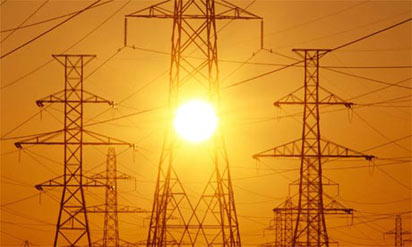
Electricity
By FAVOUR NNABUGWU
Some residents of Bwari, Karu, Kubwa, and Kuje, have lamented the huge drop in electricity, claiming that they hardly get up to six hours of power in a day in the Federal Capital Territory, FCT.

The residents, who spoke with Vanguard, said that electricity had dropped significantly over the last two months, adding that they could not boast of even the six hours supply.
Mrs Adeola Bisau, a resident of New Karu, Abuja, said that the disruption in electricity became worse in the last six weeks in that area, stating that the last two weeks have been the worse.
She said that the Abuja Electricity Distribution Company, AEDC, was yet to explain the cause of the worsening power situation to the residents.
“We have not had light (power) in the last two weeks, and we don’t know what is responsible, and the AEDC keeps going around distributing bills on little or no light while their officials keep disconnecting residents light over small debt. How will they think people will happily pay for light they did not see or use?”
“The situation has made life difficult for us, as our foods get spoilt because there is no light to store them and our businesses are crumbling due to the light problem as well, a situation that increases our expenses unnecessarily,” added Bisau.
Mr Victor Chibike, a resident of Kuje, also complained that electricity supply in that area has nose-dived, which he said made life difficult for them.
“I can’t say we have light because we hardly use the light before they put us in darkness again. It is like they are helping to take this country backward once again.”
Chibike said, “You know light is very important and you can’t compare it with generator light. I want to plead with the AEDC that is now in charge of our area to do something about it and quickly too, so we can return to our normal life.”
In Kubwa, the story is similar, as resident who gave her name as a Ms Emmanuella Udoh, said her area hardly gets enough electricity supply.
It will be recalled that AEDC was one of the 11 power distribution companies that was successfully privatised and handed over to new investors on November 1, 2013.
However, Udoh, who was visibly worried by the drop in electricity, said she sells ice blocks to make ends meet, yet there is no power to boost her business.
She pleaded with AEDC to resolve whatever problem it was that had caused electricity to drop so badly to the extent that residents could even guess the number of hours they would have power.
KANN Utility Limited, which derives its name from the states that it will serve in its operations namely Kogi, Abuja, Niger, and Nasarrawa, owns 60 per cent equity in AEDC.
Though, KANN is a Nigerian registered company formed in 2012, and is jointly owned by XerXes Global Investments Limited, and CEC Africa Investments Limited, a company wholly owned by Copperbelt Energy Corporation Plc of Zambia.
KANN was formed to participate in the development of the Nigerian power sector and has a vision to expand its footprint in the West African power sector.
However, AEDC has a franchise for the distribution and sale of electricity, across an area of 133,000 square kilometres in the three states and Abuja, and within its franchise area. AEDC is also responsible for owning and maintaining the distribution network and supporting equipment.
Headed by Mr. Neil Croucher, as the Managing Director, AEDC is organised into 26 geographic business units and two undertakings which include Wuse Business Unit; Garki Business Unit; Apo Business Unit; and Asokoro Business Unit.
Also included are Bida Business Unit; Bosso Business Unit; Bwari Business Unit; Gwagwalada Business Unit; Idah Business Unit; Jabi Bussiness Unit; Karu Business Unit; Katampe Business Unit; and Keffi Business Unit.
Others include Kontagora Business Unit; Kubwa Business Unit; Kuje Business Unit; Lafia Business Unit; Life camp Business Unit; Lokoja Business Unit; Lugbe Business Unit; and Maitama Business Unit.
The rest are Mararaba Business Unit; Minna Business Unit; Okene Business Unit; Suleja Business Unit; Gwarinpa Business Unit; Kabba Undertaking; and Akwanga Undertaking.
Disclaimer
Comments expressed here do not reflect the opinions of Vanguard newspapers or any employee thereof.