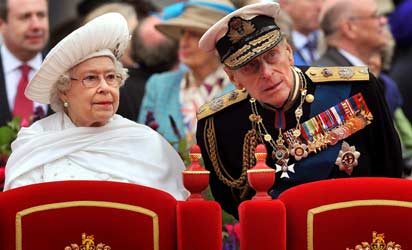
Britain’s Queen Elizabeth (L) and Prince Philip, Duke of Edinburgh, standing onboard the Spirit of Chartwell during the Thames Diamond Jubilee Pageant on the River Thames in London. Prince Philip, Queen Elizabeth II’s 90-year-old husband, was hospitalised June 4, 2012 with a bladder infection and will miss the rest of her diamond jubilee celebrations, Buckingham Palace said. AFP PHOTO
By Uche Onyebadi
THE late Guyanese scholar and political activist, Walter Rodney, years ago wrote a masterpiece titled “How Europe Underdeveloped Africa.” Today, he might have done some re-thinking and come up with another title that could read “How African leaders further underdeveloped Africa.”
The West does not beat us in intellectual aptitude. Sometime ago, I was surfing the Internet when I came across the name, IlesanmiAdesida, a man of Nigerian origin. He is the Vice Chancellor for Academic Affairs and Provost at the University of Illinois at Urbana-Champaign,the flag-ship university in the state of Illinois, and one of the prominent academic institutions in the United States. It turned out that from 1985 to 1987, Adesida served as the Head of the Electrical Engineering Department at TafawaBalewa University, Bauchi state.
Another name I am more familiar with is that of Pat Obi, a long-time finance professor at Purdue University, Calumet in Indiana.
He was recently named the White Lodging Professor of Finance in Hospitality and Tourism Management, an endowed and high-profile position in recognition of his sterling contributions within and outside the academic community. Where did his academic journey begin? As a student at the Institute of Management and Technology (IMT) in Enugu state.
You can multiply such names in the U.S. and other countries in the so-called developed world to show that in terms of matters cerebral in academic and non-academic circles, Africa can always stand shoulder-to-shoulder with the West. Sadly, the comparison ends where our governments start. One of the crucial areas where governments in West beat their African counterparts is in paying attention to infrastructure development.
But for the advent of cellphone technology, some of us old enough to recall the terror that was the Nigerian telecommunications sector, would not wish that that era ever returned. However, this piece is about transportation sector, and more precisely the road/highway and bridge networks.
At the beginning of the month of May, President Obama traveled to a small village called Tarrytown in Westchester County (New York) and made a forceful case for his country to spend more on infrastructure rebuilding and maintenance. His administration has already come up with a $302 billion program to revamp road networks and bridges in the U.S.
The program is expected to add about 700,000 jobs to the U.S. economy. In his speech, the president said something that sounds like an eternal truth: “Businesses are going to come where there’s good infrastructure.” He then warned that the U.S. risked lagging behind, as China was even ploughing in money that was four times more than the U.S. allocation to infrastructure.
President Obama’s ideas are not a piece of novelty. As a military officer governing what used to be Nigeria’s Bendel State, Brigadier Samuel OsaigbovoOgbemudia, used to pay attention to road network development in his state. In those days, once you drove into Bendel State you had a good feeling and enjoyed a smooth ride until you left the state to once more face the terror of tumbledown and dangerous roads.
Partly because of the good roads in Bendel, the state’s transport corporation known as Bendel Line was such a thriving business that the private transportation businesses in the state were given a run for their money. Brigadier Ogbemudia did not have to be a native of a developed nation to understand the importance of good infrastructure in any economy.
In his book, “The Trouble with Nigeria” the late sage of literature, Chinua Achebe, sarcastically described the roads in his country as places you dared not claim much familiarity with. He expressed the thought that the good road you used in the morning may have been reduced to a series of trenches in the evening by workers from the ministry of works who do more damage to roads in the name of repairing them. He elegantly put it that our highways are full of surprises.
Businesses will naturally gravitate towards where there is good and efficiently run infrastructure. A road journey that takes two hours to accomplish in Europe and the U.S. might be undertaken in trice the time in most African and developing nations. Businesses done in such an environment will have to pass on the extra cost of production to hapless consumers. And that inevitably leads to the recycling of poverty and distress among the people.
Political posturing aside, President Obama’s visit to Tarrytown is a dire warning that while the Republican Party stalwarts in Congress are stonewallingover the issue of refurbishing the U.S. road network, the country might begin the slide into economic doom. Already, some of the experts are beginning to classify some airports in the country as fit for a ‘third world’ economy.
But, here is the irony. What President Obama sees as decadence about the roads might be an aspiration in several developing nations. Last summer, I visited Kuwait and was enthused over their elegant road network. You might argue that Kuwait is virtually a city-state that has billions of petrodollars. True, but someone had the good sense to invest some of the money in good road network.
The road network is one area most of Africa cannot compete with the West. Good roads give a boost to commercial activities, create jobs and make trav
eling a fun thing, that is, if you are in a part of our world where the leaders have not made it their mission to underdevelop their countries.
Disclaimer
Comments expressed here do not reflect the opinions of Vanguard newspapers or any employee thereof.