By Dele Sobowale
“It is true that we have run through one of the greatest financial bonanzas that ever happened to a nation truly in need; so fast and so recklessly that we may wonder if it ever happened at all!” President Ibrahin Babangida, October 26, 1985, at NIPSS, Kuru
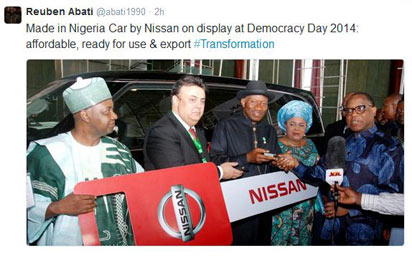
Last week this article ended with the plunge in the price of crude oil from $28 in 1982 to N9.95 during Babangida’s regime 1895-1993. At Kuru, IBB explained how we got into the mess which would later bring an end to our attempt at car manufacturing. Nissan had re-started the journey. Will history repeat itself?
By 1985, the automobile plants, established and viable in the first few years, were struggling to survive. Furthermore, some of the policy initiatives, designed to sustain the vehicle assembly ventures, e.g. the Ajaokuta Steel complex failed to deliver the flat iron required, two car battery, as well as, two tyre manufacturers failed or were in trouble, before they could support the vehicle assembly plants. The number of policy initiatives aimed at strengthening the automobile industry which were later not implemented will call for a book. Somewhere in Nigeria is a plant which was supposed to supply windscreens.
As if those were not enough problems, in 1986, the Federal Government of Nigeria announced the Structural Adjustment Programme, SAP. Peugeot and Mercedes remained the most resilient of the assembly plants. Eventually, PAN also succumbed to imported used vehicles, and later, less expensive new vehicles – oddly enough, from Japan – the home of NISSAN.
OBSTACLES FACED BY LOCAL ASSEMBLY PLANTS IN THE 1980s.
Then, as now, the Federal government, which remains the biggest customer for vehicles, promised to patronize only car assembly plants in Nigeria. State governments, under military governments readily fell in line. Most of the Organised Private Sector, OPS, also reluctantly agreed. The problems started with private individuals, especially those with contacts at the highest levels of government. They posed two challenges to the assembly plants. First, they were not convinced about the quality of locally assembled vehicles; and they knew that imports were generally less expensive. So efforts were mounted two ways; one, get government to relax its guidelines regarding imports; and two, engage in smuggling cars into the country. Suddenly, containers listed as containing raw materials would be discovered to be loaded with new cars.
Because government felt that the assembly plants might not produce enough for local consumption, they imposed high tariffs which would discourage imports. But, the implementation of the tariff structure allowed sufficient latitude for the officials of Customs Service and car importers to render the protection worthless. If all else failed, the professional smugglers move to neighbouring countries to set up shops for import of cars destined for Nigeria. Given Nigeria’s porous borders and corrupt licensing offices in Local Governments vehicles, which legally should not be licensed are permitted to be operated with impunity.
The local assembly plants operating under conditions in which the preference for imports is extremely high; imports are less expensive and enforcement weak sooner than later fold. Will history repeat itself?
FACTORS FOR SUCCESS OF THE NEW INITIATIVE.
Several factors will ultimately determine the success of the new initiative, not only by NISSAN but with respect to every other company intending to enter the Nigerian market. Not necessarily in order of importance, but the following will certainly play major roles in the success or failure of the venture(s).
1. Crude Oil Price Stability
Our first venture into automobile assembly ended in fiasco when the price of crude oil, formerly on an upward moving escalator reversed itself and started clattering downwards. By then, the nation’s external debts, which had been rising based on the assumption of perpetual price increase became unbearable. Credits to Nigerian manufacturers dried up and eventually the nation was forced into devaluation of the currency – not once but for ever several years. The inflation spiral put paid to the dreams of many Nigerians to buy new cars. The Age of Used Cars, called Tokunbo, was upon us. If crude oil prices once again reverse themselves from over $105 per barrel today to under $80 in the near future, the new car assembly plants will experience the same difficulties as the first generation assembly plants.
2. Governments
The Shagari administration which approved and encouraged the establishment of the first assembly plants simultaneously announced a battery of other initiatives to support the vehicle assembly policy. Unfortunately, not only the Shagari administration, but, its immediate successor, the Buhari regime, failed to push through the supporting initiatives. It was well understood that cars assembled from Completely Knocked Down parts, pre-manufactured elsewhere would prove to be more expensive than fully built vehicles given the advantages of economy of scale as well as proximity to the parts manufacturers. Governments’ tariff regime designed to protect our infant auto industry did not go far enough and, at any rate, were frequently circumvented. There is nothing to show that Nigerians, in and out of government, had learnt their lessons. And the lesson is simple. If Nigeria is to have a sustainable auto industry, we would collectively, have to sacrifice and hold the Nigerian Custom Service strictly accountable for lapses.
Disclaimer
Comments expressed here do not reflect the opinions of Vanguard newspapers or any employee thereof.