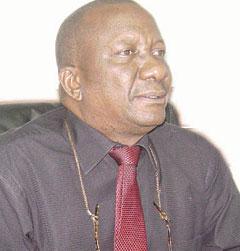
Bode Adediji…My success today was not basically as a result of academic brilliance, but a grace of God
Says government lacks political will to curb collapse of buildings
By UDEME CLEMENT
Mr. Bode Adediji is a member of the Federal Government Vision 20:2020. He is the immediate past President, Nigerian Institution of Estate Surveyors and Valuers. He is also the Group Executive Chairman, Bode Adediji Partnership, Kontiental Developers Nigeria Limited, and a member, Commonwealth Association of Surveying and Land Economic (CASLE).
He speaks on the challenges facing housing mortgage policy in Nigeria and the lack of political will by government to curb the incidence of buildings collapse.
 Lagos State government has declared its intention to demolish houses constructed under high tension electricity cables in the state. What becomes of the residents of those houses?
The situation can be described as a state of dilemma, because looking at it critically, this is a situation where people are living under the high tension cables and exposing themselves to radiation that can cause a disease like cancer. So, we should look at this action as the tenet of government to protect lives and the citizens from all dangers.
On the other hand, this action will further compound homelessness of the people. As such, government has the ability to handle separate groups of people facing this challenge in a pragmatic manner.
For instance, those to be removed should be given priority in terms of resettlement, but it is a different thing entirely where it is established that some people deliberately neglected the town planning directives of government to build structures under such restricted areas. It means they had clear understanding of the law that such area is a danger zone, so they can’t hold government accountable for their homelessness.
There is what is called the Right of Way (RoW) for petroleum products pipelines belonging to Nigerian National Petroleum Corporation (NNPC), which implies that structures must not be built on such places. But where the people build houses against this law, can they still be given compensation should those houses be demolished?
Right now, there is an on-going directive where government is paying billions as compensation to people whose land were affected by compulsory land acquisition for Independent Power projects nation-wide. But houses built on NNPC RoW are illegal structures because building against NNPC RoW is clearly against the law.
Note that at any point government sees it necessary to acquire private properties to provide public goods for the citizens, it has a way of paying compensation to the affected people. The major challenge is the capacity to enforce and sustain the enforcement of the items as stricted area.
This challenge is always a third world phenomenon and not a problem that is peculiar to Nigeria only. For example, I just returned from an international conference, which is an association of 56 countries and we shared experiences on this kind of issue. So even what we see as a problem in Nigeria is also noticeable in varying degree in other African countries.
Incessant cases of collapse buildings, especially in Lagos State is becoming worrisome. What can be done to stem the tide of collapse buildings in the country?
A lot had been said by government and professionals by way of minimising, if not absolutely preventing what can lead to collapse of buildings. However, the more we try, the more the buildings are collapsing because often people simply do not do the right thing at the right time. My advice is for government as a whole to rise up to this challenge by not limiting it only to the States that are vulnerable to recurring cases of buildings collapse.
Government at the federal level should put measures in place to provide a lasting solution to this problem.
Sometimes, majority of houses that collapsed had shown visible signs before the total collapse but no precautionary measure was taken to prevent the tragedy.
When governments at all levels join resources and the political will as well as working with professionals to address this problem pragmatically, that is when a sustainable solution will be found.
For example, if you have 200 houses in Lagos State tilting, the State government alone may not be able to cope with the situation, but federal government can investigate, obtain necessary data and map out a strategy to prevent loss of lives. Also, if we have at least 50 per cent presence of federal government in Lagos, traffic problems would have been removed since.
Lagos is where government gets the biggest taxes but its inputs in developing the State does not commensurate with the amount generating from taxes in Lagos.
What are the economic implications of Federal Government not putting sufficient inputs in Lagos where the nation has major seaports?
The situation is very sad because this has been happening from one regime to another.
Are there sanctions given to professionals like engineers, soil engineers and other experts involved in collapse building projects in the country?
This is a technical question because construction processes and procedures involve a chain of professionals like architects, engineers, soil engineers, town planners, estate valuers and project managers.
The fact is that unless there is a thorough investigation it becomes extremely difficult to blame a particular professional for a collapse building. Two examples will surface in this scenario. There was a situation I knew where the best professionals, architect and the engineers did their best, only for the land-lord for personal gains and ignorance to tamper with their drawings during the process of construction, and engaged a contractor who had never got any qualification to build a structure.
The second example is where the regulatory authority places too much emphasis on revenue generation in the cost of town planning control, than the professional oversight functions and enforcements they are actually created to carry out.
What is the way forward?
Accordingly, it is when government summons the political will to de-emphasize effort on payment of town planning and depends on revenue from property taxation, that is when true sanity will return to the environment and landscape of Nigeria.
In advanced countries there are provisions for housing mortgage for the citizens. Do we have such policy being operational in Nigeria?
My answer is no. The housing mortgage policy in Nigeria has failed despite the day-to-day propaganda. With due respect, I hesitate to say that the failure of housing programmes in the country is not due to inadequate housing policy but due to the fact that social issues on housing programmes that work in other countries are yet to be embraced by our government.
Such policies are noticeable liberal and land tenure system where land ownership is removed from political intervention. For instance, if you liberalise land tenure like Global Systems for Mobile Communications (GSM), you will not face this challenge.
Is it possible for government to roll our social housing programme for under-privileged in Nigeria?
Again, this has to do with the political will on the part of government. Beyond that, as long as our loan interest regime remains double digit, the first victim will be the mortgage sub-sector operator as well as the poor people in the country.
With these enormous challenges, is the much-talked about Vision 20:2020 still realisable?
For me, the only thing that will make it difficult for Nigeria not to achieve this Vision is lack of political will. This is because the document where the structure of the economy is drawn on how to achieve the Vision is quite clear.
The document also says there will be challenges from time to time, but these obstacles are surmountable if only government can summon the political will to do the right thing at the right time.
Disclaimer
Comments expressed here do not reflect the opinions of Vanguard newspapers or any employee thereof.