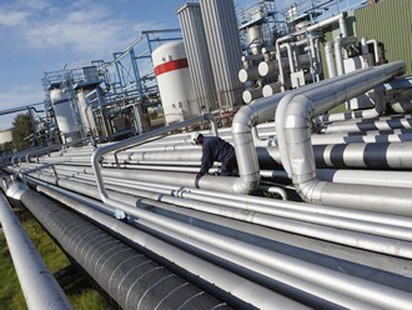
File image.
There is hope that the Port Harcourt Refining Company, PHRC, would be returned to full installed capacity this year, just as the Kaduna refinery is expected to run at 100 per cent capacity by 2015.

The hope was raised with the deployment of General Electric’s three 25-megawatt (MW), aeroderivative gas turbines to generate uninterrupted power at the PHRC.
The installation of GE’s mobile gas turbines at the PHRC would ensure that Nigeria’s largest refinery has the power it needs to overcome chronic grid outages, which have reduced PHRC’s output to 30 percent of its total capacity of 210,000 barrels per day.
The outages and other factors have forced Nigeria to import large volumes of refined petroleum products to meet its domestic needs.
Speaking on the deployment of GE’s distributed power technology to ensure reliable energy supply, Mr. Akinwole Omoboriowo, Chief Executive Officer, CEO of Genesis Electricity Limited, said the three turbines will provide both the base-load and back-up power to support refinery operations.
“We are excited to work with GE to deploy their proven TM2500+ gas turbine technology and help Nigeria successfully return the Port Harcourt refinery to full service as quickly as possible.
“This project was not only important in getting the refinery back into full operation but also to support Nigeria’s long-term economic interests by achieving optimum refining capacity,” he added.
The three gas turbines are expected to start commercial operation in August 2014, and as a result, Nigeria will be able to drastically reduce its use of imported refined fuel products.
Also speaking, Ms Lorraine Bolsinger, President and CEO of GE’s Distributed Power business said, “Our TM2500+ technology’s high-power density and compact footprint make it the perfect solution to address Port Harcourt Refining Company’s fast ramp-up, on site power requirements while also ensuring the refinery’s long-term viability.”
She explained that in support of the local content requirements and reflecting the company’s commitment to promoting workforce development opportunities in countries where it operates, GE is training local engineers to operate and manage the refinery’s TM2500+ units and also has in-country service and maintenance workshop to serve the units.
According to her, “The Port Harcourt refinery project represents GE’s second TM2500+ order in Nigeria. Both projects have been for oil and gas industry projects, illustrating how GE’s distributed power technologies as well as sales and project financing capabilities can help Nigeria and other countries more effectively utilise their domestic energy resources.”
Disclaimer
Comments expressed here do not reflect the opinions of Vanguard newspapers or any employee thereof.