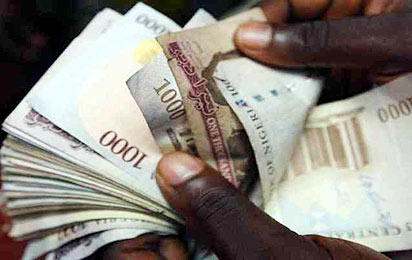
Naira
By Babajide Komolafe
The ten percent interest rate on banks’ deposit with the Central Bank of Nigeria (CBN) through its Standing Deposit Facility (SDF) is discouraging banks from lending to each other, and to the economy.

A member of the Monetary Policy Committee (MPC) of the apex bank, Garba, Abdul-Ganiyu, raised this alarm in his personal statement at the meeting of the committee held last month.
The SDF was introduced in 2006 to encourage banks to place their excess liquidity with the CBN as deposits. The interest rate on such deposits is 200 basis points below the Monetary Policy Rate (MPR) of the CBN. Given that the MPR is presently 12 percent, interest rate on bank’s deposit with the apex bank is presently 10 percent.
Garba however observed that this deposit rate is discouraging banks from lending to each other hence the low level of activity in the interbank money market, and high patronage of the SDF. He therefore called for a 300 basis points reduction in the rate to seven percent.
Garba said, “I am convinced that there is a need for an asymmetric corridor to gradually reduce the incentive for the rapidly expanding activities in the Standing Deposit Facility (SDF) window.
It is axiomatic that an active interbank lending market (ILM) is necessary for the efficient pricing of risks and financial assets, for allocative efficiency as well as for the effectiveness of monetary policy to stimulate the growth in investments, employment and economic development.
“Indeed, both the interbank lending market and Open Buy Back are pivotal to the transmission mechanism of the monetary policy regime guiding the MPC decisions. Since the interbank call rate became the operating target for monetary policy, the call rate also became the benchmark for short-term rates (prime and maximum lending rates).
Until recently, strong linkages were successfully established between MPR, call rate and the short term rates in the tightening regime that began with the September 2010 MPC meeting. When the interbank lending market becomes significantly less active for whatever reason (s), the call rate becomes a less effective benchmark for the pricing of short-term risks and rates and for the efficient allocation of financial assets.
“I am convinced based on analysis of available data and from institutional perspectives that (1) the AMCON effects on the interbank market are exaggerated; (2) a 10 percent rate on SDF has been a consistently strong incentive for inverted intermediation.
Disclaimer
Comments expressed here do not reflect the opinions of Vanguard newspapers or any employee thereof.