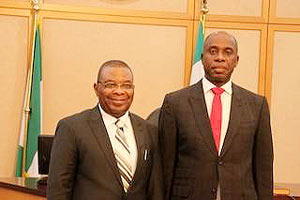
*Justice P.C.N Agumagu (l) and Governor Amaechi
By Biola Phillips
The vertical and horizontal lines that define our system of government are the key battlegrounds at which issues of democratisation will be joined. If we remain firm in our resolve, we will be well on the way to building the kind of institutions that are the surest bulwarks against the ever-present threat of the rule of man.
The vertical lines separate executive from legislative from judicial, while the horizontal lines separate federal from state from local government. The parity implicit in vertical lines reflects a reality in contradistinction to the assumption of hierarchy innate in horizontal divisions. It is at these places – these junctures – that the path to democracy is trod and epochal battles won and lost.
Amid the din and clamour, it is yet again Rivers State that is the lab rat in our nation’s journey in evolving a democracy. Of particular interest in the ongoing struggle to appoint and dismiss the Chief Judge of Rivers State is the fact that both vertical and horizontal dividing lines are simultaneously tested. And in the process, legal rights and political expediency are joined.
I was once under the sway of a professor whose lenses were principally those of realpolitik and so I am periodically prone to seeing things as they are rather than as I would wish them. The distinction is important in understanding the way and manner a governor would come to a decision on the appointment of a state Chief Judge. The legal right to appoint a state Chief Judge lies with the governor of the state; period.
It is not an unfettered right; the governor has a duty to consult the National Judicial Council. The governor is not required to accept the NJC’s recommendations but he is required to solicit its views and hear it out. The NJC can counsel and recommend, it cannot appoint. That is the law.
Then there is convention. There is, for example, the convention that the most senior judge ought to become the head of an appellate court when an opening arises. That is convention, it is not law. Conventions do not have the force of law. So it is that Justice Nnamani could be elevated to the position of Justice of the Supreme Court of Nigeria without ever spending a single day on the bench prior, and our jurisprudence is all the richer for his elevation.
Again, convention was done away with when Taslim Elias was appointed Chief Justice of the Supreme Court (the pinnacle of the judiciary) without having spent one day prior on the bench; his experience was as an academic and as an Attorney-General. I offer these examples to demonstrate that in the highest and most hallowed of our judicial halls, conventions do not have the force of law.
It is axiomatic that in a federal system (horizontal lines), a power residing with the governor of a state (to appoint a state judge) cannot be subsumed to the centre in the person of the NJC. Once the governor has satisfied himself that the person being considered is qualified (i.e. has ten years at the bar, is of sound mind etc.), the final decision is his. For a federal quasi-judicial organ to arrogate to itself the power of veto is ultra vires the NJC.
The considerations that exercise the mind of a governor appointing a CJ are of interest but he is not bound to share them. Once the mandatory boxes (including consulting the NJC) are ticked off, the governor is unfettered. He will address his mind to a range of other considerations, including those that reflect the political facts on the ground. So, in the case of Rotimi Amaechi, I would fully expect those political facts to include the intentions and mindset of those with whom he has been joined in a titanic political struggle.
He would do well to recall how easily the high places of state judiciaries are subverted by rampaging executives; witness the haste with which the sitting Lagos State CJ at the time Femi Pedro was being summarily evicted convened a tribunal. Amaechi will be wary of a judiciary in the hands of persons potentially close to his adversaries.
To be concluded
Disclaimer
Comments expressed here do not reflect the opinions of Vanguard newspapers or any employee thereof.