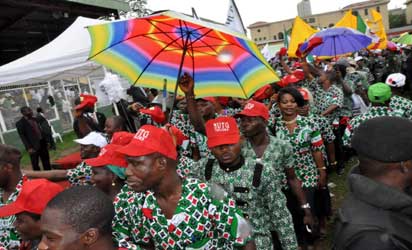
A Cross section of Workers Match Pasts, during the 2013 Workers Day Commemoration by The Lagos state Council of Nigeria Labour Congress and Trade Union Congress of Nigeria, Theme: 100 Year of Nationhood, The Challenges of National Development, held at Onikan Stadium, Lagos. Photo: Bunmi Azeez
By Les Leba
Nigerians could be forgiven, if their impulsive reaction to the above comparison is a derisive sneer because of the general perception that the Zimbabwean economy was dysfunctional. Indeed, about five years ago, Zimbabwe was the ultimate butt of universal jokes because of the abiding inflationary spiral that had gone haywire at 231,000,000%!
Consequently, the Zimbabwean dollar was exchanging at about two billion Zimbabwean dollars to US$1; in other words, the value of the currency was less than the paper on which it was printed! Inevitably, Zimbabweans forsook the national currency and resorted to simple trade by barter; for example, parents paid the school fees of their wards with farm produce, such as eggs, chickens and other such consumables.
Zimbabwean supermarkets, which were once fully well stocked soon became characterized by unending rows of empty shelves. Inevitably, also, the rate of unemployment climbed well beyond 50% of the working population!
Thus, it may seem inappropriate to compare such a “horrid primitive” economic environment with that of the self-acclaimed “giant of Africa,” where, in spite of a steady decline in the purchasing power of the naira, the strength of the economy still compared more favourably with the apparent economic crisis in Zimbabwe!
However, the preceding dismal picture of Zimbabwe was certainly true in 2008; today, the situation is much different! I agree that in making a comprehensive comparison between economies, several indices, such as Gross Domestic Product, Per Capita Income, level of infrastructure, particularly power, inflation rate, cost of funds, exchange rate stability, etc, etc, would all be important factors.
However, for the purpose of our current exercise, we may just beam on inflation and the prevailing minimum wage levels. Incidentally, our monetary authorities were quick to celebrate, when inflation rate receded below 8%, after remaining in double digits for several years.
Interestingly, however, the implication of Nigeria’s current 8% inflation rate is that people with static incomes, such as pensioners, would lose over 96% of the purchasing value of their incomes every 12 years! It is this recognition that untamed inflation is a poisonous plague, that predicates the prime mandate of all central/reserve banks on price stability.
In addition to inducing poverty, our current rate of inflation, also ultimately makes it impossible to enjoy the advantages of the use of primary currency such as kobo coins. Indeed, such primary coins have become irrelevant, cumbersome, and relatively valueless, and have therefore, become rejected for transactions. In those countries where primary coins have remained a vital component of their currency profile, inflation rates have invariably remained low between one and four percent; the inflation rates in the United States and UK, for example, where primary coins have continued to be used, is currently below 2%, while it would be regarded as crisis dimension, if inflation approaches 5%!
Incidentally, on the 31st of December 2013, Ghana’s leading newspaper, the Daily Graphic, published the inflation rates in about 15 African countries; surprisingly, as at August 2013, Zimbabwe posted the lowest inflation rate of 1.28% ahead of Ivory Coast in second place with 2.2%! However, the “Trading Economics” website reported in early February 2014 that Zimbabwe’s inflation had further reduced to 0.33%!
Certainly, Lamido Sanusi, our Central Bank Governor, has often insisted that it would require the skills of a magician to bring down inflation to such benign level as in present day Zimbabwe, and at the same time bring down cost of funds to single digit, with a stronger naira exchange rate in tow. Maybe there are lessons that we could learn from the experience of Zimbabwe!
In a related development, a recent Reuters report stated as follows “Zimbabwe’s government employees have rejected pay increases of 27% as too small…. The Unions want a monthly minimum wage of US$543, equivalent to the poverty line for Zimbabwe’s 235,000 state employees, the bulk of who are teachers…. Meanwhile, the government has proposed that the lowest paid worker would earn $375 a month, a 27% increase from the current $296″.
It will be instructive to compare Zimbabwe’s existing minimum wage level to our own N18,000 (about $110) per month. Evidently, the lowest paid government worker in Zimbabwe currently earns about three times the minimum wage in Nigeria! Incidentally, also, the jobless rate in Zimbabwe is a relatively credible 10.7%, as against almost 24% for Nigeria.
Furthermore, Zimbabwean businesses obtain loans at below 14%, whereas in Nigeria, cost of funds to the real sector remains well above 20%. Undoubtedly, other parameters such as peace, political stability, and security would be required in addition to above indices to paint a more accurate picture and make a fair comparative evaluation of economic and social welfare between workers in Zimbabwe and Nigeria.
The ultimate question, however, is how the Reserve Bank of Zimbabwe turned around the economic fortunes of that country! Indeed, in line with my consistent position in this column, inflation rates will rise in sympathy with increasing and unrestrained printing/creation of fresh money by a country’s monetary authorities; in such event, too much money will chase fewer goods, and smaller stock of foreign reserves, and ultimately, inevitably weaken the exchange rate of the national currency.
Our own monetary authorities have regrettably loyally trodden this path of ‘perdition’, when it unceasingly inundates the system with hundreds of billions of naira, which it substitutes for dollar-derived revenue in monthly government allocations. Five years ago, Zimbabwe’s authorities realized the folly and anti-social impact of such monetary strategy and decided to throw their own currency, the Zimbabwean dollar, which exchanged at two billion Zimbabwean dollar to US$1, into the dustbin, and adopt wholesale and retail use of the US dollar, as their official domestic currency; today, Zimbabwe has succeeded in performing the elusive magic and their economy is once again on a steady rebound!
Instructively, Nigeria’s adoption of dollar certificates for the payment of allocations of dollar revenue will also do the same magic for our economy, on a healthy inclusive platform, with increasing job opportunities.
Disclaimer
Comments expressed here do not reflect the opinions of Vanguard newspapers or any employee thereof.