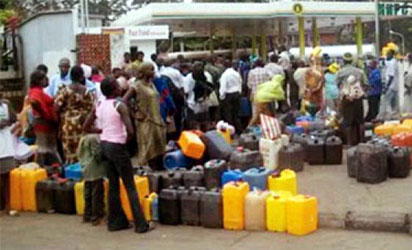
The long queue for expensive and unavailable kerosine…but when will this scarcitystop?
By Clara Nwachukwu
Last Thursday’s counter by the Minister of Finance and Coordinating Minister of the Economy, Dr. Ngozi Okonjo-Iweala, questioned the genuineness of the Central Bank of Nigeria, CBN Governor Mallam Sanusi Lamido Sanusi’s outburst declaring the continued subsidy on kerosene as illegal.

WAITING: Queue for kerosene at a Nigerian National Petroleum Corporation, NNPC, Mega Filling Station in Yelwa, Bauchi State, yesterday. NAN PHOTO.
On February 4, at a public hearing at the Senate on the Nigerian National Petroleum Corporation, NNPC books, Sanusi among others declared as followed:
•That implementation of kerosene subsidy regime is a violation of the DPK deregulation order by the late President Yar’adua.
•That the directive was communicated to and received by NNPC.
•That the average supply of DPK vessels by NNPC was between four and six vessels per month with a conversion factor of 1,136 litres equals 1 Metric Ton.
•That NNPC rendered nil returns on kerosene subsidy from April 2012 to December 2013.
•That NNPC delayed in filing subsidy claims to PPPRA.
•That the entire subsidy implementation is a farce/myth.
However, Okonjo-Iweala’s clarifications not only confirmed the participation of Sanusi in the alleged subsidy illegality on account of his membership of the Federation Accounts Allocation Committee, FAAC, but also indicative of a house divided against itself.
According to her, “The Ministry of Finance is the Chair of FAAC. We have, month after month with the presence of NNPC, CBN, State Commissioners of Finance, and the Revenue Mobilisation Allocation and Fiscal Commission, RMAFC, been meticulously reconciling accounts.”
Condoning kerosene subsidy
At the renewed public hearing on the controversial NNPC deductions, the issue was no longerthat the NNPC still had additional $20billion to account for as insisted by Sanusi, or the initial $10.8billion discovered from the reconciled account. The new issue became the legality of retaining subsidy on kerosene.
The Chairman, Senate Committee on Finance, Senator Ahmed Makarfi, also noted during the hearing that, “The major issue laid to rest substantially is the issue on the Subsidy on petrol, which is $5.254bn, because the Petroleum Products Price Regulatory Agency, PPPRA has satisfied it. We have also received certification for kerosene subsidy, but the key issue is the appropriation to it and we have all agreed here that no appropriation has been made to it.”
According to him, “As far as the CBN is concerned, … We have presented documents from the PPPRA and the Presidency that in our view, there is no subsidy on kerosene first of all, and that the payment of kerosene subsidy is a violation of a written presidential directive.”
Unknown tomany Nigerians, subsidy on household kerosene was removed in July 2009, albeit, with a caveat that“Public announcement of this measure should be avoided,” as directed by late President Shehu Musa Yar’Adua.
Sanusi, who was appointed CBN Governor by the late president, obviously based his outburst on an official memo from the then Yar’Adua’s Principal Secretary, Mr. David Edevbie, to the then National Security Adviser, informing him among others that “the NNPC was no longer entitled to kerosene subsidy, effective June 15, 2009.”
Ironically, the CBN governor who is also a member of FAAC never raised objections regarding the continued implementation of kerosene subsidy until now, almost five years after, which has opened room for speculations as to his motive for doing so now.
Seeking clarifications
Available records indicate that since 2009,the NNPC had continuously sought for clarifications on kerosene subsidy.
From the time of Dr. Mansur Mukhtar, as Minister of Finance, the minister of Petroleum Resources, and NNPC Group Managing Directors, GMDs, have constantly requested for subsidy reimbursement for petrol and kerosene.
Muhtar on his part had to seek Presidential approval “… for the settlement of overdue petroleum products import bills,” to sustain the financial health of the Corporation.
Nonetheless, up to the time of Mr. OlusegunAganga, as the finance minister, subsidy on kerosene had remained a recurring issue.
Specifically, some of the correspondences exclusively obtained by Vanguard on the issue include:
•Mr. OdeinAjumogobia (Minister of State), on April 17, 2009 to Muhtar
•Mr. Mohammed Barkindo (GMD), December 16, 2009, to Muhtar
•Mr. Mohammed Barkindo, February 15, 2010, to Muhtar
•Mr. Mohammed Barkindo, March 2, 2010, to Muhtar
?MallamShehuLadan (GMD), April 30, 2010 to Aganga
•Mrs. Diezani Alison-Madueke (Minister), May 24, 2010 to Aganga
•Austin Oniwon (GMD), March 1, 2011 to Alison-Madueke
•Alison-Madueke, March 1, 2011 to Aganga.
In all of these correspondences, the NNPC had expressed support for the full deregulation of the downstream petroleum sector and the removal of subsidy on kerosene, “if specifically directed to do so.”
The NNPC’s caveat on the removal of kerosene subsidy was apparently based on the appointment of Muhtar by Yar’Adua as Chair of the Presidential Committee on Implementation of the Petroleum Products Deregulation on June 9, 2009.
A subsequent meeting on the above subject was convened in his office by the then Minister of Petroleum Resources, Dr. RilwanLukman. The meeting was also attended by Muhtar, and Ajumogobia, as well as the Chief Economic Adviser to the President and Barkindo, decided among others, to put a stay of action on the removal of kerosene subsidy.
In the memo written by Barkindo to Muhtar on December 16, 2009, he recalled that “After extensive discussions on the issues on the implementation of kerosene subsidy removal, which at that time will translate to an increase in the price of kerosene, NNPC was directed to delay the implementation of the Presidential decision to remove subsidy on kerosene.”
He further recalled that the Committee’s decision was based on “… a strategic move to win the hearts and minds of NLC (Nigeria Labour Congress) and the public over the eventual goal of deregulating the downstream sector as a whole.”
He therefore complained that: “The Principal Secretary to the President and Commander-in-Chief of the Federal Republic of Nigeria (PSP), had in a memo to the National Security Adviser, dated October 19, 2009, sought to deny NNPC of the right to claim subsidy on kerosene effective June 15, 2009, on the ground that NNPC did not implement Mr. President’s directive on the issue.”
Barkindo further noted that Muhtar in his capacity as the Chairman of the Presidential Committee, “has the authority of Mr. President to determine the takeoff date for the implementation of the decision to eliminate subsidy on kerosene.”
He therefore, sought among others for the minister to continue to approve NNPV’s claims on Kerosene subsidy; to direct the PPPRA to continue to honour such claims as well as advisethe Principal Secretary to the President “of the decisions of the inter-ministerial committee on the deregulation of the downstream sector directing NNPC to delay the implementation of the sale of DPK (kerosene) at deregulated price and to clear up any misunderstanding on the part of the PSP in this regard.”
Unfortunately, the misunderstanding have remained till date, as Sanusi insisted, “We do not accept the legality of the kerosene deduction.”
Against this backdrop, the incumbent NNPC boss, Mr. Andrew Yakubu, insisted at the public hearing that“NNPC did not flout any directive. The actual position is that the directive to implement the deregulation of Kerosene was not received by NNPC … ostensibly due to the perceived challenges in implementation process.”
He added that “…the presidential directive contained conflicting provisions that required further clarification to support the implementation. Mr. Chairman, NNPC attempted through several correspondences to seek clarifications on the conflicting provisions in the directive without any positive response.”
Disclaimer
Comments expressed here do not reflect the opinions of Vanguard newspapers or any employee thereof.