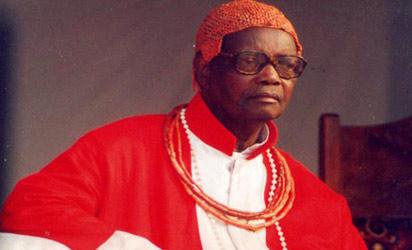
Late Erediauwa
By Josef Omorotionmwan
TO this villager, going to Benin City from Oghada, a distance of some 64 kilometres, was an annual pilgrimage of sorts. From an early age, I accompanied my parents to the city where they sold yams, the main product from the farm.
At the close of sales, I got my fringe benefits, my Christmas clothes. I wore them so proudly because, whereas they were the superior materials from Benin City, the abode of the Oba, my contemporaries in the village had the cheap products hawked by Yoruba traders who worked out deferred payment plans for them under the “osun meta” (three months) scheme.
History books are replete with the origin and history of the Igue festival. We are particularly fascinated by the pains-taking research of our kinsman, Prince (Dr.) Ademola Iyi-Eweka, who carefully chronicled the events around the Igue from its inception during the reign of Oba Ewuare to the present day.
In its original form, Igue was non-religious. In just the same way that President Abraham Lincoln, in 1863, proclaimed a national day of “Thanksgiving and Praise to our beneficent Father who dwelleth in the Heavens”, the founding fathers of the Edo Nation had proclaimed Igue as the “Ultimate Thanksgiving to OSANOBUWA, OSANUDAZI, OGHODUA – the Almighty Creator of Heaven and Earth, the Alpha and the Omega… the protector of the human race against the vicissitudes of life.”
And in just the same way that Thanksgiving is celebrated by Americans irrespective of their religious affiliation, the Igue festival was meant for all Edos of all religions. But incidentally, the African traditional religion, which predates Christianity and other religions here, was the only thing on ground when the other religions arrived. Christians should have done well to key into the celebration. Rather, they were preoccupied with trying to indoctrinate the indigenes into Christianity.
Understandably, the Igue festival is celebrated with greater intensity in the rural areas than in Benin City. The ruralites who are mainly farmers faced greater hazards in the course of the farming year. For instance, in those days, there were no motor-saws. As a result, those big trees were brought down either with fire or with the axes. In the case of the latter, able-bodied men tied scaffolds around the big trees and hewed them from the top of the scaffolds. It was quite a hazardous job and the few who survived it had to celebrate big.
We also invaded the animal kingdom without being hurt by the wild animals – the lions, the tigers, the elephants, the gorillas and the rest. Since our farms were too far from home, we slept there for an entire native week of four days and only visited home on the native Sunday – the Eken market day. We survived all the dangers through the mercies of Osanobuwa and Igue provided an opportunity to thank Him.
The Americans celebrate their Thanksgiving with turkey meat. We celebrate the Igue with dried bush meat collected over a three-month period prior to the Igue and preserved in the fire place. As children, the meat eyed us once in a while and we pinched it. This did not qualify for stealing; just an honest confession.
We recollect, with nostalgia, that on ordinary days, attempts could have be made to share one crayfish for two children, the erroneous belief being that children did not require meat; but on Igue day, each of the two children was sentenced to two legs of a big grass cutter with a big bowl of pounded yam to match! We ate almost to saturation point; went to play for a few hours; and came back to deal with the balance.
In fact, a few days before Igue, we were de-wormed with purgative to clean up the stomach, preparatory for the heavy food ahead.
If only people knew the similarities in their lives, much of the controversies between the African traditional religion and Christianity would not arise. At the Church Thanksgiving, people’s heads are anointed with olive oil and at Igue, people’s heads are anointed with coconut oil and water.
The Edos believe that the best way of understanding where you are going is to constantly remember where you are coming from, hence the strong attachment to our ancestry. This is not any different from the Bible’s continuous references to the God of Abraham, the God of Isaac and the God of Jacob. Essentially, the more things change, the more they remain the same.
The spiritual content of the Igue festival is enormous. At the village level, the ceremony culminates in the “Ubi” in which the villagers dance round every house down to the village square, hitting the ground with palm fronts to exorcize evil spirits from the village, chanting songs like “Azen……Olelubirie”; “Oso….. Olelubirie”; “Okpokpomwan…..Olelubirie”; “Ologhomwan…..Olelubirie” – meaning, witches, wizards and all workers of iniquity are gone with the “Ubi”. At the end, the palm fronts are either burnt at the entrance of the cemetery or simply deposited in the cemetery.
There are dire consequences attached to the non-celebration of the Igue in any particular year and it is only major catastrophes that can cause the non-celebration. That explains the non-celebration of Igue during the period 1897-1914 when Oba Ovonramwen was on exile in Calabar, an era of deep melancholy to the Edos.
At the restoration of the monarchy in 1914, Chief Agho Obaseki who was the right hand man of Oba Ovonramwen became the Iyase of Benin. It was during the reign of Oba Eweka II. Christians quickly moved in to try to convert the duo to Christianity. While Oba Eweka II resisted them, Chief Obaseki was converted.
In protest to Obaseki’s action, Oba Eweka II aborted the Igue festival of 1916/17, saying, “I cannot celebrate Igue without my Iyase. When you took my Iyase away, you took the Igue festival with him”.As a consequence of the failure to celebrate the Igue, a great epidemic, which took the lives of thousands of Edos, struck the Kingdom in 1918. The rest is now history.
Disclaimer
Comments expressed here do not reflect the opinions of Vanguard newspapers or any employee thereof.