By Rotimi Fasan
TIME was about 10:30 pm Nigerian time and the BBC’s Hard Talk was on the screen on this dark night of December 5, 2013. I had only minutes before finished writing my original copy for the column this week.
Many minutes into Hard Talk and as Steven Sakur’s usually hard-hitting questions elicited rapid responses from his guest, this time an American senator of Hispanic origin (I cannot recall his name), the programme suddenly went off the screen and the image of two BBC newscasters, a male and a female, came on as they announced that South Africa’s President Jacob Zuma was about making an important announcement. There was live picture of President Zuma as he walked to the podium.

He tested the microphone and I knew either one of two things had happened even as I closely studied his body language for clues of the news he was about to pass.
The thought that flashed through my mind at that moment was this: Nelson Mandela is dead or decision had been taken to take him off life support (which he was rumoured to be on) and his death was just a matter of time. But Zuma smiled and made eye contacts with some people around him while testing the microphone. He was calm, absolutely unhurried, which gave me hope that Mandela was still alive.
But then he began speaking and he didn’t keep his listeners in suspense as he announced within his first few words the passing of the world’s most revered political leader, statesman and South Africa’s first Black and post-apartheid president, Nelson Rolihlahla Mandela.
I was up for the next four hours or thereabout surfing channels for more news on Mandela as live pictures of people gathering around his Johannesburg home in celebration streamed in. This would be followed by live transmission of tributes from Barack Obama, David Cameron, Ban Ki-Moon, among several world leaders. People at the United Nations headquarters stood in silence for a minute to honour Mandela.
And so the round-the-clock report on Mandela went on throughout the night into the early hours of the morning with more and more people joining the crowds around his home. Flags in South Africa were ordered to fly at half mast. David Cameron ordered the flag at 10 Downing Street to fly at half mast. And it could be expected that the same thing happened in many parts of the world in memory of the man who went from villain to hero, prisoner to president.
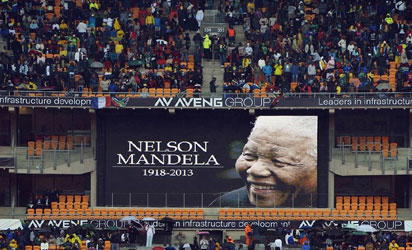
In four days time Mandela would be accorded a full state funeral befitting a hero of his calibre. Perhaps not since Mahatma Ghandi has a world leader’s death elicited the type of universal emotion generated by the passing of Nelson Mandela. Mandela was a moral as well as a political force.
He was a hero’s hero, one whose legacy of generosity and forgiveness of those who dishonoured him and his people did not leave him an embittered man.
The world had anxiously awaited news of Mandela’s passing. He gave sufficient notice of his passing having been in and out of hospital in the last six months of his life. He had sought cure for a lingering lung infection he first contracted while in prison breaking rocks on RobbenIsland.
In a sense, the corruption of apartheid, of RobbenIsland where Mandela contracted tuberculosis and lost the sharpness of his sight to the poisonous dusts of hard rocks he had to break in prison- the hell of apartheid finally did for Mandela. But he was in every sense a survivor who, in his own words, beat the Afrikaners at their own game- but this with an uncommon generosity of spirit and forgiveness of his enemies.
He did his best to promote unity among South Africans across racial divides and left South Africa a united society ready to face the future without the recriminations of the past. If South Africans fail to uphold the Mandela legacy of forgiveness and togetherness it wouldn’t be for want of a good example.
In a July 10 piece in this space, I had paid tribute to Mandela. This was at the height of fears that the Grand Old Man of South African politics and world number one citizen would probably not make it out of hospital. I was just over a week in South Africa on a two months sabbatical at RhodesUniversity located in the South African Eastern Cape, region of Mandela’s birth.
Rallies, marches, symposia and prayers were still being held across the country in celebration of Mandela’s 95th birthday and for his quick recovery. Barack Obama’s visit to South Africa at this time was overshadowed by news of Mandela’s health. Amid this outpouring of emotions the Mandela family was being torn apart by a bitter family feud.
With intervention by the courts and appeals from South African leaders like Desmond Tutu the feuding family would find a way round their differences and give up the front page of South African newspapers for others.
There were periodic reports of recovery, of Mandela being in stable but critical condition. He would be moved home to continue his treatment in due course, and it all looked like he would remain in this state for a long time to come. Until early last week when his daughter hinted that he was on his death bed and in his last days. Just appropriately after family disagreements had been either settled or allowed room for peaceful resolution.
The occurrence of the word ‘death bed’ in Mandela’s daughter’s speech had a sinister ring that told me the Mandela family had finally reconciled themselves to the death of their patriarch. Six months during which there was no major improvement in Madiba’s health was enough for the family to say their adieus. Her comment told me that it was just a matter of time before news of Mandela’s passing travelled round the world.
And it happened within the week of her initial comment. Jacob Zuma broke the news to an expectant but nonetheless shocked world. As Obama noted, Mandela has done more than we could honestly expect of one man. He deserves his rest. A true son of Africa, he was one of the originals that pointed at the greatness of Africa and the oneness of all human beings. Safe trip. Rest well Madiba!
Disclaimer
Comments expressed here do not reflect the opinions of Vanguard newspapers or any employee thereof.