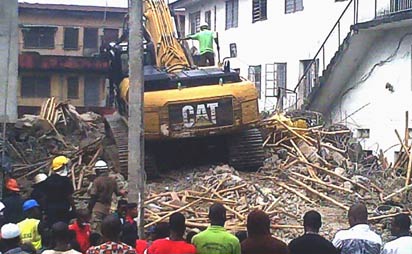
File: Collapsed building in Surulere
By Jude Njoku
FACED by increasing complexity of modern construction projects, clients’ high expectations and industrialisation, construction cost experts have been charged to hone their skills and knowledge base with a view to offering better services to their clients.
The charge was given by resource persons at the annual conference of registered quantity surveyors put together by the Quantity Surveyors Registration Board of Nigeria, QSRBN and the Nigerian Institute of Quantity Surveyors, NIQS.
Quantity surveyors
Setting the tone for deliberations at the two-day forum which had ‘Quantity Surveying profession: Unbundling latent competencies and developing new frontiers’ as its theme, the President of the Quantity Surveyors Registration Board of Nigeria, QSRBN, Mallam Hussaini Adamu Dikko said the conference was “designed to bring all registered quantity surveyors who practise the profession in the various sectors of the Nigerian economy under one roof to brainstorm on how they can use the tools of the profession, knowledge and intellect to promote and contribute to the strategic reforms of the Federal government of His Excellency, President Goodluck E. Jonathan”.
The conference, he said, was also put together to “create the institutional platform for the quantity surveyor to adapt the robust knowledge base of the profession to meet the challenges which will come from higher clients’ requirements through increasing complexity of modern construction projects and industrialisation, impact of computerisation and competition from other professionals”.
Mallam Dikko noted that the “training of the quantity surveyor and the body of knowledge of the profession predisposes the practitioner to function seamlessly on building, engineering and other projects in the built environment sector of the economy”.
“It is therefore important that to survive and grow in the future, the QS profession must respond quickly and creatively to the challenges of accelerating social, technological, economical and environmental change,” he said.
In his own remarks, the President of the Nigerian Institute of Quantity Surveyors, NIQS, Mr. Ajele John Alufohai, enjoined quantity surveyors be maintain the highest level of transparency in the discharge of their duties. He charged the cost experts to brace up and face the challenges that would arise from public-private partnership in infrastructure procurement.
“Nigeria is required to invest about 2.9 trillion USD to close its infrastructure gap-which we need to become more productive, diversity our economy and create jobs. It’s not very sensible exclusively to rely on oil export receipts to finance the infrastructure we need, more so at a time when even more endowed countries are turning to PPPs to finance their infrastructure and when we urgently need to spend on social sectors such as health and education in which the reach of private capital is more controversial if not impossible to rapidly extend.
If we create the right legal, regulatory and socio-political environment for investment in PPPs, a significant portion of our infrastructure needs can be privately financed. I firmly believe that the skills of Quantity Surveyors are required to create the trust and transparency –between Government and investors, between investors and financiers and between infrastructure project companies and communities-that sustainable Private-Private-Public-Partnerships require.
As Nigeria turns a corner in privatizations, it will surely turn a new leaf in PPPs. Quantity Surveyors need to be prepared for this new frontier,” he said.
The NIQS President explained that as more public and private sector clients begin to make use of quantity surveyors’ services, they should expect to be often summoned to probe panels and commissions of inquiry.
“The public ought to be keenly interested in and be confident that every Naira of public funds invested in public infrastructure or related procurement is fairly and efficiently utilized. As Ministries, Departments and Agencies increasingly realize the centrality of engaging Quantity Surveyors, expect names of Quantity Surveying firms to be cited in newspapers-as some auditing firms are cited in relation to the finances of some public companies –in the media.
Expect to see the names of some Quantity Surveying firms to be invited to the Senate or House of Representatives in relation to budget and oversight functions in respect of project. I have no doubt that we will continue to preserve our reputation for enabling transparency and for integrity. My point-and warning-is that we must be prepared,” he said.
A senior lecturer in the Department of Quantity Surveying, Imo state University, Owerri, Dr. SIJ Onwusonye called on the Government to exhibit transparency in its policies especially on budgetary affairs so as to inject desirable macro economic activities in the construction industry.
“These will release appreciable financial empowerment to quantity surveying practice to enable them update their competencies and virtually eliminate identity crises.
These are relevant as non release or late release of funds from the budge will be counterproductive to the objectives of infrastructure development,” he said.
The trio of A.E. Oke, I.O. Aja and T.O. Ibironke who teach in the Department of Quantity Surveying , Federal University of Technology, Akure, charged quantity surveyors to “continually pursue the path of globalisation so as to remain relevant and allow for global oneness in the profession”.
The dons who spoke on the “Impact of globalisation on Quantity Surveying Profession in Nigeria also advised construction cost experts to be wary of the negative implications of such globalisation. “Importance should be attached to ICT and knowledge management in the profession and this can be achieved by keeping ourselves abreast with latest technology and information in the profession.
Quantity Surveyors in Nigeria are also advised to be wary of the negative effect of globalisation, and devise policies that can absorb such negativity,” they advised.
Disclaimer
Comments expressed here do not reflect the opinions of Vanguard newspapers or any employee thereof.