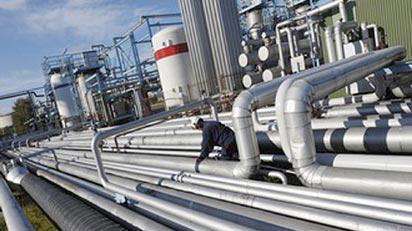
File photo of a refinery.
By Felix Ayanruoh
In an attempt to best achieve self sufficiency of petroleum product in Nigeria, within a strong commercial framework, the Nigerian government constituted the National Refineries Special Task Force (NRSTF). “Changes in the ownership structure and business model of the refineries are necessary, in order to turn them around” the NRSTF recommended, “the Federal Government should relinquish control of the operation and management of the three Nigerian refineries by divesting a majority of its 100% equity to competent, resourceful and experienced refining private partner(s) in accordance with the Public (Privatisation and Commercialisation) Enterprises Act 1991.”
The Bureau of Public Enterprise’s (BPE) recent statement at the Nigeria Investors’ Summit held in New York was a remarkable clarification of the recommendations of the National Refineries Special Task Force. The BPE cautioned interested investors in the oil and gas sector that when the Petroleum Industry Bill (PIB) is passed, the nation’s refineries would be available for privatization.
Perhaps the best part of the BPE’s presentation was that the network of oil and gas pipelines would also be available for concession. Private Public Partnership (PPP) is a crucial component of public policy in the globalized world today. It is a cost efficient or effective mechanism for the implementation of public policy across a range of policy agendas such as the state of the nation’s refineries and the devastating effect of fuel shortages in Nigeria.
Uncertainty frequently exists between infrastructure financing and infrastructure investing. While infrastructure financing can arise from privatisation of existing facilities, infrastructure investing involves the development, operation and ownership either by the private sector alone or in joint venture between the government and private sector entity.
Accordingly, PPPs are long-term, contractual partnerships between the public and private sector agencies, geared towards financing, designing, implementing, and operating infrastructural facilities and services in a country. These joint ventures are built around the expertise and capacity of the project partners usually government and a private player and are based on a contractual agreement, which ensures appropriate and mutually agreed allocation of resources, risks, and returns. PPPs could be in the form of Build Own and Operate (BOT), Build Own and Operate among others.
Under PPP contractual arrangement, the government is the coordinator and facilitator, while the private partner is the financier, builder, and operator of the service or facilities, PPP’s goal is to combine the skills, expertise, and experience of both the public and private sectors to deliver quality standards of services to customers. The public sector contributes assurance in terms of stable governance, and establishment of clear legal, regulatory and fiscal regimes.
The private sector brings with it operational efficiencies, innovative technologies, managerial effectiveness, access to additional finances, construction and commercial risk sharing. Since the 1990s, there has been a rapid growth of PPPs around the world. Governments in developing as well as developed countries are using PPP arrangements for improved delivery of infrastructure services. Governments are building transport, energy, healthcare, waste management, and water infrastructures.
Given the Nigerian government’s intention to establish a clear regulatory and fiscal regime, and deregulation of the downstream sector, the author is of the opinion that public private partnership of our refineries is a sine qua non to a viable and bankable petroleum product transaction in Nigeria.
Disclaimer
Comments expressed here do not reflect the opinions of Vanguard newspapers or any employee thereof.